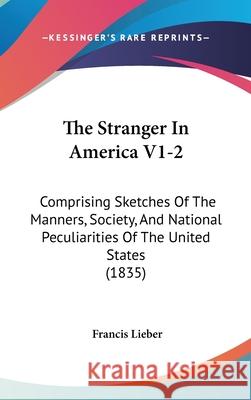
Ten glorious months in Europe with one of the nineteenth century's greatest thinkers; "I live the life of a long dried sponge thrown into water," enthused the celebrated intellectual Francis Lieber (1798-1872) in a letter from Paris to his friend, the future Massachusetts senator Charles Sumner. In that letter, Lieber, a scholar well known on both sides of the Atlantic, described his joyous return to Europe in 1844 after two decades teaching and working in the United States. During his ten-month sabbatical, Lieber gloried in Europe's people, places, art, theater, and diversity. He not only...
Ten glorious months in Europe with one of the nineteenth century's greatest thinkers; "I live the life of a long dried sponge thrown into water," enth...
This scarce antiquarian book is a facsimile reprint of the original. Due to its age, it may contain imperfections such as marks, notations, marginalia and flawed pages. Because we believe this work is culturally important, we have made it available as part of our commitment for protecting, preserving, and promoting the world's literature in affordable, high quality, modern editions that are true to the original work.
This scarce antiquarian book is a facsimile reprint of the original. Due to its age, it may contain imperfections such as marks, notations, marginalia...
A combined two-volume collection of frank assessment on nineteenth-century America from one of the era's leading men of letters and a distinguished faculty member of the University of South Carolina Reproduced from the first edition in the South Caroliniana Library, University of South Carolina
A combined two-volume collection of frank assessment on nineteenth-century America from one of the era's leading men of letters and a distinguished fa...
An Important Early Contribution to the Field of Political Science This work received high praise from Chancellor Kent, Henry Clay, Rufus Choate, Joseph Story and others. At the time of publication, there was a great deal of debate about the interpretation of the United States Constitution, and this book is Lieber's contribution to the mix. He asserts that Constitutions should be construed closely, since their words were carefully measured, and distinguishes between interpretation ("the art of finding out the true sense of any form of words") and construction as the drawing of conclusions...
An Important Early Contribution to the Field of Political Science This work received high praise from Chancellor Kent, Henry Clay, Rufus Choate, Josep...
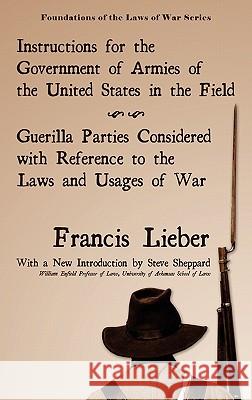
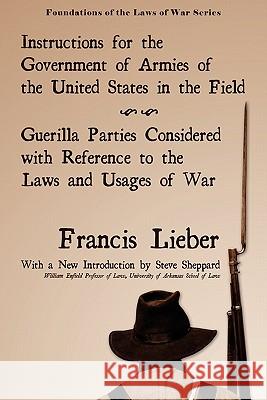
Military commanders from ancient time had set down rules and regulations to discipline their troops. From the Pharaohs on, commanders directed the strategy, tactics, and camp discipline of the often unruly hosts of soldiers under their command. They had one aim: to create an efficient fighting force. Military officers, camp-followers and cooks were all expected to perform their services according to mandate and in light of the best interests of the armed force and the fighting soldiery. Modern commanders have exemplified the same passion for military discipline to produce an effective combat...
Military commanders from ancient time had set down rules and regulations to discipline their troops. From the Pharaohs on, commanders directed the str...
Foundations of the Laws of War Series. The Foundation of the Modern International Law of War. Known officially as General Orders No. 100, Lieber's code (1863) was the first of its kind. It served as the model for several European eff orts and was an important source for the second and fourth Hague Conventions (1899, 1907). It was an authority during the Nuremberg and Tokyo war crime trials. Its use by the framers of the 1998 Rome Treaty, which established the International Criminal Court, demonstrates its lasting value in our time. Indeed, with only a handful of modifications it is used by...
Foundations of the Laws of War Series. The Foundation of the Modern International Law of War. Known officially as General Orders No. 100, Lieber's cod...
Foundations of the Laws of War Series. The Foundation of the Modern International Law of War. Known officially as General Orders No. 100, Lieber's code (1863) was the first of its kind. It served as the model for several European eff orts and was an important source for the second and fourth Hague Conventions (1899, 1907). It was an authority during the Nuremberg and Tokyo war crime trials. Its use by the framers of the 1998 Rome Treaty, which established the International Criminal Court, demonstrates its lasting value in our time. Indeed, with only a handful of modifications it is used by...
Foundations of the Laws of War Series. The Foundation of the Modern International Law of War. Known officially as General Orders No. 100, Lieber's cod...