The head carries most of the sensory systems that enable us to function effectively in our three-dimensional habitat. Without adequate head movement control, efficient spatial orientation and motor responses to visual and auditory stimuli could not be carried out. This is the most comprehensive and up-to-date account of the control of vertebrate head movements and its biomechanical and neural basis. It covers the entire spectrum of research on head-neck movements, ranging from the global description and analysis of a particular behavior to its underlying mechanisms at the level of...
The head carries most of the sensory systems that enable us to function effectively in our three-dimensional habitat. Without adequate head movement c...
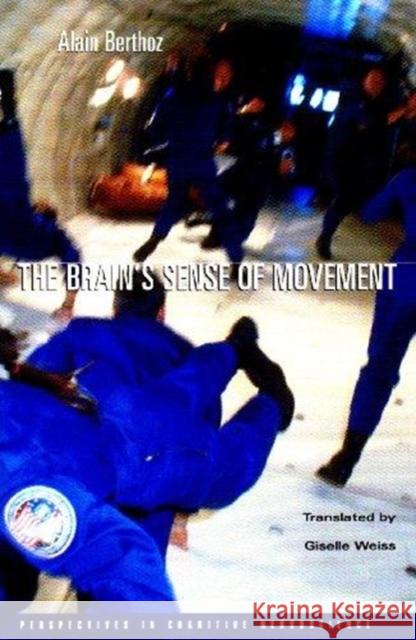
The neuroscientist Alain Berthoz experimented on Russian astronauts in space to answer these questions: How does weightlessness affect motion? How are motion and three-dimensional space perceived? In this erudite and witty book, Berthoz describes how human beings on earth perceive and control bodily movement. Reviewing a wealth of research in neurophysiology and experimental psychology, he argues for a rethinking of the traditional separation between action and perception, and for the division of perception into five senses.
In Berthoz's view, perception and cognition are inherently...
The neuroscientist Alain Berthoz experimented on Russian astronauts in space to answer these questions: How does weightlessness affect motion? How ...
At the beginning of the 20th century, German biologist Jakob von Uexkull created the concept of "Umwelt" to denote the environment as experienced by a subject. This concept of environment differs from the idea of passive surroundings and is defined not just by physical surroundings, but is rather a "subjective universe," a space weighted with meaning. Today, neuroscience provides a new way to look at the brain s capability to create a representation of the world. At the same time behavioural specialists are demonstrating that animals have a richer mental universe than previously known....
At the beginning of the 20th century, German biologist Jakob von Uexkull created the concept of "Umwelt" to denote the environment as experienced b...
At the beginning of the 20th century, German biologist Jakob von Uexkull created the concept of "Umwelt" to denote the environment as experienced by a subject. This concept of environment differs from the idea of passive surroundings and is defined not just by physical surroundings, but is rather a "subjective universe," a space weighted with meaning. Today, neuroscience provides a new way to look at the brain s capability to create a representation of the world. At the same time behavioural specialists are demonstrating that animals have a richer mental universe than previously known....
At the beginning of the 20th century, German biologist Jakob von Uexkull created the concept of "Umwelt" to denote the environment as experienced b...
Groping around a familiar room in the dark, or learning to read again after a traumatic brain injury; navigating a virtual landscape through an avatar, or envisioning a scene through the eyes of a character--all of these are expressions of one fundamental property of life, Alain Berthoz argues. They are instances of vicariance, when the brain sidesteps an impasse by substituting one process or function for another. In The Vicarious Brain, Creator of Worlds, Berthoz shows that this capacity is the foundation of the human ability to think creatively and function in a complex...
Groping around a familiar room in the dark, or learning to read again after a traumatic brain injury; navigating a virtual landscape through an ava...