VJver forty years ago Gordon R. Willey (1953b:361) stated that " t]he objectives of archeology . . . are approached by the study and manipulation of three basic factors: form, space, and time. " A few years later, Albert C. Spaulding (1960b:439) repeated this thought using different words: " AJrchaeology can be defined minimally as the study of the interrelation- ship of form, temporal locus, and spatial locus exhibited by artifacts. In other words, archaeologists are always concerned with these interrelation- ships, whatever broader interests they may have, and these interrelation- ships are...
VJver forty years ago Gordon R. Willey (1953b:361) stated that " t]he objectives of archeology . . . are approached by the study and manipulation of t...
It is difficult for today's students of archaeology to imagine an era when chronometric dating methods were unavailable. However, even a casual perusal of the large body of literature that arose during the first half of the twentieth century reveals a battery of clever methods used to determine the relative ages of archaeological phenomena, often with considerable precision. Stratigraphic excavation is perhaps the best known of the various relative-dating methods used by prehistorians. Although there are several techniques of using artifacts from superposed strata to measure time, these...
It is difficult for today's students of archaeology to imagine an era when chronometric dating methods were unavailable. However, even a casual perusa...
Anthropology, and by extension archaeology, has had a long-standing interest in evolution in one or several of its various guises. Pick up any lengthy treatise on humankind written in the last quarter of the nineteenth century and the chances are good that the word evolution will appear somewhere in the text. If for some reason the word itself is absent, the odds are excellent that at least the concept of change over time will have a central role in the discussion. After one of the preeminent (and often vilified) social scientists of the nineteenth century, Herbert Spencer, popularized the...
Anthropology, and by extension archaeology, has had a long-standing interest in evolution in one or several of its various guises. Pick up any lengthy...
In recent years archaeologists and paleontologists have become increasingly interested in how and why vertebrate animal remains become, or do not become, fossils. Vertebrate Taphonomy introduces interested researchers to the wealth of analytical techniques developed by archaeologists and paleontologists to help them understand why prehistoric animal remains do or do not preserve, and why those that preserve appear the way they do. This book is comprehensive in scope, and will serve as an important work of reference for years to come.
In recent years archaeologists and paleontologists have become increasingly interested in how and why vertebrate animal remains become, or do not beco...
This collection of Ford's works focuses on the development of ceramic chronology a key tool in Americanist archaeology.
When James Ford began archaeological fieldwork in 1927, scholars divided time simply into prehistory and history. Though certainly influenced by his colleagues, Ford devoted his life to establishing a chronology for prehistory based on ceramic types, and today he deserves credit for bringing chronological order to the vast archaeological record of the Mississippi Valley.
This book collects Ford's seminal...
A Dan Josselyn Memorial Publication
This collection of Ford's works focuses on the development of ceramic chronology a key tool in Americanist ...
This collection elucidates the key role played by the National Research Council seminars, reports, and pamphlets in setting an agenda that has guided American archaeology in the 20th century.
In the 1920s and 1930s, the fascination that Americans had for the continent's prehistoric past was leading to a widespread and general destruction of archaeological evidence. In a drive toward the commercialization of antiquities, amateur collectors and "pot hunters" pillaged premier and lesser-known sites before the archaeological...
A Dan Josselyn Memorial Publication
This collection elucidates the key role played by the National Research Council seminars,...
Gordon Randolph Willey Philip Phillips R. Lee Lyman
A Dan Josselyn Memorial Publication This invaluable classic provides the framework for the development of American archaeology during the last half of the 20th century.
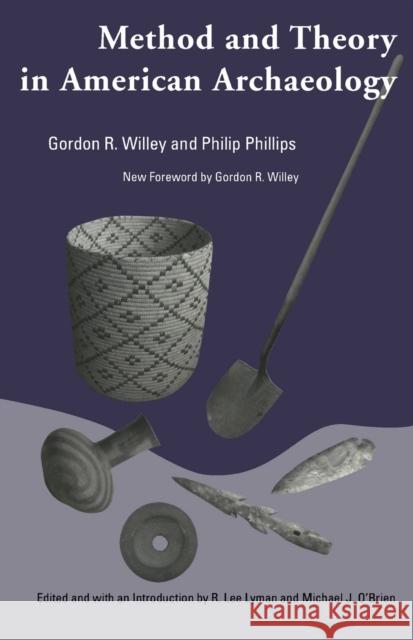
In 1958 Gordon R. Willey and Philip Phillips first published Method and Theory in American Archaeology--a volume that went through five printings, the last in 1967 at the height of what became known as the new, or processual, archaeology. The advent of processual archaeology, according to Willey and Phillips, represented a "theoretical debate . . . a question of whether archaeology should be the study of...
A Dan Josselyn Memorial Publication This invaluable classic provides the framework for the development of American archaeology during the las...
Anthropology, and by extension archaeology, has had a long-standing interest in evolution in one or several of its various guises. Pick up any lengthy treatise on humankind written in the last quarter of the nineteenth century and the chances are good that the word evolution will appear somewhere in the text. If for some reason the word itself is absent, the odds are excellent that at least the concept of change over time will have a central role in the discussion. After one of the preeminent (and often vilified) social scientists of the nineteenth century, Herbert Spencer, popularized the...
Anthropology, and by extension archaeology, has had a long-standing interest in evolution in one or several of its various guises. Pick up any lengthy...