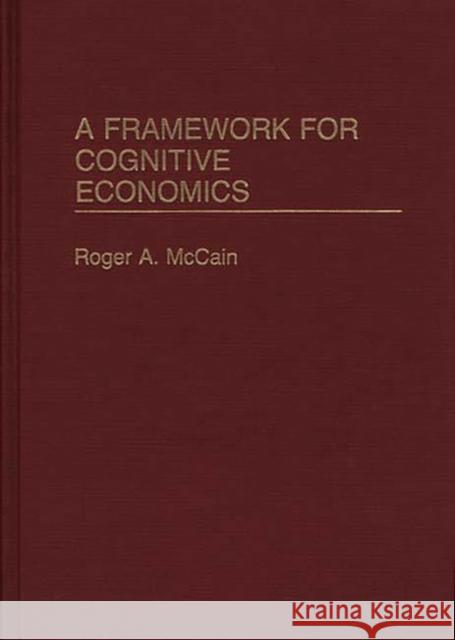
This is the first book-length work to integrate the insights of cognitive science fully into economics. It reviews a wide range of related work in both fields and proposes new approaches to choice theory, rationality, and interaction (equilibrium) that are consistent with the limited cognitive capacity of real human beings. While joining with neoclassical economics in supporting the validity of supply-and-demand theory where it is literally applicable, McCain challenges most neoclassical theory, especially monopoly, oligopoly, and general equilibrium theory and welfare economics. His work...
This is the first book-length work to integrate the insights of cognitive science fully into economics. It reviews a wide range of related work in ...
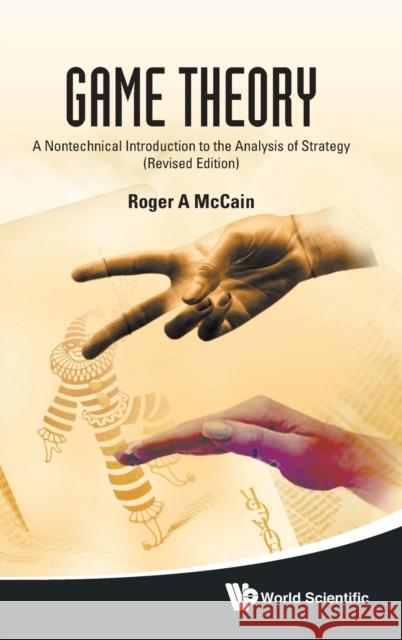
This book serves as an introduction to game theory for students with no prior game theory knowledge, or with limited background in economics and mathematics. It is specifically designed to provide an intuitive and accessible interdisciplinary approach to game theory, while simultaneously exploring cooperative games, repeated play, correlated equilibrium, and a range of applications.
This book serves as an introduction to game theory for students with no prior game theory knowledge, or with limited background in economics and mathe...
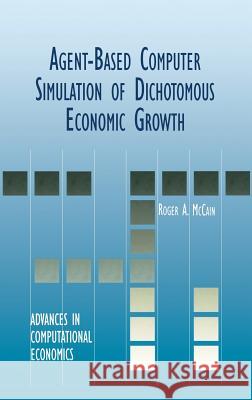
Agent-Based Computer Simulation of Dichotomous Economic Growth reports a project in agent-based computer stimulation of processes of economic growth in a population of boundedly rational learning agents. The study is an exercise in comparative simulation. That is, the same family of growth models will be simulated under different assumptions about the nature of the learning process and details of the production and growth processes. The purpose of this procedure is to establish a relationship between the assumptions and the simulation results. The study brings together a...
Agent-Based Computer Simulation of Dichotomous Economic Growth reports a project in agent-based computer stimulation of processes of economic...
Agent-Based Computer Simulation of Dichotomous Economic Growth reports a project in agent-based computer stimulation of processes of economic growth in a population of boundedly rational learning agents. The study is an exercise in comparative simulation. That is, the same family of growth models will be simulated under different assumptions about the nature of the learning process and details of the production and growth processes. The purpose of this procedure is to establish a relationship between the assumptions and the simulation results. The study brings together a...
Agent-Based Computer Simulation of Dichotomous Economic Growth reports a project in agent-based computer stimulation of processes of economic...