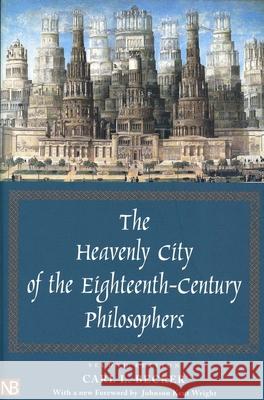
Here a distinguished American historian challenges the belief that the eighteenth century was essentially modern in its temper. In crystalline prose Carl Becker demonstrates that the period commonly described as the Age of Reason was, in fact, very far from that; that Voltaire, Hume, Diderot, and Locke were living in a medieval world, and that these philosophers "demolished the Heavenly City of St. Augustine only to rebuild it with more up-to-date materials." In a new foreword, Johnson Kent Wright looks at the book's continuing relevance within the context of current discussion about the...
Here a distinguished American historian challenges the belief that the eighteenth century was essentially modern in its temper. In crystalline prose C...
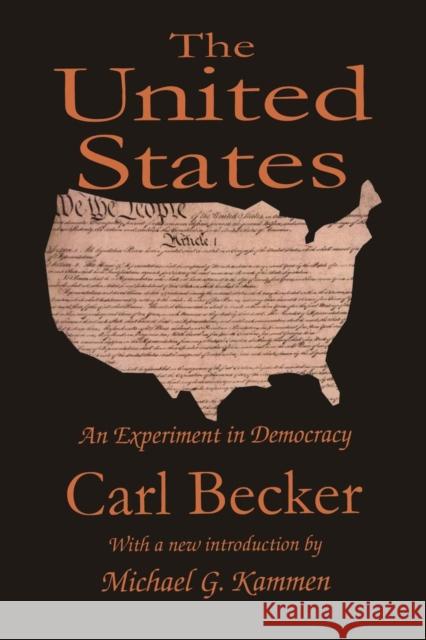
According to Carl Becker "if the framers of the Constitution could come back to earth and see what the federal government is doing to-day, they would all agree that this monstrous thing was no child of theirs; for to-day the federal government exercises as a matter of course powers which they never dreamed of." This prescient statement rings as true today as it did when Becker wrote An Experiment in Democracy nearly eighty years ago. This American classic is an engaging, gracefully rendered piece of historical literature as well as a non-ideological meditation on the "meaning of...
According to Carl Becker "if the framers of the Constitution could come back to earth and see what the federal government is doing to-day, they wou...
This succinct and engaging history of the founding of Cornell University traces the institution's origins within the educational climate of mid-nineteenth-century America. Originally delivered as six lectures celebrating the seventy-fifth anniversary of the opening the university, this book was first published by Cornell University Press in 1943.
Beginning with a survey of collegiate education prior to the Civil War, Carl L. Becker details the history of the Morrill Land Grant College Act that made possible the establishment of Cornell (among other universities); deftly portrays the...
This succinct and engaging history of the founding of Cornell University traces the institution's origins within the educational climate of mid-nin...
First published in 1958, Detachment and the Writing of History collects essays and letters by Carl L. Becker in which the noted historian outlines his views on the study of history, the craft of the historian, the art of teaching, and the historical evolution of the idea of democracy. Together, these invaluable writings demonstrate Becker's conviction of the moral seriousness of the historian's calling and of the importance of history as a factor, at once intellectual and artistically imaginative, in the life of society.
First published in 1958, Detachment and the Writing of History collects essays and letters by Carl L. Becker in which the noted historian ...