/homepage/sac/cam/na2000/index.html7-Volume Set now available at special set price
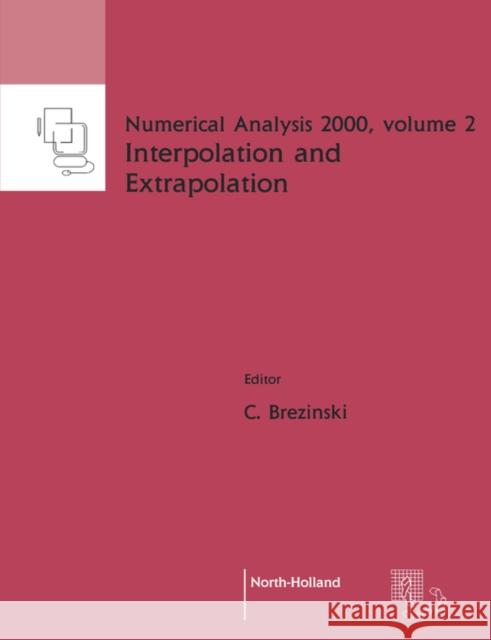
This volume is dedicated to two closely related subjects: interpolation and extrapolation. The papers can be divided into three categories: historical papers, survey papers and papers presenting new developments. Interpolation is an old subject since, as noticed in the paper by M. Gasca and T. Sauer, the term was coined by John Wallis in 1655. Interpolation was the first technique for obtaining an approximation of a function. Polynomial interpolation was then used in quadrature methods and...
/homepage/sac/cam/na2000/index.html7-Volume Set now available at special set price
This volume is dedicated to two closely related subj...
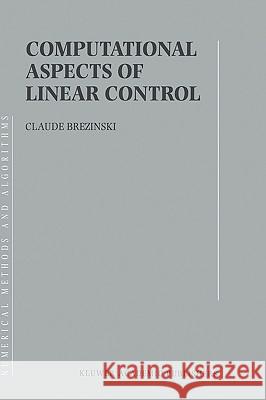
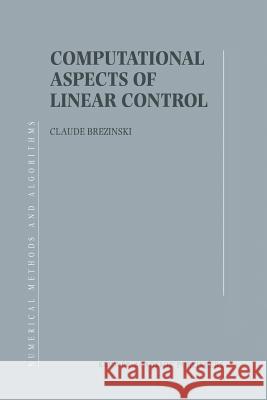
Many devices (we say dynamical systems or simply systems) behave like black boxes: they receive an input, this input is transformed following some laws (usually a differential equation) and an output is observed. The problem is to regulate the input in order to control the output, that is for obtaining a desired output. Such a mechanism, where the input is modified according to the output measured, is called feedback. The study and design of such automatic processes is called control theory. As we will see, the term system embraces any device and control theory has a wide variety of...
Many devices (we say dynamical systems or simply systems) behave like black boxes: they receive an input, this input is transformed following some law...
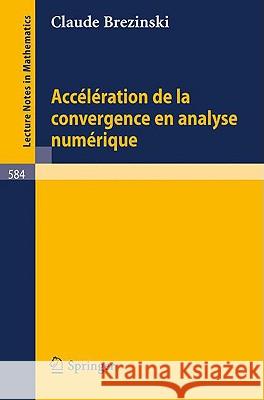
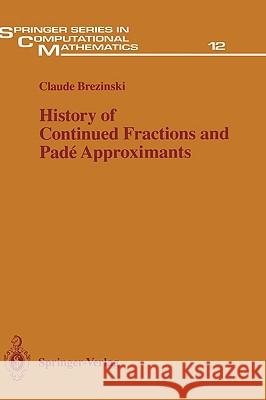
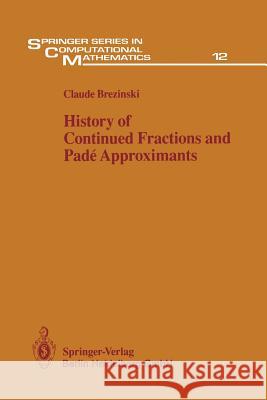
The history of continued fractions is certainly one of the longest among those of mathematical concepts, since it begins with Euclid's algorithm for the great- est common divisor at least three centuries B.C. As it is often the case and like Monsieur Jourdain in Moliere's "Ie bourgeois gentilhomme" (who was speak- ing in prose though he did not know he was doing so), continued fractions were used for many centuries before their real discovery. The history of continued fractions and Pade approximants is also quite im- portant, since they played a leading role in the development of some...
The history of continued fractions is certainly one of the longest among those of mathematical concepts, since it begins with Euclid's algorithm for t...
Many devices (we say dynamical systems or simply systems) behave like black boxes: they receive an input, this input is transformed following some laws (usually a differential equation) and an output is observed. The problem is to regulate the input in order to control the output, that is for obtaining a desired output. Such a mechanism, where the input is modified according to the output measured, is called feedback. The study and design of such automatic processes is called control theory. As we will see, the term system embraces any device and control theory has a wide variety of...
Many devices (we say dynamical systems or simply systems) behave like black boxes: they receive an input, this input is transformed following some law...
The history of continued fractions is certainly one of the longest among those of mathematical concepts, since it begins with Euclid's algorithm for the great- est common divisor at least three centuries B.C. As it is often the case and like Monsieur Jourdain in Moliere's "Ie bourgeois gentilhomme" (who was speak- ing in prose though he did not know he was doing so), continued fractions were used for many centuries before their real discovery. The history of continued fractions and Pade approximants is also quite im- portant, since they played a leading role in the development of some...
The history of continued fractions is certainly one of the longest among those of mathematical concepts, since it begins with Euclid's algorithm for t...
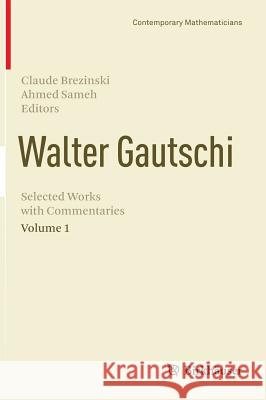
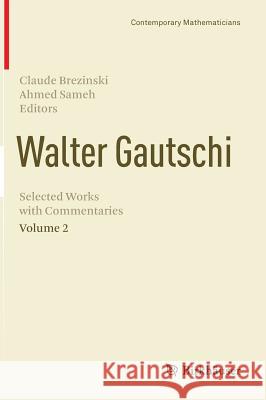
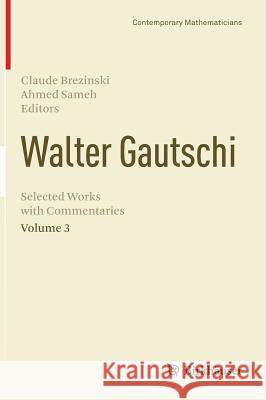
Walter Gautschi has written extensively on topics ranging from special functions, quadrature and orthogonal polynomials to difference and differential equations, software implementations, and the history of mathematics. He is world renowned for his pioneering work in numerical analysis and constructive orthogonal polynomials, including a definitive textbook in the former, and a monograph in the latter area.
This three-volume set, Walter Gautschi: Selected Works with Commentaries, is a compilation of Gautschi's most influential papers and includes commentaries by...
Walter Gautschi has written extensively on topics ranging from special functions, quadrature and orthogonal polynomials to difference and different...
Walter Gautschi has written extensively on topics ranging from special functions, quadrature and orthogonal polynomials to difference and differential equations, software implementations, and the history of mathematics. He is world renowned for his pioneering work in numerical analysis and constructive orthogonal polynomials, including a definitive textbook in the former, and a monograph in the latter area.
This three-volume set, Walter Gautschi: Selected Works with Commentaries, is a compilation of Gautschi's most influential papers and includes commentaries by...
Walter Gautschi has written extensively on topics ranging from special functions, quadrature and orthogonal polynomials to difference and different...
Walter Gautschi has written extensively on topics ranging from special functions, quadrature and orthogonal polynomials to difference and differential equations, software implementations, and the history of mathematics. He is world renowned for his pioneering work in numerical analysis and constructive orthogonal polynomials, including a definitive textbook in the former, and a monograph in the latter area.
This three-volume set, Walter Gautschi: Selected Works with Commentaries, is a compilation of Gautschi's most influential papers and includes commentaries by...
Walter Gautschi has written extensively on topics ranging from special functions, quadrature and orthogonal polynomials to difference and different...