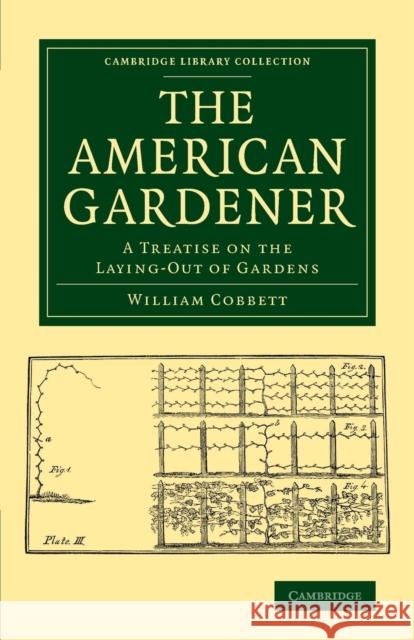
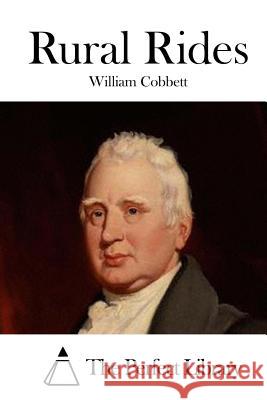
The political writer William Cobbett (1763 1835) was also a farmer 'bred at the plough's tail', who took a keen and observant interest in agriculture and gardening throughout his life. (His Cottage Economy and Rural Rides, among other works, are also reissued in the Cambridge Library Collection.) In 1792 he left England, where his views made him very unpopular, for France and then America, where he lived until 1800; in 1817 he fled to America again, leasing a farm on Long Island for two years. This 1821 book is written in Cobbett's characteristically robust style: his purpose is 'to cause the...
The political writer William Cobbett (1763 1835) was also a farmer 'bred at the plough's tail', who took a keen and observant interest in agriculture ...
1. It is the duty, and ought to be the pleasure, of age and experience to warn and instruct youth and to come to the aid of inexperience. When sailors have discovered rocks or breakers, and have had the good luck to escape with life from amidst them, they, unless they be pirates or barbarians as well as sailors, point out the spots for the placing of buoys and of lights, in order that others may not be exposed to the danger which they have so narrowly escaped. What man of common humanity, having, by good luck, missed being engulfed in a quagmire or quicksand, will withhold from his neighbours...
1. It is the duty, and ought to be the pleasure, of age and experience to warn and instruct youth and to come to the aid of inexperience. When sailors...
Throughout this little work, I shall number the Paragraphs, in order to be able, at some stages of the work, to refer, with the more facility, to parts that have gone before. The last Number will contain an Index, by the means of which the several matters may be turned to without loss of time; for, when economy is the subject, time is a thing which ought by no means to be overlooked.
Throughout this little work, I shall number the Paragraphs, in order to be able, at some stages of the work, to refer, with the more facility, to part...
Fog that you might cut with a knife all the way from London to Newbury. This fog does not wet things. It is rather a smoke than a fog. There are no two things in this world; and, were it not for fear of Six-Acts (the "wholesome restraint" of which I continually feel) I might be tempted to carry my comparison further; but, certainly, there are no two things in this world so dissimilar as an English and a Long Island autumn.-These fogs are certainly the white clouds that we sometimes see aloft.
Fog that you might cut with a knife all the way from London to Newbury. This fog does not wet things. It is rather a smoke than a fog. There are no tw...