International Astronomical Union Immo Appenzeller C. Jordan
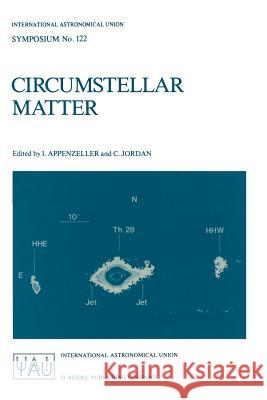
The objective of this meeting was to bring together collea gues from different branches of observational astronomy and theoretical astrophysics to discuss and analyse the rapid progress in our knowledge and understanding of the matter surrounding stars, streaming off stellar surfaces, or fall ing onto stars. The meeting was sponsored by IAU Commis sions 36 (Theory of Stellar Atmospheres), 29 (Stellar Spec tra), and 34 (Interstellar Matter). There were two special reasons for organizing this meeting at Heidelberg in 1986: During this year the University of Heidelberg celebrated its 600th...
The objective of this meeting was to bring together collea gues from different branches of observational astronomy and theoretical astrophysics to dis...
The publication of this volume coincides with the 55th anni versary of the discovery of the neutron and Landau's suggestion at the time that one could make stars out of the new particles. This year also marks the twenty-fifth anniversary of the detection of Sco X-I, the first known X-ray binary system, and follows by just twenty years Jocelyn Bell Burnell's discovery of that "little bit of scruff" o her chart record that led to the recognition of radio pulsars. As Q. Y. Qu, President of Nanjing University noted in his welcoming address, however, Chinese astronomers have been observing the...
The publication of this volume coincides with the 55th anni versary of the discovery of the neutron and Landau's suggestion at the time that one could...
IAU Symposium 127 was held in Princeton on May 28-31, 1986, at the Institute for Advanced Study. There were 150 participants from 19 countries. This was the first IAU Symposium devoted exclusively to elliptical galaxies. The last decade has been a period of exceptionally rapid progress regard ing our understanding of elliptical galaxies, driven on the observational side by a wealth of new photometric and spectroscopic data, and on the theoretical side by the recognition that ellipticals are slowly rotating triaxial systems, instead of rotationally flattened bodies. The 30 invited speakers...
IAU Symposium 127 was held in Princeton on May 28-31, 1986, at the Institute for Advanced Study. There were 150 participants from 19 countries. This w...
Helio- and asteroseismology study the interior of the Sun and other stars, by means of observations of oscillations on their surfaces. The last 10 years in the study of the solar interior, to a has witnessed a very rapid evolution point where we can now contemplate investigating the physical state of matter, or the details of rotation and other large-scale motion, in the Sun. The stellar studies are in some respects at the point of the solar studies 10 years ago, but appear poised to take off. Thus the time was deemed ripe for lAO Symposium No 123, to assess the present status of this work,...
Helio- and asteroseismology study the interior of the Sun and other stars, by means of observations of oscillations on their surfaces. The last 10 yea...
In the centennial year, 1985-86, of Harlow Shapley's birth, the study of globular clusters was no less important to the development of astronomy than in 1915, when Shapley first noted their concentration on the sky. By 1917 Shapley had used the properties of the system of globular clusters to complete the Copernican revolution and locate the solar system, and its Earth-bound observers, far from the center of the Galaxy and the globular cluster distribution. Seven decades later, in the year of these proceedings, globular cluster research and the study of the system of globular clusters in our...
In the centennial year, 1985-86, of Harlow Shapley's birth, the study of globular clusters was no less important to the development of astronomy than ...
The present volume contains the texts of the invited talks and contributed papers presented at IAU Colloquium No. 123 on Observations in Earth Orbit and Beyond', which was held at Goddard Space Flight Center on 24-27 April 1990. The Colloquium featured invited reviews of virtually all current and approved future projects in space astronomy, over the entire electromagnetic spectrum from gamma-ray to radio, of all major space faring nations of the world. The reviewer was typically either the project scientist or principal investigator of a given project. Also included are reviews and panel...
The present volume contains the texts of the invited talks and contributed papers presented at IAU Colloquium No. 123 on Observations in Earth Orbit a...
Highly ionized atoms in the general interstellar gas of the galactic disk were first detected through interstellar absorption line observations of 0 VI with the Copernicus satellite (Rogerson et al. 1973). Survey measurements by Jenkins (1978) of interstellar 0 VI absorption toward 72 stars demonstrated the general presence of 0 VI in the interstellar medium of the galactic disk. This researcIi. and parallel observational studies of the soft X-ra}' background (Williamson et al. 1974; McCammon et al. 1983; Marshall and ClarK 1984) provided direct evidence for the existence of hot low density...
Highly ionized atoms in the general interstellar gas of the galactic disk were first detected through interstellar absorption line observations of 0 V...
International Astronomical Union A. C. Levasseur-Regourd H. Hasegawa
The origin and evolution of interplanetary dust have been extensively discussed ever since the 1960s when a series of meetings began which brought together the interplanetary dust community. More recently, during the 1980s, new knowledge has emerged from comprehensive studies of cometary flybys and from infrared space observations. At present new, in-situ explorations of interplanetary dust are providing some promising results.
The origin and evolution of interplanetary dust have been extensively discussed ever since the 1960s when a series of meetings began which brought tog...
International Astronomical Union B. Barbuy A. Renzini
One approach to learning about stellar populations is to study them at three different levels of resolution. First in our own galaxy; secondly from nearby galaxies where stars can still be resolved; and thirdly in remote galaxies in which the stellar population can only be studied in integrated light.
One approach to learning about stellar populations is to study them at three different levels of resolution. First in our own galaxy; secondly from ne...
One approach to learning about stellar populations is to study them at three different levels of resolution. First in our own Galaxy; secondly from nearby galaxies where stars can still be resolved; and thirdly in remote galaxies in which the stellar population can only be studied in integrated light. This IAU Symposium covered the entire range of galaxies in its study of their stellar populations. Interspersed with theoretical papers, the wealth of observational results provides an important state-of-the-art presentation of the progress that has been made in this field.
One approach to learning about stellar populations is to study them at three different levels of resolution. First in our own Galaxy; secondly from ne...