Friedrich Nietzsche's most accessible and influential philosophical work, misquoted, misrepresented, brilliantly original and enormously influential Nietzsche was one of the most revolutionary and subversive thinkers in Western philosophy, and Thus Spoke Zarathustra remains his most famous and influential work. It describes how the ancient Persian prophet Zarathustra descends from his solitude in the mountains to tell the world that God is dead and that the Superman, the human embodiment of divinity, is his successor. Nietzsche's utterance 'God is dead', his insistence that the...
Friedrich Nietzsche's most accessible and influential philosophical work, misquoted, misrepresented, brilliantly original and enormously influentia...
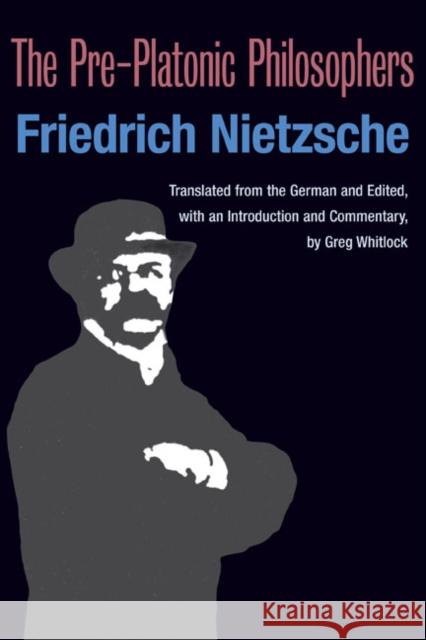
Whitlock's translation makes available for the first time in English a key lecture series delivered by the young Friedrich Nietzsche at the University of Basel.
Whitlock's translation makes available for the first time in English a key lecture series delivered by the young Friedrich Nietzsche at the University...
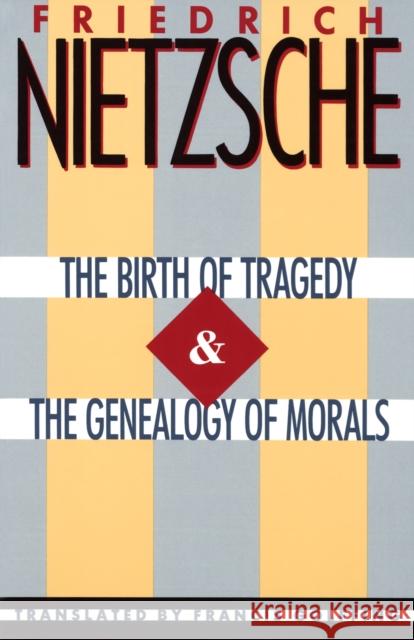
Skillful, sophisticated translations of two of Nietzsche's essential works about the conflict between the moral and aesthetic approaches to life, the impact of Christianity on human values, the meaning of science, the contrast between the Apollonian and Dionysian spirits, and other themes central to his thinking. The Birth of Tragedy (1872) was Nietzsche's first book, The Geneology of Morals (1887) one of his last. Though they span the career of this controversial genius, both address the problems such as the conflict between the moral versus aesthetic approaches to life,...
Skillful, sophisticated translations of two of Nietzsche's essential works about the conflict between the moral and aesthetic approaches to life, the ...
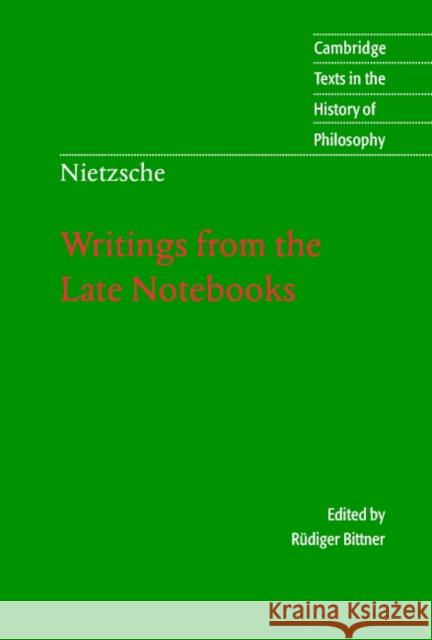
This volume offers, for the first time, accurate translations of a selection of writings from Nietzsche's late notebooks, dating from his last productive years between 1885 and 1889. Many of them have never before been published in English. They are translated by Kate Sturge from reliable texts in the Colli-Montinari edition, and edited by RUdiger Bittner, whose introduction analyzes them in the context of Nietzsche's philosophy as a whole. This volume will be widely welcomed by all those working in Nietzsche studies.
This volume offers, for the first time, accurate translations of a selection of writings from Nietzsche's late notebooks, dating from his last product...
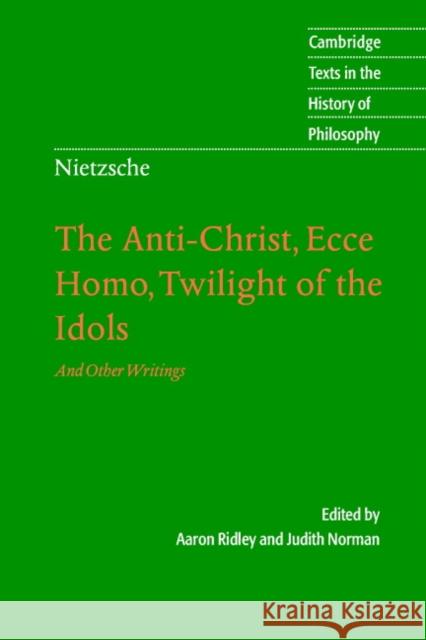
Nietzsche's late works are brilliant and uncompromising, and stand as monuments to his lucidity, rigor, and style. This volume combines, for the first time in English, five of these works: The Antichrist, Ecce Homo, Twilight of the Idols, Nietzsche contra Wagner, and The Case of Wagner. Nietzsche takes on some of his greatest adversaries in these works: traditional religion, contemporary culture, and above all, his one-time hero, Richard Wagner. His writing is simultaneously critical and creative, revealing his alternative philosophical vision, which, after more than a hundred years, still...
Nietzsche's late works are brilliant and uncompromising, and stand as monuments to his lucidity, rigor, and style. This volume combines, for the first...
Friedrich Wilhelm Nietzsche Daniel Breazeale Karl Ameriks
The four early essays in Untimely Meditations are key documents for understanding the development of Nietzsche's thought and clearly anticipate many of his later writings. They deal with such broad topics as the relationship between popular and genuine culture, strategies for cultural reform, the task of philosophy, the nature of education, and the relationship among art, science and life. This new edition presents R. J. Hollingdale's translation of the essays and a new introduction by Daniel Breazeale, who places them in their historical context and discusses their significance for...
The four early essays in Untimely Meditations are key documents for understanding the development of Nietzsche's thought and clearly anticipate many o...
This is a major work by the philosopher Friedrich Nietzsche, whose writings have been deeply influential on subsequent generations of philosophers. It is offered here in a new translation by Judith Norman, with an introduction by Rolf Peter Horstmann that places the work in its historical and philosophical context.
This is a major work by the philosopher Friedrich Nietzsche, whose writings have been deeply influential on subsequent generations of philosophers. It...
Nietzsche's late works are brilliant and uncompromising, and stand as monuments to his lucidity, rigor, and style. This volume combines, for the first time in English, five of these works: The Antichrist, Ecce Homo, Twilight of the Idols, Nietzsche contra Wagner, and The Case of Wagner. Nietzsche takes on some of his greatest adversaries in these works: traditional religion, contemporary culture, and above all, his one-time hero, Richard Wagner. His writing is simultaneously critical and creative, revealing his alternative philosophical vision, which, after more than a hundred years, still...
Nietzsche's late works are brilliant and uncompromising, and stand as monuments to his lucidity, rigor, and style. This volume combines, for the first...
Friedrich Wilhelm Nietzsche Adrian De Robert B. Pippin
Nietzsche regarded 'Thus Spoke Zarathustra' as his most important work, and his story of the wandering Zarathustra has had enormous influence on subsequent culture. Nietzsche uses a mixture of homilies, parables, epigrams and dreams to introduce some of his most striking doctrines, including the Overman, nihilism, and the eternal return of the same. This edition offers a new translation by Adrian Del Caro which restores the original versification of Nietzsche's text and captures its poetic brilliance. Robert Pippin's introduction discusses many of the most important interpretative issues...
Nietzsche regarded 'Thus Spoke Zarathustra' as his most important work, and his story of the wandering Zarathustra has had enormous influence on subse...
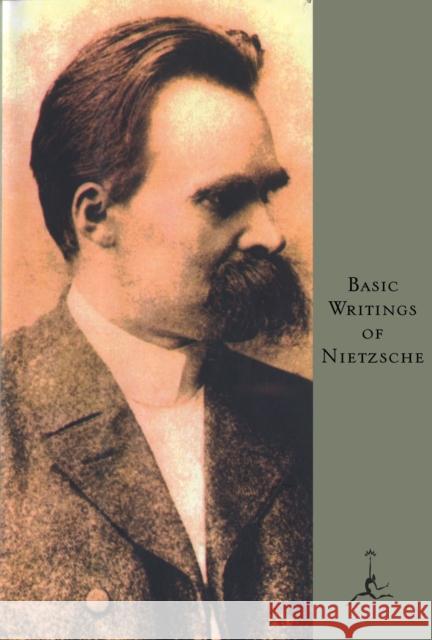
Introduction by Peter Gay Translated and edited by Walter Kaufmann Commentary by Martin Heidegger, Albert Camus, and Gilles Deleuze One hundred years after his death, Friedrich Nietzsche remains the most influential philosopher of the modern era. Basic Writings of Nietzsche gathers the complete texts of five of Nietzsche's most important works, from his first book to his last: The Birth of Tragedy, Beyond Good and Evil, On the Genealogy of Morals, The Case of Wagner, and Ecce Homo. Edited and translated by the great Nietzsche...
Introduction by Peter Gay Translated and edited by Walter Kaufmann Commentary by Martin Heidegger, Albert Camus, and Gilles...