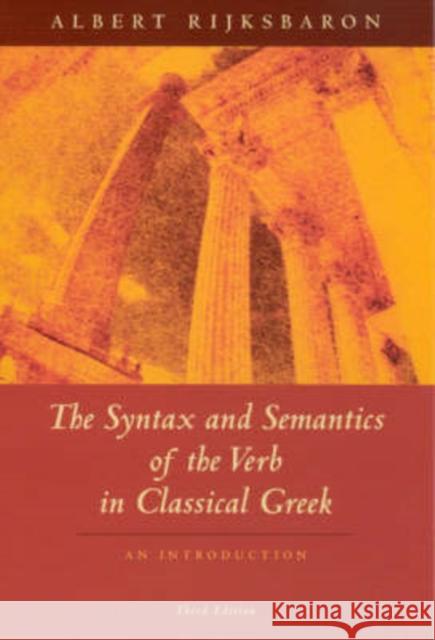
The verb is, in any language, the motor of all communication: no verb, no action. In Greek, verb forms change not only with person, number, tense, and voice, but in four possible moods as well. Available now in a special reprint for the North American market, The Syntax and Semantics of the Verb in Classical Greek is an incomparable resource to students and scholars charged with the considerable task of untangling the Greek language's many complexities. With clear, concise instruction, Albert Rijksbaron shows how the various verb forms contribute to the richness of the Greek...
The verb is, in any language, the motor of all communication: no verb, no action. In Greek, verb forms change not only with person, number, tense, ...
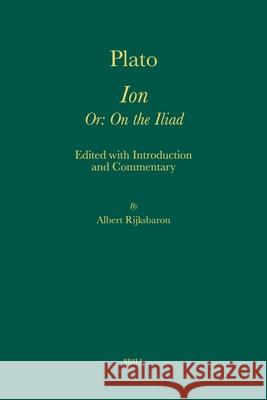
On the basis of a fresh collation of the four primary manuscripts, this book presents a revised text of Plato's Ion, with full apparatus criticus. The commentary has a strong linguistic orientation; it includes discussions of Platonic vocabulary. Linguistic considerations are also the leading principle in the choice of one MS reading rather than another. Drawing on Byzantine practices and theories, the book pays special attention to questions of punctuation, an area too often ignored in editions of classical texts. The extensive introduction deals with, inter alia, Plato's attack on...
On the basis of a fresh collation of the four primary manuscripts, this book presents a revised text of Plato's Ion, with full apparatus critic...