An ethnographic contribution describing the beliefs and ideas associated with witchcraft as shared -knowledge- that the Apaches have about their universe. Uncovers the types of interpersonal relationships with which witchcraft accusations are regularly associated and posits explanations for these associations.
An ethnographic contribution describing the beliefs and ideas associated with witchcraft as shared -knowledge- that the Apaches have about their unive...
This volume grew out of a symposium held at the Annual Meeting of the American Anthropological Association in November 1969 at New Orleans, Louisiana. The "Apachean Symposium" was designed to provide an opportunity for scholars engaged in research on southern Athapaskan cultures to report upon their findings, and wherever possible, to link them to known fact and existing theory. The diverse work presented here will add significantly to the knowledge about Apachean cultures, and each of contributions also pertains directly to wider spheres of anthropological concern.
This volume grew out of a symposium held at the Annual Meeting of the American Anthropological Association in November 1969 at New Orleans, Louisiana....
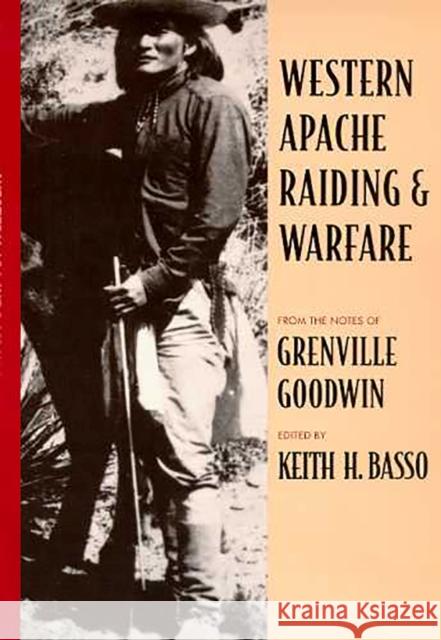
This is a remarkable series of personal narrations from Western Apaches before and just after the various agencies and sub-agencies were established. It also includes extensive commentary on weapons and traditions, with Apache words and phrases translated and complete annotation.
This is a remarkable series of personal narrations from Western Apaches before and just after the various agencies and sub-agencies were establ...
Seven essays, collected here for the first time, define some of the central concerns of linguistic anthropology through the close study of Western Apache, a language of astonishing complexity. All of the essays have been revised for this anthology. Basso, a major authority in the field of linguistic anthropology, has drawn on fieldwork at the village of Cibecue, whose residents speak a dialect of Western Apache that is spoken nowhere else. He shows how intricacies of language place names, metaphor, uses of silence help a people define their very existence, so that, in the words of one...
Seven essays, collected here for the first time, define some of the central concerns of linguistic anthropology through the close study of Wes...
When the Apache wars ended in the late nineteenth century, a harsh and harrowing time began for the Western Apache people. Living under the authority of nervous Indian agents, pitiless government-school officials, and menacing mounted police, they knew that resistance to American authority would be foolish. But some Apache families did resist in the most basic way they could: they resolved to endure. Although Apache history has inspired numerous works by non-Indian authors, Apache people themselves have been reluctant to comment at length on their own past. Eva Tulene Watt, born in...
When the Apache wars ended in the late nineteenth century, a harsh and harrowing time began for the Western Apache people. Living under the au...
When the Apache wars ended in the late nineteenth century, a harsh and harrowing time began for the Western Apache people. Living under the authority of nervous Indian agents, pitiless government-school officials, and menacing mounted police, they knew that resistance to American authority would be foolish. But some Apache families did resist in the most basic way they could: they resolved to endure. Although Apache history has inspired numerous works by non-Indian authors, Apache people themselves have been reluctant to comment at length on their own past. Eva Tulene Watt, born in 1913, now...
When the Apache wars ended in the late nineteenth century, a harsh and harrowing time began for the Western Apache people. Living under the authority ...
Presents an in-depth historical reconstruction and a detailed ethnographic account of the Western Apache culture based on firsthand observations made over a span of nearly ten years in the fieldThe Social Organization of the Western Apache is still one of the most comprehensive descriptions of the social life of an American Indian tribe. Grenville Goodwin knew the Western Apache better than any other ethnographer who ever lived. And he wrote about them from the conviction that his knowledge was important--not only for specialists interested in the tribes of the Southwest,...
Presents an in-depth historical reconstruction and a detailed ethnographic account of the Western Apache culture based on firsthand observations ma...