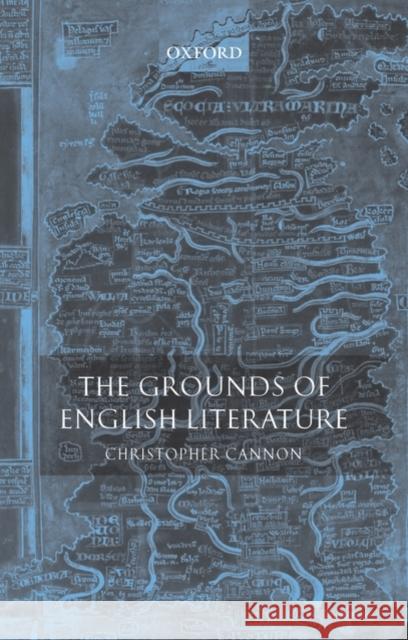
The centuries just after the Norman Conquest are the forgotten period of English literary history. In fact, the years 1066-1300 witnessed an unparalleled ingenuity in the creation of written forms, for this was a time when almost every writer was unaware of the existence of other English writing. In a series of detailed readings of the more important early Middle English works, Cannon shows how the many and varied texts of the period laid the foundations for the project of English literature. This richness is for the first time given credit in these readings by means of an innovative theory...
The centuries just after the Norman Conquest are the forgotten period of English literary history. In fact, the years 1066-1300 witnessed an unparalle...
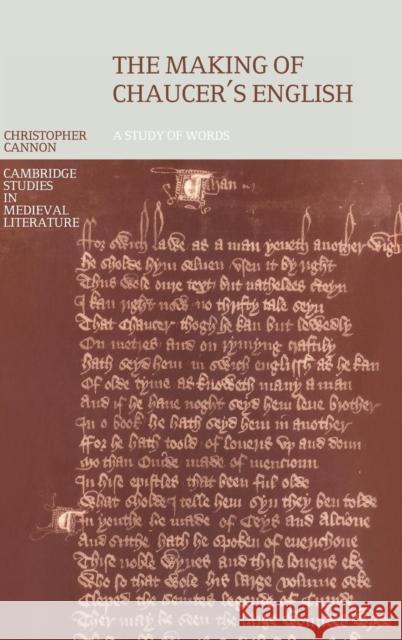
This book is a study of Chaucer's words. It describes how these words became evidence for calling Chaucer the "father of English poetry" but, also, why that label is wrong. It shows that Chaucer's language is, in fact, traditional and argues that his linguistic innovation was as much performance as fact. It provides a thorough history of every one of Chaucer's words and maps the origins and patterns of use that have made these words so compelling for six hundred years.
This book is a study of Chaucer's words. It describes how these words became evidence for calling Chaucer the "father of English poetry" but, also, wh...
This book provides a boldly original account of Middle English literature from the Norman Conquest to the beginning of the sixteenth century. It argues that these centuries are, in fundamental ways, the momentous period in our literary history, for they are the long moment in which the category of literature itself emerged as English writing began to insist, for the first time, that it floated free of any social reality or function.
This book also charts the complex mechanisms by which English writing acquired this power in a series of linked close readings of both canonical and...
This book provides a boldly original account of Middle English literature from the Norman Conquest to the beginning of the sixteenth century. It argue...
This book provides a boldly original account of Middle English literature from the Norman Conquest to the beginning of the sixteenth century. It argues that these centuries are, in fundamental ways, the momentous period in our literary history, for they are the long moment in which the category of literature itself emerged as English writing began to insist, for the first time, that it floated free of any social reality or function.
This book also charts the complex mechanisms by which English writing acquired this power in a series of linked close readings of both canonical and...
This book provides a boldly original account of Middle English literature from the Norman Conquest to the beginning of the sixteenth century. It argue...
This book is a study of Chaucer's words. It describes how these words became evidence for calling Chaucer the "father of English poetry" but, also, why that label is wrong. It shows that Chaucer's language is, in fact, traditional and argues that his linguistic innovation was as much performance as fact. It provides a thorough history of every one of Chaucer's words and maps the origins and patterns of use that have made these words so compelling for six hundred years.
This book is a study of Chaucer's words. It describes how these words became evidence for calling Chaucer the "father of English poetry" but, also, wh...
The centuries just after the Norman Conquest are the forgotten period of English literary history. In fact, the years 1066-1300 witnessed an unparalleled ingenuity in the creation of written forms, for this was a time when almost every writer was unaware of the existence of other English writing. In a series of detailed readings of the more important early Middle English works, Cannon shows how the many and varied texts of the period laid the foundations for the project of English literature. This richness is given credit for the first time in these readings by means of an innovative theory...
The centuries just after the Norman Conquest are the forgotten period of English literary history. In fact, the years 1066-1300 witnessed an unparalle...
Acute Coronary Syndrome covers the spectrum of clinical conditions ranging from unstable angina to non-ST elevation myocardial infarction and ST elevation myocardial infarction. These life-threatening disorders are a major cause of emergency medical care, hospitalization and mortality. Management of Acute Coronary Syndromes is designed to provide busy clinicians with a comprehensive guide to the investigation, diagnosis and treatment of these syndromes. It encompasses the latest technologies, including the use of biomarkers and non-invasive imaging procedures.
For each condition,...
Acute Coronary Syndrome covers the spectrum of clinical conditions ranging from unstable angina to non-ST elevation myocardial infarction and ST eleva...
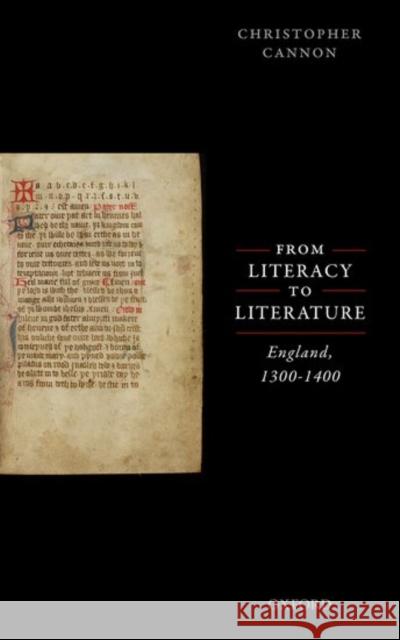
The first lessons we learn in school can stay with us all our lives, but this was nowhere more true than in the last decades of the fourteenth century when grammar-school students were not only learning to read and write, but understanding, for the first time, that their mother tongue, English, was grammatical. The efflorescence of Ricardian poetry was not a direct result of this change, but it was everywhere shaped by it. This book characterizes this close connection between literacy training and literature, as it is manifest in the fine and ambitious poetry by Gower, Langland and Chaucer,...
The first lessons we learn in school can stay with us all our lives, but this was nowhere more true than in the last decades of the fourteenth century...