"This writing has to do with some things I saw, felt, and was part of": with quiet modesty, David Jones begins a work that is among the most powerful imaginative efforts to grapple with the carnage of the First World War, a book celebrated by W.B. Yeats and T.S. Eliot as one of the masterpieces of modern literature. Fusing poetry and prose, gutter talk and high music, wartime terror and ancient myth, Jones, who served as an infantryman on the Western Front, presents a picture at once panoramic and intimate of a world of interminable waiting and unforeseen death. And yet throughout he remains...
"This writing has to do with some things I saw, felt, and was part of": with quiet modesty, David Jones begins a work that is among the most powerful ...
Osip Mandelstam is a central figure not only in modern Russian but in world poetry, the author of some of the most haunting and memorable poems of the twentieth century. A contemporary of Anna Akhmatova, Marina Tsvetayeva, and Boris Pasternak, a touchstone for later masters such as Paul Celan and Robert Lowell, Mandelstam was a crucial instigator of the -revolution of the word- that took place in St. Petersburg, only to be crushed by the Bolshevik Revolution. Mandelstam's last poems, written in the interval between his exile to the provinces by Stalin and his death in the Gulag, are an...
Osip Mandelstam is a central figure not only in modern Russian but in world poetry, the author of some of the most haunting and memorable poems of the...
Zen Buddhism distinguishes itself by brilliant flashes of insight and its terseness of expression. The haiku verse form is a superb means of studying Zen modes of thought and expression, for its seventeen syllables impose a rigorous limitation that confines the poet to vital experience. Here haiku by Basho are translated by Robert Aitken, with commentary that provides a new and far deeper understanding of Basho's work than ever before. In presenting themes from the haiku and from Zen literature that open the doors both to the poems and to Zen itself, Aitken has produced the first book...
Zen Buddhism distinguishes itself by brilliant flashes of insight and its terseness of expression. The haiku verse form is a superb means of studying ...
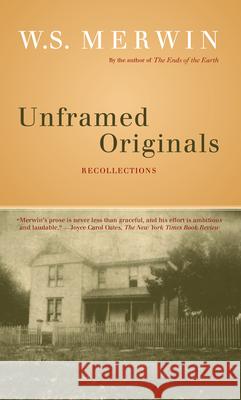
In this haunting, elegantly written memoir, W. S. Merwin recalls in utterly unsentimental prose his youth, growing up in a repressed Presbyterian household in the small river towns of New Jersey and Pennsylvania. The complex portrait that emerges of a family without language or history, transforms the story of their isolated lives into the development of a writer's conscience and a warning about the fate of a middle class eager to obliterate origins. "This book is superbly written, offering deep glimpses into the complexities and mysteries of family bonds, with just that distancing from...
In this haunting, elegantly written memoir, W. S. Merwin recalls in utterly unsentimental prose his youth, growing up in a repressed Presbyterian hous...
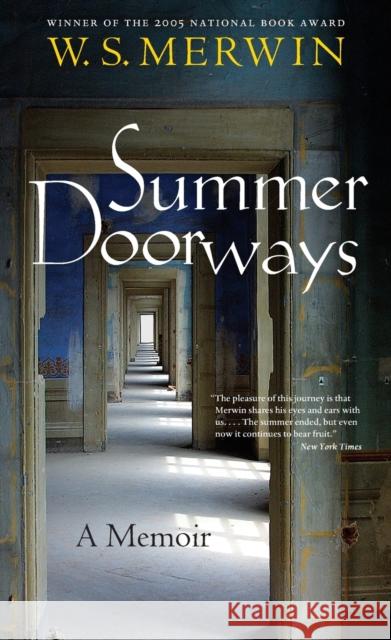
America today is a mobile society. Many of us travel abroad, and few of us live in the towns or cities where we were born. It wasn't always so. "Travel from America to Europe became a commonplace, an ordinary commodity, some time ago, but when I first went such departure was still surrounded with an atmosphere of adventure and improvisation, and my youth and inexperience and my all but complete lack of money heightened that vertiginous sensation," writes W. S. Merwin. Twenty-one, married and graduated from Princeton, the poet embarked on his first visit to Europe in 1948 when life and...
America today is a mobile society. Many of us travel abroad, and few of us live in the towns or cities where we were born. It wasn't always so. "Trave...
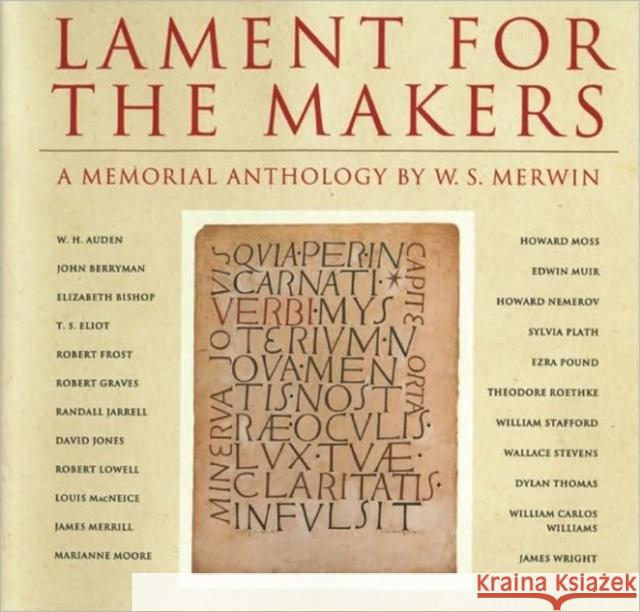
With Lament for the Makers W. S. Merwin honors the lives and work of twenty-three poets of our time. Each of them has been important to him, and all of them died during his life as a poet. Following the title poem, Merwin presents works by Dylan Thomas, Wallace Stevens, Edwin Muir, Sylvia Plath, William Carlos Williams, Robert Frost, Theodore Roethke, Louis MacNeice, T. S. Eliot, Randall Jarrell, John Berryman, W. H. Auden, Marianne Moore, Ezra Pound, David Jones, Robert Lowell, Elizabeth Bishop, James Wright, Howard Moss, Robert Graves, Howard Nemerov, William Stafford, and James...
With Lament for the Makers W. S. Merwin honors the lives and work of twenty-three poets of our time. Each of them has been important to him, an...
"Merwin has attained a transcendent and transformative elevation of beaming perception, exquisite balance, and clarifying beauty."--Booklist, starred review
"In his personal anonymity, his strict individuated manner, his defense of the earth, and his heartache at time's passing, Merwin has become instantly recognizable on the page."--Helen Vendler, The New York Review of Books
"W.S. Merwin's legacy is unquestionably secure."--Poetry
"Merwin is tackling the mysteries of life and impending death with a grace and dexterity of imagination that leaves one...
"Merwin has attained a transcendent and transformative elevation of beaming perception, exquisite balance, and clarifying beauty."--Booklist...
Poet and environmentalist W. S. Merwin moved to Hawaii in 1976 and has spent the last forty years planting nineteen acres with more than eight hundred species of palm, creating a lush garden on a ruined former pineapple plantation. Now the Merwin Conservancy, this land has served as Merwin's muse and his passion, appearing as a consistent subject of his poems and his germinal essays on conservation. What Is a Garden? collects eight of Merwin's poems and three of his essays emblematic of his palm garden writings from the 1980s to the present and presents them alongside photographer Larry...
Poet and environmentalist W. S. Merwin moved to Hawaii in 1976 and has spent the last forty years planting nineteen acres with more than eight hundred...