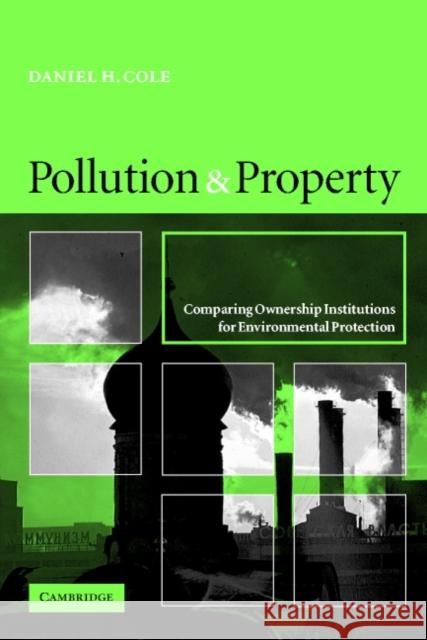
All solutions to environmental problems depend on the imposition of private, common, or public-property rights in natural resources. Who should own the resources: private individuals, private groups of "stakeholders," or the entire society (the public)? Contrary to much of the literature in this field, this book argues that no single property regime works best in all circumstances. Environmental protection requires the use of multiple property regimes--including admixtures of private, common, and public-property systems.
All solutions to environmental problems depend on the imposition of private, common, or public-property rights in natural resources. Who should own th...
This book addresses the fundamental issues underlying the debate over electric power regulation and deregulation. After decades of the presumption that the electric power industry was a natural monopoly, recent times have seen a trend of deregulation followed by panicked re-regulation. This important book critically analyses this controversial area from a legal and economic perspective.
This book addresses the fundamental issues underlying the debate over electric power regulation and deregulation. After decades of the presumption ...
Daniel H. Cole Michael D. McGinnis Paul Dragos Aligica
Elinor (Lin) Ostrom was awarded the 2009 Nobel Memorial Prize in Economic Sciences for her pathbreaking research on "economic governance, especially the commons"; but she also made important contributions to several other fields of political economy and public policy. The range of topics she covered and the multiple methods she used might convey the mistaken impression that her body of work is disjointed and incoherent. This four-volume compendium of papers written by Lin, alone or with various coauthors (most notably including her husband and partner, Vincent), supplemented by others...
Elinor (Lin) Ostrom was awarded the 2009 Nobel Memorial Prize in Economic Sciences for her pathbreaking research on "economic governance, especially t...
In addition to winning the 2009 Nobel Prize in Economic Sciences for her path-breaking research on "economic governance, especially the commons," Elinor (Lin) Ostrom also made important contributions to other fields of political economy and public policy. This four-volume compendium of papers written by Lin (often with coauthors, most notably her husband, Vincent), along with papers by others expanding on her work, brings together the strands of her entire empirical, analytical, theoretical, and methodological research program. Together with Vincent's important theoretical contributions, they...
In addition to winning the 2009 Nobel Prize in Economic Sciences for her path-breaking research on "economic governance, especially the commons," Elin...