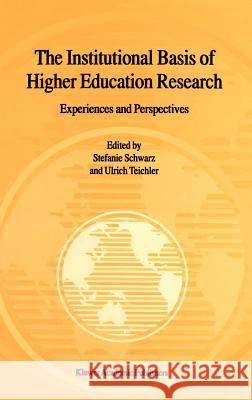
In the US, the university administration runs its own office of insti- tional research in order to base its decisions on systematic information. Furthermore, higher education research can rely on a relatively stable academic basis if study programmes on higher education exist. Again, this is most frequently the case in the United States. Finally, governments and other macro-societal actors sometimes have their own offices or institutes of policy research and prepare the policies of the actors they report to. In addition, research on higher education can be institutionalized in a - riety of...
In the US, the university administration runs its own office of insti- tional research in order to base its decisions on systematic information. Furth...
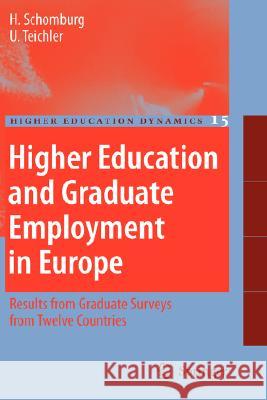
From autumn 1998 to spring 2000, about 3,000 graduates each from nine countries in the European Union (Austria, Finland, France, Germany, Italy, the Netherlands, Spain, Sweden, United Kingdom), one EFTA country (Norway), one of the Central and Eastern European countries in transition (the Czech Republic) and one econo- cally advanced country outside Europe (Japan) provided information through a wr- ten questionnaire on the relationship between higher education and employment three to four years after graduation. In total, over 40,000 graduates from higher education institutions answered...
From autumn 1998 to spring 2000, about 3,000 graduates each from nine countries in the European Union (Austria, Finland, France, Germany, Italy, the N...
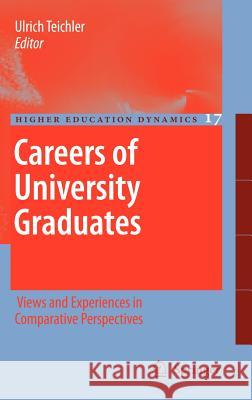
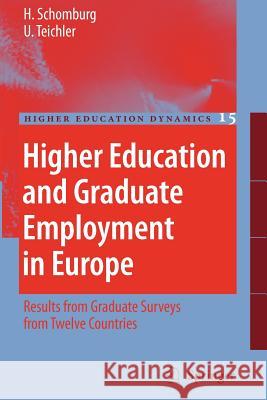
This book offers detailed comparative analyses of graduate employment and work, drawn from a survey of graduates in 11 European countries and Japan. The book shows how transition to employment, job assignments, employee assessments of the quality of employment and work vary by the graduates socio-biographic and educational background. It demonstrates more substantial differences in the relationships between study and subsequent employment between various countries than previous debates and analyses have suggested."
This book offers detailed comparative analyses of graduate employment and work, drawn from a survey of graduates in 11 European countries and Japan...
Today, unprecedented emphasis is being placed on research as key motor for advancing the knowledge society and its offspring, the knowledge economy. Consequently, "research on the state of research" has moved high on the priority agendas for governments, for their specialized agencies and bodies devoted to this area, and for higher education institutions. Against this background, the central premise of the 2006 Global Colloquium of the UNESCO Forum for Higher Education Research and Knowledge "Universities as Centres of Research and Knowledge Creation - An Endangered Species" was that...
Today, unprecedented emphasis is being placed on research as key motor for advancing the knowledge society and its offspring, the knowledge economy. C...
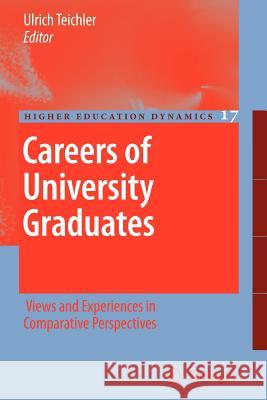
What does higher education offer to make students competent actors in the world of work and other life spheres? This issue is most controversially debated in economically advanced countries since about four decades when higher education in economically advanced countries began to serve larger ranges of the occupational pyramid than merely the intellectually and professionally chosen few. The author of this volume analyzes a broad range of issues over four decades of his academic career. Employers and graduate surveys, secondary analyses of education and employment statistics as well as...
What does higher education offer to make students competent actors in the world of work and other life spheres? This issue is most controversially deb...
In the US, the university administration runs its own office of insti- tional research in order to base its decisions on systematic information. Furthermore, higher education research can rely on a relatively stable academic basis if study programmes on higher education exist. Again, this is most frequently the case in the United States. Finally, governments and other macro-societal actors sometimes have their own offices or institutes of policy research and prepare the policies of the actors they report to. In addition, research on higher education can be institutionalized in a - riety of...
In the US, the university administration runs its own office of insti- tional research in order to base its decisions on systematic information. Furth...
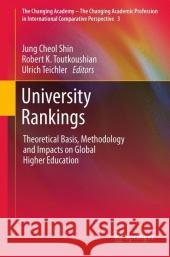
This ground-breaking and exhaustive analysis of university ranking surveys scrutinizes their theoretical bases, methodological issues, societal impact, and policy implications, providing readers with a deep understanding of these controversial comparators. The authors propose that university rankings are misused by policymakers and institutional leaders alike. They assert that these interested parties overlook the highly problematic internal logic of ranking methodologies even as they obsess over the surveys assessment of their status. The result is that institutions suffer from...
This ground-breaking and exhaustive analysis of university ranking surveys scrutinizes their theoretical bases, methodological issues, societal imp...
This book offers detailed comparative analyses of graduate employment and work, drawn from a survey of graduates in 11 European countries and Japan. The book shows how transition to employment, job assignments, employee assessments of the quality of employment and work vary by the graduates socio-biographic and educational background. It demonstrates more substantial differences in the relationships between study and subsequent employment between various countries than previous debates and analyses have suggested."
This book offers detailed comparative analyses of graduate employment and work, drawn from a survey of graduates in 11 European countries and Japan...
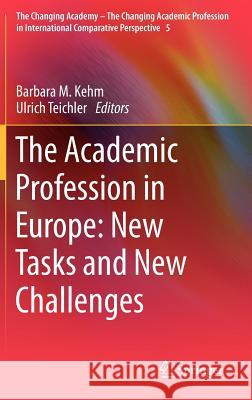
This book is the first of several with the results of a collaborative European project supported by the European Science Foundation on changes in the academic profession in Europe (EUROAC). It provides a short description of the ESF EUROHESC programme and the particular forms of international collaborative research projects which are funded under the umbrella of this programme. It then outlines the EUROAC project. This project has chosen three foci (governance, professionalisation, academic careers) to analyse changes in the work of the academic profession. The first results in the form of...
This book is the first of several with the results of a collaborative European project supported by the European Science Foundation on changes in t...
From autumn 1998 to spring 2000, about 3,000 graduates each from nine countries in the European Union (Austria, Finland, France, Germany, Italy, the Netherlands, Spain, Sweden, United Kingdom), one EFTA country (Norway), one of the Central and Eastern European countries in transition (the Czech Republic) and one econo- cally advanced country outside Europe (Japan) provided information through a wr- ten questionnaire on the relationship between higher education and employment three to four years after graduation. In total, over 40,000 graduates from higher education institutions answered...
From autumn 1998 to spring 2000, about 3,000 graduates each from nine countries in the European Union (Austria, Finland, France, Germany, Italy, the N...