The Order of Moed in the Mishnah and Babylonian Talmud outlines the way Jews celebrate their festivals. It is well known among feminists that Jewish life is not the same for men and women, and that women experience Jewish festivals differently. The purpose of the feminist commentary on Seder Moed is to outline these differences, as they are reflected in the mishnaic and talmudic texts, which have become canonical for Jews and serve as a blueprint for the way they live their lives. In this introductory volume the questions of women's participation in Jewish festivals are handled on a more...
The Order of Moed in the Mishnah and Babylonian Talmud outlines the way Jews celebrate their festivals. It is well known among feminists that Jewish l...
Tal Ilan discusses tractate Ta'anit of the Babylonian Talmud, which deals with ritual fasting, usually in the case of rain failure. In this commentary, the author presents and discusses texts from the tractate which are relevant to women and gender. These include legal proclamations on the participation of women in public fasts, stories on pious men, whose proper conduct toward women make them ideal intermediaries for bringing rain and discussions of gendered rabbinic terms such as Bat Qol, usually translated as 'heavenly voice' but which literally translated means 'a daughter's voice'. The...
Tal Ilan discusses tractate Ta'anit of the Babylonian Talmud, which deals with ritual fasting, usually in the case of rain failure. In this commentary...
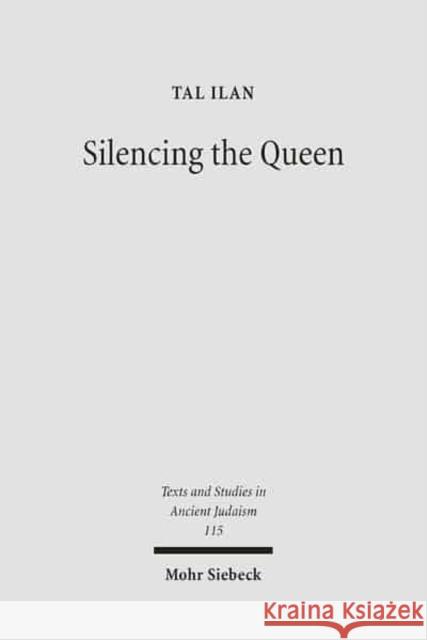
Tal Ilan explores the way historical documents from antiquity are reworked and edited in a long process that ends in silencing the women originally mentioned in them. Many methods are used to produce this end result: elimination of women or their words, denigration of the women and their role or unification of several significant women into one. These methods and others are illuminated in this book, as it uses the example of the Jewish queen Shelamzion Alexandra (76-67 BCE) for its starting point. Queen Shelamzion was the only legitimate Jewish queen in history. Yet all the documents in which...
Tal Ilan explores the way historical documents from antiquity are reworked and edited in a long process that ends in silencing the women originally me...
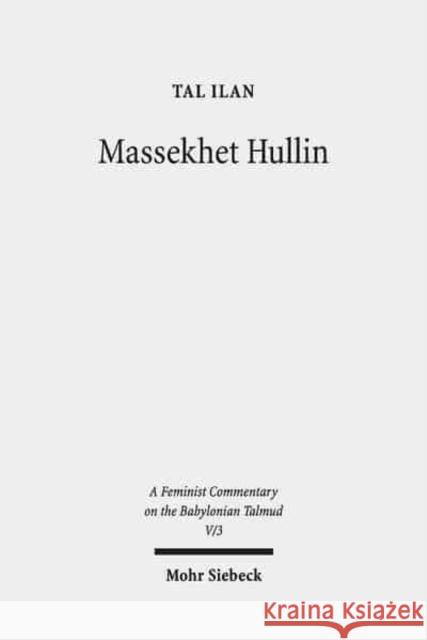
The Babylonian Talmud's Tractate Hullin is the longest in the Order of Qodashim with twelve chapters and over 140 pages. The Order of Qodashim (-holy things-) in general deals with the Temple. The word hullin, however, means -profane things- and actually describes the kosher slaughter of beasts for human consumption outside the temple. Even though this topic is not overtly gendered, and neither does it pertain specifically to women, Tal Ilan discusses over 100 traditions that touch on women and gender. She shows that -women- forever served as good -tools- with which to discuss various topics...
The Babylonian Talmud's Tractate Hullin is the longest in the Order of Qodashim with twelve chapters and over 140 pages. The Order of Qodashim (-holy ...
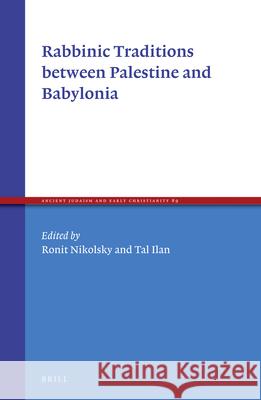
In this book various authors explore how rabbinic traditions that were formulated in the Land of Israel migrated to Jewish study houses in Babylonia. The authors demonstrate how the new location and the unique literary character of the Babylonian Talmud combine to create new and surprising texts out of the old ones. Some authors concentrate on inner rabbinic social structures that influence the changes the traditions underwent. Others show the influence of the host culture on the metamorphosis of the traditions. The result is a complex study of cultural processes, as shaped by a unique...
In this book various authors explore how rabbinic traditions that were formulated in the Land of Israel migrated to Jewish study houses in Babylonia. ...





![[The Ptolemaic Period (323 Bce-30 Bce)] Hacham, Noah 9783110674507 Walter de Gruyter](/9783110674507_the_ptolemaic_period_323_bce_30_bce.jpg "[The Ptolemaic Period (323 Bce-30 Bce)]")