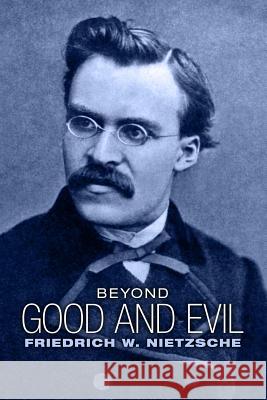
Beyond Good and Evil is one of Nietzsche's most important works and, although it is relatively easy to read, it is one of the more difficult to fully grasp on a first reading. The thesis is, as the title alludes, that morality is ultimately relativistic - that right and wrong are not absolutes but are considerably flexible - and variable in different societies at all times.
Although he qualifies his views as opinions rather than facts and asks his readers to examine his premises critically before agreeing with his views, Nietzsche leaves no doubt that he is confident that all...
Beyond Good and Evil is one of Nietzsche's most important works and, although it is relatively easy to read, it is one of the more difficul...
Beyond Good and Evil, Prelude to a Philosophy of the Future, by Friedrich Nietzsche expands on the ideas of his work, Thus Spoke Zarathustra, takes an approach from a more critical, polemical direction. In Beyond Good and Evil, Nietzsche accuses past philosophers of lacking critical sense and blindly accepting Judeo-Christian premises in their consideration of morality. The work moves beyond good and evil in the sense of leaving behind the traditional morality which Nietzsche subjects to a destructive critique in favor of what he regards as an affirmative approach that fearlessly confronts...
Beyond Good and Evil, Prelude to a Philosophy of the Future, by Friedrich Nietzsche expands on the ideas of his work, Thus Spoke Zarathustra, takes an...
In Beyond Good and Evil, Nietzsche accuses past philosophers of lacking critical sense and blindly accepting dogmatic premises in their consideration of morality. The work moves into the realm "beyond good and evil" in the sense of leaving behind the traditional morality which Nietzsche subjects to a destructive critique in favour of what he regards as an affirmative approach that fearlessly confronts the perspectival nature of knowledge and the perilous condition of the modern individual.
In Beyond Good and Evil, Nietzsche accuses past philosophers of lacking critical sense and blindly accepting dogmatic premises in their consideration ...
To unfold that interesting and dramatic period which opened with the return of Pius IX. and closed with the fall of the temporal power, it was necessary to pause and weigh the mass of publications issued concerning the epoch, besides searching among private archives and familiar correspondence and also questioning survivors. More than once I was discouraged, and felt tempted to abandon the enterprise. Only the passion for research supported me in this arduous labour, which often appeared indiscreet and was often painful, because it destroyed many a legend, dashed many a prejudice, and...
To unfold that interesting and dramatic period which opened with the return of Pius IX. and closed with the fall of the temporal power, it was necessa...