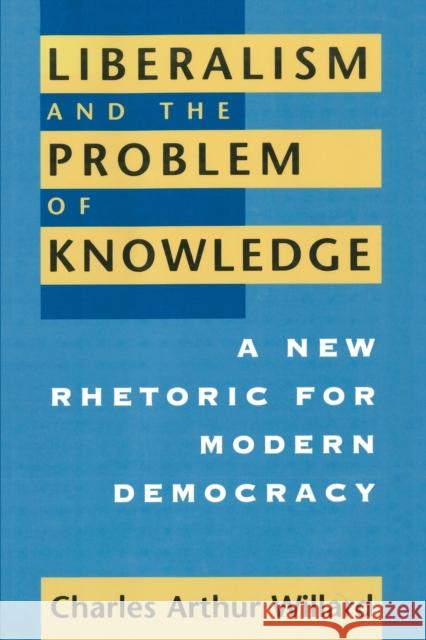
In this witty and provocative study of democracy and its critics, Charles Willard debunks liberalism, arguing that its exaggerated ideals of authenticity, unity, and community have deflected attention from the pervasive incompetence of "the rule of experts." He proposes a ground of communication that emphasizes common interests rather than narrow disputes. The problem of "unity" and the public sphere has driven a wedge between libertarians and communitarians. To mediate this conflict, Willard advocates a shift from the discourse of liberalism to that of epistemics. As a means of...
In this witty and provocative study of democracy and its critics, Charles Willard debunks liberalism, arguing that its exaggerated ideals of authentic...
The thesis of this book is that argument is not a kind of logic but a kind of communication conversation based on disagreement. Claims about the epistemic and political effects of argument get their authority not from logic but from their fit with the facts about how communication works. A Theory of Communication thus offers a picture of communication distilled from elements of symbolic interactionism, personal construct theory, constructivism, and Barbara O Keefe s provocative thinking about logics of message design. The picture of argument that emerges from this tapestry is...
The thesis of this book is that argument is not a kind of logic but a kind of communication conversation based on disagreement. Claims about the e...