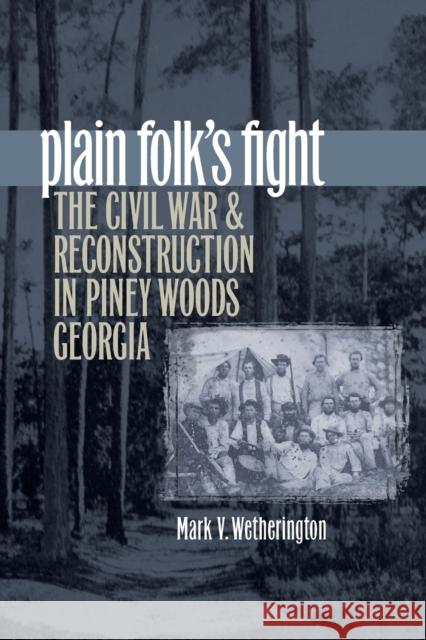
This first book-length examination of cultural change in the Georgia Pine Belt challenges the conventional view of this area as an unchanging economic backwater by examining its postbellum evolution from a self-sufficient economy to one largely dependent upon a single commercial crop - cotton. Before the Civil War, the Piney Woods easily supported a population of mostly yeomen farmers and livestock herders. After the war, a variety of external forces invaded the region, permanently altering the social, political, and economic landscape. Mark V. Wetherington's in-depth study sheds new light on...
This first book-length examination of cultural change in the Georgia Pine Belt challenges the conventional view of this area as an unchanging economic...
In an examination of the effects of the Civil War on the rural Southern home front, Mark V. Wetherington looks closely at the experiences of white "plain folk--mostly yeoman farmers and craftspeople--in the wiregrass region of southern Georgia before, during, and after the war. Although previous scholars have argued that common people in the South fought the battles of the region's elites, Wetherington contends that the plain folk in this Georgia region fought for their own self-interest.
Plain folk, whose communities were outside areas in which slaves were the majority of the...
In an examination of the effects of the Civil War on the rural Southern home front, Mark V. Wetherington looks closely at the experiences of white "pl...