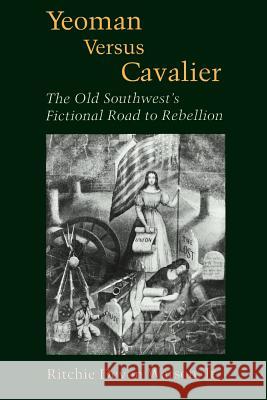
In Yeoman Versus Cavalier: The Old Southwest's Fictional Road to Rebellion, Ritchie Devon Watson, Jr., examines the emergence of the planter-aristocrat over the yeoman as the dominant cultural icon in the newly settled states of the Old Southwest -- Kentucky, Tennessee, Alabama, Mississippi, Louisiana, and Arkansas -- during the first half of the nineteenth century. He related this region's shift in cultural ideals, as reflected in its literature, both to the coming of the Civil War and the failure of the postbellum South to reintegrate itself fully into the nation.
In the early 1800s...
In Yeoman Versus Cavalier: The Old Southwest's Fictional Road to Rebellion, Ritchie Devon Watson, Jr., examines the emergence of the planter-aristo...
When Representative Preston Brooks of South Carolina savagely caned Senator Charles Sumner Massachusetts on the floor of the U.S. Senate on May 21, 1856, southerners viewed the attack as a triumphant affirmation of southern chivalry, northerners as a confirmation of southern barbarity. Public opinion was similarly divided nearly three-and-a-half years later after abolitionist John Brown's raid on the Federal arsenal at Harper's Ferry, Virginia, with northerners crowning John Brown as a martyr to the cause of freedom as southerners excoriated him as a consciousness fanatic. These events...
When Representative Preston Brooks of South Carolina savagely caned Senator Charles Sumner Massachusetts on the floor of the U.S. Senate on May 21,...