Geoarchaeological studies can significantly enhance interpretations of human prehistory by allowing archaeologists to decipher from sediments and soils the effects of earth processes on the evidence of human activity. While a number of previous books have provided broad geographic and temporal treatments of geoarchaeology, this new volume presents a single author's view intended for North American archaeologists. Waters deals with those aspects of geoarchaeology--stratigraphy, site formation processes, and landscape reconstruction--most fundamental to archaeology, and he focuses on the...
Geoarchaeological studies can significantly enhance interpretations of human prehistory by allowing archaeologists to decipher from sediments a...
MICHAEL. WATERS is the principal author of this work and served as the head of the research team. He is a professor of anthropology and geography at Texas A&M University and is Associate Director of the Center for the Study of the First Americans What Readers Are Saying: "It is well written, engaging, and original . . . will fill an important gap in our knowledge of World War Two on the homefront . . . Waters' book is the only book to examine the history of a single camp, and that in Texas, complete with interviews with former prisoners, guards, and local townspeople. Even more important,...
MICHAEL. WATERS is the principal author of this work and served as the head of the research team. He is a professor of anthropology and geography at T...
Some 13,000 years ago, humans were drawn repeatedly to a small valley in what is now Central Texas, near the banks of Buttermilk Creek. These early hunter-gatherers camped, collected stone, and shaped it into a variety of tools they needed to hunt game, process food, and subsist in the Texas wilderness. Their toolkit included bifaces, blades, and deadly spear points. Where they worked, they left thousands of pieces of debris, which have allowed archaeologists to reconstruct their methods of tool production. Along with the faunal material that was also discarded in their prehistoric...
Some 13,000 years ago, humans were drawn repeatedly to a small valley in what is now Central Texas, near the banks of Buttermilk Creek. These early...
Kelly E. Graf Caroline V. Ketron Michael R. Waters
As research continues on the earliest migration of modern humans into North and South America, the current state of knowledge about these first Americans is continually evolving. Especially with recent advances in human genomic studies, both of living populations and ancient skeletal remains, new light is being shed in the ongoing quest toward understanding the full complexity and timing of prehistoric migration patterns. Paleoamerican Odyssey collects thirty-one studies presented at the 2013 conference by the same name, hosted in Santa Fe, New Mexico, by the Center for the Study of the...
As research continues on the earliest migration of modern humans into North and South America, the current state of knowledge about these first Americ...
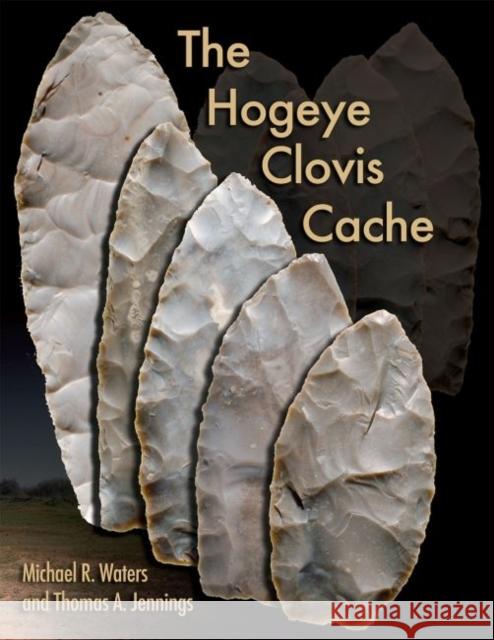
Roughly thirteen thousand years ago, Clovis hunters cached more than fifty projectile points, preforms, and knives at the toe of a gentle slope near present-day Elgin, Bastrop County, in central Texas. Over the next millennia, deposition buried the cache several meters below the surface. The entombed artifacts lay undisturbed until 2003. A circuitous path brought thirteen of the original thirty-seven Clovis bifaces and points through many hands before reaching the attention of Michael Waters at Texas A&M University. At the site of the original cache, Waters and coauthor Thomas A....
Roughly thirteen thousand years ago, Clovis hunters cached more than fifty projectile points, preforms, and knives at the toe of a gentle slope near p...