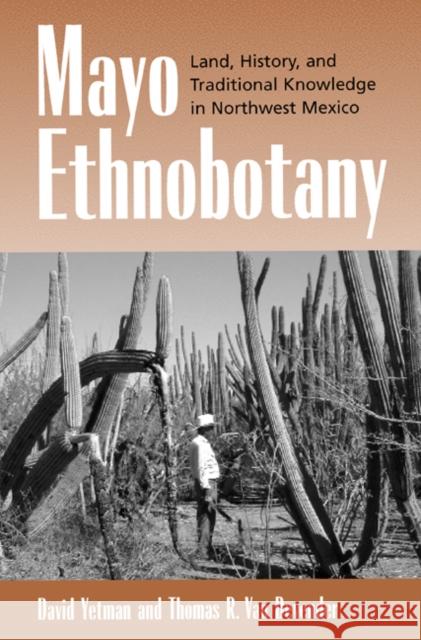
The Mayos, an indigenous people of northwestern Mexico, live in small towns spread over southern Sonora and northern Sinaloa, lands of remarkable biological diversity. Traditional Mayo knowledge is quickly being lost as this culture becomes absorbed into modern Mexico. Moreover, as big agriculture spreads into the region, the natural biodiversity of these lands is also rapidly disappearing. This engaging and accessible ethnobotany, based on hundreds of interviews with the Mayos and illustrated with the authors' strikingly beautiful photographs, helps preserve our knowledge of both an...
The Mayos, an indigenous people of northwestern Mexico, live in small towns spread over southern Sonora and northern Sinaloa, lands of remarkable biol...
The mixed grass and shrub vegetation known to scientists as desert grassland is common to the basins and valleys that skirt the mountain ranges throughout southwestern North America, extending from Arizona, New Mexico and Texas down through thirteen Mexican states. This variegated ground cover is crucial to life in an arid environment. The Desert Grassland offers the most comprehensive study to date of these flora and the rich biotic communities they support. Leading experts in geography, biology, botany, zoology, and geoscience present new research on the desert grassland and...
The mixed grass and shrub vegetation known to scientists as desert grassland is common to the basins and valleys that skirt the mountain ranges throug...
One of the most recognizable animals of the Southwest, the desert tortoise (Gopherus agassizii) makes its home in both the Sonoran and Mohave Deserts, as well as in tropical areas to the south in Mexico. Called by Tohono O'odham people "komik'c-ed," or "shell with living thing inside," it is one of the few desert creatures kept as a domestic pet as well as one of the most studied reptiles in the world. Most of our knowledge of desert tortoises comes from studies of Mohave Desert populations in California and Nevada. However, the ecology, physiology, and behavior of these...
One of the most recognizable animals of the Southwest, the desert tortoise (Gopherus agassizii) makes its home in both the Sonoran and ...
Over the past thirty years, late Quaternary environments in the arid interior of western North America have been revealed by a unique source of fossils: well-preserved fragments of plants and animals accumulated locally by packrats and quite often encased, amberlike, in large masses of crystallized urine. These packrat middens are ubiquitous in caves and rock crevices throughout the arid West, where they can lie preserved for tens of thousands of years. More than a thousand of these deposits have been dated and analyzed, and middens have supplanted pollen records as a touchstone for studying...
Over the past thirty years, late Quaternary environments in the arid interior of western North America have been revealed by a unique source of fossil...
Over the past thirty years, late Quaternary environments in the arid interior of western North America have been revealed by a unique source of fossils: well-preserved fragments of plants and animals accumulated locally by packrats and quite often encased, amberlike, in large masses of crystallized urine. These packrat middens are ubiquitous in caves and rock crevices throughout the arid West, where they can lie preserved for tens of thousands of years. More than a thousand of these deposits have been dated and analyzed, and middens have supplanted pollen records as a touchstone for studying...
Over the past thirty years, late Quaternary environments in the arid interior of western North America have been revealed by a unique source of fossil...