Gertrude and Claudius are the "villains" of Hamlet: he the killer of Hamlet's father and usurper of the Danish throne; she his lusty consort, who marries Claudius before her late husband's body is cold. But in this imaginative "prequel" to the play, John Updike makes a case for the royal couple that Shakespeare only hinted at. Gertrude and Claudius are seen afresh against a background of fond intentions and family dysfunction, on a stage darkened by the ominous shadow of a sullen, erratic, disaffected prince. "I hoped to keep the texture light," Updike said of this novel, "to move...
Gertrude and Claudius are the "villains" of Hamlet: he the killer of Hamlet's father and usurper of the Danish throne; she his lusty consor...
"In the Beauty of the Lilies" begins in 1910 and traces God s relation to four generations of American seekers, beginning with Clarence Wilmot, a clergyman in Paterson, New Jersey. He loses his faith but finds solace at the movies, respite from the bleak facts of life, his life, gutted by God s withdrawal. His son, Teddy, becomes a mailman who retreats from American exceptionalism, religious and otherwise, into a life of studied ordinariness. Teddy has a daughter, Esther, who becomes a movie star, an object of worship, an All-American goddess. Her neglected son, Clark, is possessed of a...
"In the Beauty of the Lilies" begins in 1910 and traces God s relation to four generations of American seekers, beginning with Clarence Wilmot, a cler...
Rabbit, Run is the book thatestablished John Updike as one of the major American novelists of his--or any other--generation. Its hero is Harry "Rabbit" Angstrom, a onetime high-school basketball star who on an impulse deserts his wife and son. He is twenty-six years old, a man-child caught in a struggle between instinct and thought, self and society, sexual gratification and family duty--even, in a sense, human hard-heartedness and divine Grace. Though his flight from home traces a zigzag of evasion, he holds to the faith that he is on the right path, an invisible line toward...
Rabbit, Run is the book thatestablished John Updike as one of the major American novelists of his--or any other--generation. Its hero i...
One of the signature novels of the American 1960s, Couples is a book that, when it debuted, scandalized the public with prose pictures of the way people live, and that today provides an engrossing epitaph to the short, happy life of the "post-Pill paradise." It chronicles the interactions of ten young married couples in a seaside New England community who make a cult of sex and of themselves. The group of acquaintances form a magical circle, complete with ritualistic games, religious substitutions, a priest (Freddy Thorne), and a scapegoat (Piet Hanema). As with most American utopias,...
One of the signature novels of the American 1960s, Couples is a book that, when it debuted, scandalized the public with prose pictures of the w...
In this sequel to Rabbit, Run, John Updike resumes the spiritual quest of his anxious Everyman, Harry "Rabbit" Angstrom. Ten years have passed; the impulsive former athlete has become a paunchy thirty-six-year-old conservative, and Eisenhower's becalmed America has become 1969's lurid turmoil of technology, fantasy, drugs, and violence. Rabbit is abandoned by his family, his home invaded by a runaway and a radical, his past reduced to a ruined inner landscape; still he clings to semblances of decency and responsibility, and yearns to belong and to believe.
In this sequel to Rabbit, Run, John Updike resumes the spiritual quest of his anxious Everyman, Harry "Rabbit" Angstrom. Ten years have pas...
Winner of the Pulitzer Prize, the Howells Medal, and the National Book Critics Circle Award In John Updike's fourth and final novel about Harry "Rabbit" Angstrom, the hero has acquired a Florida condo, a second grandchild, and a troubled, overworked heart. His son, Nelson, is behaving erratically; his daughter-in-law, Pru, is sending him mixed signals; and his wife, Janice, decides in midlife to return to the world of work. As, through the year of 1989, Reagan's debt-ridden, AIDS-plagued America yields to that of the first George Bush, Rabbit explores the bleak terrain...
Winner of the Pulitzer Prize, the Howells Medal, and the National Book Critics Circle Award In John Updike's fourth and final ...
As Roger Lambert tells it, he, a middle-aged professor of divinity, is buttonholed in his office by Dale Kohler, an earnest young computer scientist who believes that quantifiable evidence of God s existence is irresistibly accumulating. The theological-scientific debate that ensues, and the wicked strategies that Roger employs to disembarrass Dale of his faith, form the substance of this novel these and the current of erotic attraction that pulls Esther, Roger s much younger wife, away from him and into Dale s bed. The novel, a majestic allegory of faith and reason, ends also as a black...
As Roger Lambert tells it, he, a middle-aged professor of divinity, is buttonholed in his office by Dale Kohler, an earnest young computer scientist w...
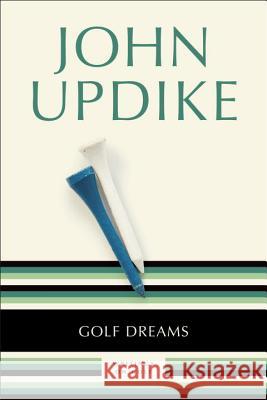
"BUBBLY AND QUIZZICAL AND LUMINOUS." --Los Angeles Times "JOYFUL . . . THE JACK NICKLAUS OF GOLF WRITING . . . The 30 entries in this collection, drawn mainly from magazine pieces, constitute a championship round. . . . This unbridled appreciation of golf's mystical opportunities for grace and redemption will enthrall even those who have never followed an 80-yard worm-burner with an elegant chip to the pin." --People "VINTAGE UPDIKE AND A RARE TREAT FOR GOLFERS." --San Francisco Chronicle "A BOOK WRITTEN UNDER A CLEAR BLUE SKY WITH AN UTTERLY PURE SWING . . . [ending]...
"BUBBLY AND QUIZZICAL AND LUMINOUS." --Los Angeles Times "JOYFUL . . . THE JACK NICKLAUS OF GOLF WRITING . . . The 30 entries in this collectio...