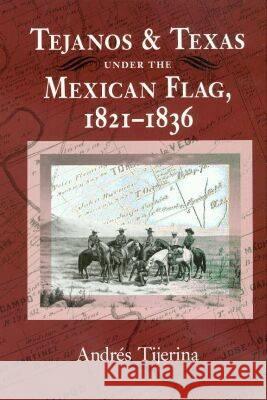
Historians have amply recorded the battles and the Anglo-Americans' military, economic, and political domination of the Mexican lands after 1836. But few studies have documented the reverse flow in the interchange while Anglo and Mexican co-existed under the Mexican flag in the previous years. Andres Tijerina's book, focusing on Texas between 1821 and 1836, provides background facts for a better understanding of the exchange of land, power, culture, and social institutions that took place between the Anglo-American frontier and the Hispanic frontier during those critical years. To be sure,...
Historians have amply recorded the battles and the Anglo-Americans' military, economic, and political domination of the Mexican lands after 1836. But ...
Elena Zamora O'Shea Leticia M. Garza-Falcon Andres Tijerina
The open country of Texas between the Nueces River and the Rio Grande was sparsely settled through the nineteenth century, and most of the settlers who did live there had Hispanic names that until recently were rarely admitted into the pages of Texas history. In 1935, however, a descendant of one of the old Spanish land-grant families in the region--a woman, no less--found an ingenious way to publish the history of her region at a time when neither Tejanos nor women had much voice. She told the story from the perspective of an ancient mesquite tree, under whose branches much South Texas...
The open country of Texas between the Nueces River and the Rio Grande was sparsely settled through the nineteenth century, and most of the settlers wh...
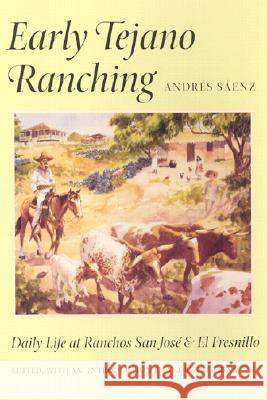
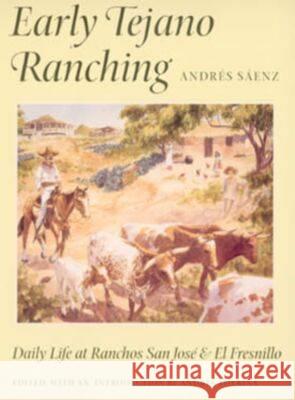
For two and a half centuries Tejanos have lived and ranched on the land of South Texas, establishing many homesteads and communities. This modest book tells the story of one such family, the Saenzes, who established Ranchos San Jose and El Fresnillo. Obtaining land grants from the municipality of Mier in the Mexican state of Tamaulipas, these settlers crossed the Wild Horse Desert, known as Desierto Muerto, into present-day Duval County in the 1850s and 1860s. Through the simple, direct telling of his family s stories, Andres Saenz lets readers learn about their homes of piedra...
For two and a half centuries Tejanos have lived and ranched on the land of South Texas, establishing many homesteads and communities. This modest book...
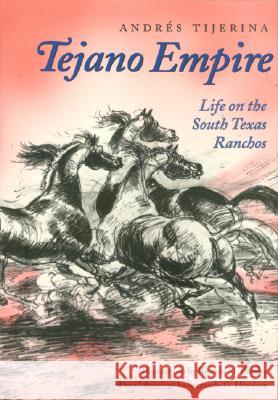
A silent story is told by the stone chimneys of South Texas that were used to prepare the Tejano ranch meals of an earlier century and by the rifle port holes still seen in crumbling walls that once protected families. It is a story of a life and culture rarely portrayed in standard historical accounts, but to some degree kept alive in literary works and ballads and revealed mutely in the material culture nineteenth-century ranchers left behind. Andres Tijerina has mined both traditional and nontraditional sources to portray the daily lives of the Texans of Mexican descent who peopled the...
A silent story is told by the stone chimneys of South Texas that were used to prepare the Tejano ranch meals of an earlier century and by the rifle po...
For two and a half centuries Tejanos have lived and ranched on the land of South Texas. This modest book tells the story of one family, the Saenzes, who established Ranchos San Jose and El Fresnillo. Obtaining land grants from the municipality of Mier in Tamaulipas, these settlers crossed the Wild Horse Desert into present-day Duval County in the 1850s and 1860s.Through the simple, direct telling of his family's stories, Andres Saenz lets readers learn about their homes of piedra (stone) and sillares (large blocks of limestone or sandstone), as well as the jacales (thatched-roof log huts) in...
For two and a half centuries Tejanos have lived and ranched on the land of South Texas. This modest book tells the story of one family, the Saenzes, w...