From Dominance to Disappearance is the first detailed history of the Indians of Texas and the Near Southwest from the late eighteenth to the middle nineteenth century, a period that began with Native peoples dominating the region and ended with their disappearance, after settlers forced the Indians in Texas to take refuge in Indian Territory. Drawing on a variety of published and unpublished sources in Spanish, French, and English, F. Todd Smith traces the differing histories of Texas's Native peoples. He begins in 1786, when the Spaniards concluded treaties with the Comanches and the...
From Dominance to Disappearance is the first detailed history of the Indians of Texas and the Near Southwest from the late eighteenth to the mi...
F. Todd Smith's new narrative picks up the story of these tribes begun in his volume The Caddo Indians: Tribes at the Convergence of Empires, 1542-1854. Their relations with the United States government, the state of Texas (whose role in Indian policy was distinctive because of its previous status as a sovereign nation), and officials of Indian Territory, as well as their ongoing struggles with other tribes similarly being forced from traditional lands, make compelling reading. Smith documents the process by which the Caddos and Wichitas increasingly lost control of their own fate and came to...
F. Todd Smith's new narrative picks up the story of these tribes begun in his volume The Caddo Indians: Tribes at the Convergence of Empires, 1542-185...
When two Wichita traders first encountered Europeans visiting the Pecos Pueblo in 1540, the Wichita tribes dominated the Southern Plains area, which stretched from Kansas to Central Texas. In the three centuries that followed, the Wichitas would be forced to negotiate with competitors, both European and Indian, for land, resources, trade, and their very survival. The Wichita Indians presents a thorough narrative of these bands from their first contact with Europeans until 1845, when the United States annexed Texas. Historian F. Todd Smith provides background information on the Wichita...
When two Wichita traders first encountered Europeans visiting the Pecos Pueblo in 1540, the Wichita tribes dominated the Southern Plains area, which s...
In 1542 members of the thriving Caddo Indian culture came face to face with Luis de Moscoso, successor to Hernando de Soto as leader of a Spanish exploration party. That encounter marked a turning point for this centuries-old people, whose history from then on would be dominated by the interaction of the native confederacies with the empires of various European adventurers and settlers.Much has been written about the confrontations of Euro-Americans with Native Americans, but most of it has focused on the Anglo-Indian relations of the eastern part of the continent or on the final phases of...
In 1542 members of the thriving Caddo Indian culture came face to face with Luis de Moscoso, successor to Hernando de Soto as leader of a Spanish expl...
From Dominance to Disappearance is the first detailed history of the Indians of Texas and the Near Southwest from the late eighteenth to the middle nineteenth century, a period that began with Native peoples dominating the region and ended with their disappearance, after settlers forced the Indians in Texas to take refuge in Indian Territory. Drawing on a variety of published and unpublished sources in Spanish, French, and English, F. Todd Smith traces the differing histories of Texas's Native peoples. He begins in 1786, when the Spaniards concluded treaties with the Comanches and the...
From Dominance to Disappearance is the first detailed history of the Indians of Texas and the Near Southwest from the late eighteenth to the middle ni...
Bound together by social, demographic, and economic commonalities, the territory extending from East Texas to West Florida occupies a unique space in early American history. A masterful synthesis of two decades of scholarly work, F. Todd Smith's Louisiana and the Gulf South Frontier, 1500-1821 examines the region's history from the eve of European colonization to the final imposition of American hegemony.
The agricultural richness of the Gulf Coast gave rise to an extraordinarily diverse society: development of food crops rendered local indigenous groups wealthier and more powerful than...
Bound together by social, demographic, and economic commonalities, the territory extending from East Texas to West Florida occupies a unique space ...
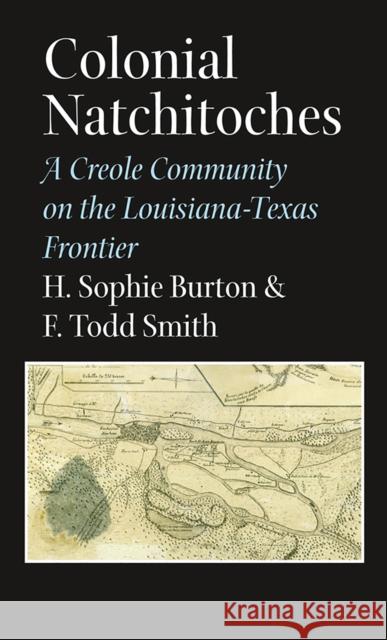
Strategically located at the western edge of the Atlantic World, the French post of Natchitoches thrived during the eighteenth century as a trade hub between the well-supplied settlers and the isolated Spaniards and Indians of Texas. Its critical economic and diplomatic role made it the most important community on the Louisiana-Texas frontier during the colonial era. Despite the community's critical role under French and then Spanish rule, Colonial Natchitoches is the first thorough study of its society and economy. Founded in 1714, four years before New Orleans, Natchitoches developed a...
Strategically located at the western edge of the Atlantic World, the French post of Natchitoches thrived during the eighteenth century as a trade hub ...