On March29, Grant opened the Ap-pomattox campaign, informing Sheridan that "I now feel like ending the matter." Despite pleas to cancel the offensive because of adverse weather, Grant pressed ahead. Sheridan won the battle of Five Forks on April 1, and the next day Grant overran Lee's lines at Petersburg, forcing the evacuation of Richmond. Grant's mastery was never more appar-ent than during his last battle. "I shall press the pursuit to the end," he wrote to Sherman, and by April 19 Lee had to choose between capitulation or annihila-tion. With the surrender at...
On March29, Grant opened the Ap-pomattox campaign, informing Sheridan that "I now feel like ending the matter." Despite pleas to cance...
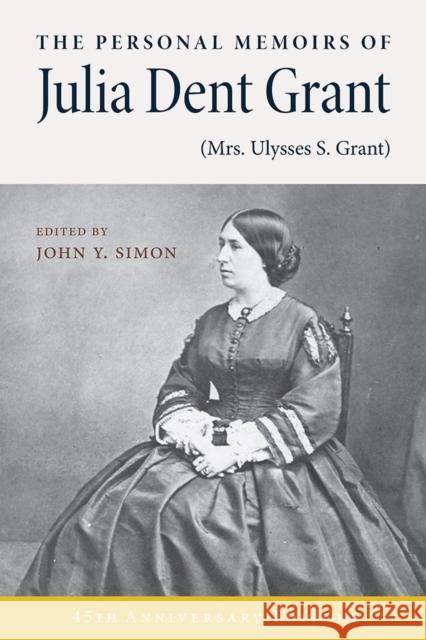
Julia Dent Grant wrote her reminiscences with the vivacity and charm she exhibited throughout her life, telling her story in the easy flow of an afternoon conversation with a close friend. Mrs. Grant was raised the pampered daughter of a Missouri planter, and she later remembered her girlhood as an idyll that she wished could have lasted.
Many of the anecdotes she relates give fascinating glimpses into a very troubled period of American history. A dramatic reminiscence recounts the night that Lincoln was assassinated. Mrs. Grant insisted that she and her husband turn down an...
Julia Dent Grant wrote her reminiscences with the vivacity and charm she exhibited throughout her life, telling her story in the easy flow of an af...
This volume provides material that will allow a fresh evaluation of Grant's activities following Appomattox.
In April Grant commanded an army of more than 1,000,000 men maintained at enormous cost. Disbanding this army took priority. By mid-July, more than two-thirds of the volunteers had been mustered out.
Grant as peacemaker exerted his power to protect his former adversaries. He opposed prosecuting Southern military leaders, including Robert E. Lee and others who had been indicted for treason. The South had to accept defeat, but Grant was no believer in a Carthaginian...
This volume provides material that will allow a fresh evaluation of Grant's activities following Appomattox.
Although Ulysses S. Grant is best remembered as Civil War commander and as president, documents included here demonstrate his importance in the intervening years. Grant interpreted Reconstruction as the means to preserve battlefield victories. He avoided taking a public stand in the bitter dispute between President Andrew Johnson and Congress because he believed that military men served the country, not partisan interests. Nevertheless, he recognized that presidential Reconstruction had failed and privately supported passage of the First Reconstruction Act.
Grant's public silence on...
Although Ulysses S. Grant is best remembered as Civil War commander and as president, documents included here demonstrate his importance in the int...
In spite of his public silence, Grant was caught in the dispute between Congress and President Andrew Johnson. His position became intolerable after Johnson publicly accused Grant of dishonesty.
The same sense of duty that sent Grant to war in 1861 gave him no alternative to accepting the Republican nomination. "I could back down without, as it seems to me, leaving the contest for power for the next four years between mere trading politicians, the elevation of whom, no matter which party won, would lose to us, largely, the results of the costly war which we have gone through." From...
In spite of his public silence, Grant was caught in the dispute between Congress and President Andrew Johnson. His position became intolerable afte...
John A. Logan, called "Black Jack" by the men he led in Civil War battles from the Henry-Donelson campaign to Vicksburg, Chattanooga, and on to Atlanta, was one of the Union Army s most colorful generals.
James Pickett Jones places Logan in his southern Illinois surroundings as he examines the role of the political soldier in the Civil War. When Logan altered his stance on national issues, so did the southern part of the state. Although secession, civil strife, Copperheadism, and the new attitudes created by the war contributed to this change of position in southern Illinois, Logan...
John A. Logan, called "Black Jack" by the men he led in Civil War battles from the Henry-Donelson campaign to Vicksburg, Chattanooga, and on to Atl...
When the Civil War erupted in April 1861, many German immigrants in Illinois rushed to enlist in the Union Army. Volunteers from Illinois towns in St. Clair CountyBelleville, Millstadt, Mascoutah, Lebanon, and othersmarched to Springfield under the command of August Mersy, a veteran of the failed 1848 revolt in Baden, Germany.
Marion Morrison notes that when the German immigrants reached Springfield, August Mersy was rejected as commander because of his limited facility with English. Replaced by Colonel Eleazer A. Paine, an Ohioan and West Point graduate, Lieutenant Colonel Mersy fell to...
When the Civil War erupted in April 1861, many German immigrants in Illinois rushed to enlist in the Union Army. Volunteers from Illinois towns in ...
This is Marion Morrison's account of the Bloody Ninth, the Ninth Regiment Illinois Volunteer Infantry who found themselves in the thick of battle, bearing the brunt of the Confederate attempt at Fort Donelson to break Grant's siege lines.
This is Marion Morrison's account of the Bloody Ninth, the Ninth Regiment Illinois Volunteer Infantry who found themselves in the thick of battle, bea...
A high-spirited idealist who craved excitement when he enlisted in the Eighth Illinois Volunteers for three months and reenlisted for three years, Charles W. Wills of Canton, Illinois, wrote frequently to his sister Mary Emily Wills and kept a diary of General William T. Sherman s campaigns during the last year of the war. In the beginning of his service, Wills could boast that his company refused to enlist "roughs." He reported that he and his comrades "drink no liquors and keep ourselves as cleanly as possible.... Almost all are reading or writing, and I defy anyone to find "75 "men...
A high-spirited idealist who craved excitement when he enlisted in the Eighth Illinois Volunteers for three months and reenlisted for three years, ...
"To tell my own story is to tell that of my famous husband, General John A. Logan," explains Mary S. Logan in the preface to her autobiography.
Married to John A. Logan for thirty-one years, Mary Logan shared in her distinguished husband s career as a prosecutor in southern Illinois, as a Civil War general, and as a senator from Illinois. She observed firsthand the extraordinary events before, during, and after the Civil War, and she knew personally those world leaders who held the power to shape history. After the death of her husband, she maintained her influence in Washington, D.C....
"To tell my own story is to tell that of my famous husband, General John A. Logan," explains Mary S. Logan in the preface to her autobiography.