Originally a presidio on the frontier of New Spain, Tucson was a Mexican community before the arrival of Anglo settlers. Unlike most cities in California and Texas, Tucson was not initially overwhelmed by Anglo immigrants, so that even until the early 1900s Mexicans made up a majority of the town's population. Indeed, it was through the efforts of Mexican businessmen and politicians that Tucson became a commercial center of the Southwest.Los Tucsonenses celebrates the efforts of these early entrepreneurs as it traces the Mexican community's gradual loss of economic and political...
Originally a presidio on the frontier of New Spain, Tucson was a Mexican community before the arrival of Anglo settlers. Unlike most cities in ...
Within these pages are living portraits of fifteen Native American groups of Arizona and northern Mexico. Literally and figuratively, the paths they walk are the same paths walked by their ancestors, going back hundreds and even thousands of years.
Within these pages are living portraits of fifteen Native American groups of Arizona and northern Mexico. Literally and figuratively, the paths they w...
Acclaimed by readers and reviewers alike, the first volume of The Presidio and Militia on the Northern Frontier of New Spain was a landmark in the documentary study of seventeenth-century Spanish Colonial Mexico. Here, Charles W. Polzer and Thomas E. Sheridan bring the same incisive scholarship and careful editing to long-awaited Volume Two, covering the years 1700-1765.The two-part second volume looks at the Spanish expansion as occurring in four north-south corridors that carried the main components of social and political activity. Divided geographically, materials in this book...
Acclaimed by readers and reviewers alike, the first volume of The Presidio and Militia on the Northern Frontier of New Spain was a landmark in ...
Thomas Sheridan's study of the municipio of Cucurpe, Sonora, offers new insight into the ability of peasants to respond to ecological and political change. In order to survive as small rancher-farmers, the Cucurpenos battle aridity and one another in a society characterized by sharp economic inequality and long-standing conflict over the distribution of land and water. Sheridan has written an ethnography of resource control, one that weds the approaches of political economy and cultural ecology in order to focus upon both the external linkages and internal adaptations that shape three...
Thomas Sheridan's study of the municipio of Cucurpe, Sonora, offers new insight into the ability of peasants to respond to ecological and polit...
From the earliest days of their empire in the New World, the Spanish sought to gain control of the native peoples and lands of what is now Sonora. While missionaries were successful in pacifying many Indians, the Seris--independent groups of hunter-gatherers who lived on the desert shores and islands of the Gulf of California--steadfastly defied Spanish efforts to subjugate them. "Empire of Sand" is a documentary history of Spanish attempts to convert, control, and ultimately annihilate the Seris. These papers of religious, military, and government officials attest to the Seris' resilience in...
From the earliest days of their empire in the New World, the Spanish sought to gain control of the native peoples and lands of what is now Sonora. Whi...
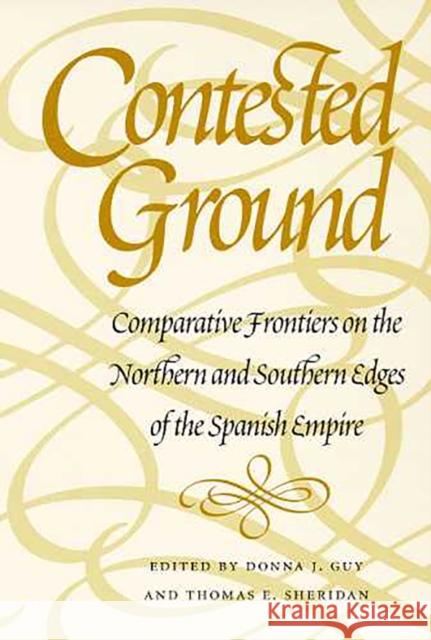
The Spanish empire in the Americas spanned two continents and a vast diversity of peoples and landscapes. Yet intriguing parallels characterized conquest, colonization, and indigenous resistance along its northern and southern frontiers, from the role played by Jesuit missions in the subjugation of native peoples to the emergence of livestock industries, with their attendant cowboys and gauchos and threats of Indian raids. In this book, nine historians, three anthropologists, and one sociologist compare and contrast these fringes of New Spain between 1500 and 1880, showing that in each...
The Spanish empire in the Americas spanned two continents and a vast diversity of peoples and landscapes. Yet intriguing parallels characterize...
Hailed as a model state history thanks to Thomas E. Sheridan's thoughtful analysis and lively interpretation of the people and events shaping the Grand Canyon State, Arizona has become a standard in the field. Now, just in time for Arizona's centennial, Sheridan has revised and expanded this already top-tier state history to incorporate events and changes that have taken place in recent years. Addressing contemporary issues like land use, water rights, dramatic population increases, suburban sprawl, and the US-Mexico border, the new material makes the book more essential than ever....
Hailed as a model state history thanks to Thomas E. Sheridan's thoughtful analysis and lively interpretation of the people and events shaping the ...
The Devil s Highway El Camino del Diablo crosses hundreds of miles and thousands of years of Arizona and Southwest history. This heritage trail follows a torturous route along the U.S. Mexico border through a lonely landscape of cactus, desert flats, drifting sand dunes, ancient lava flows, and searing summer heat. The most famous waterhole along the way is Tinajas Altas, or High Tanks, a series of natural rock basins that are among the few reliable sources of water in this notoriously parched region. Now an expert cast of authors describes, narrates, and explains the human and natural...
The Devil s Highway El Camino del Diablo crosses hundreds of miles and thousands of years of Arizona and Southwest history. This heritage trail follow...
News headlines would often have us believe that conservationists are inevitably locked in conflict with the people who live and work on the lands they seek to protect. Not so. Across the western expanses of the United States, conservationists, ranchers, and forest workers are bucking preconceptions to establish common ground. As they join together to protect the wide open spaces, diverse habitats, and working landscapes upon which people, plants, and animals depend, a new vision of management is emerging in which the conservation of biodiversity, ecosystem integrity, and sustainable resource...
News headlines would often have us believe that conservationists are inevitably locked in conflict with the people who live and work on the lands they...
News headlines would often have us believe that conservationists are inevitably locked in conflict with the people who live and work on the lands they seek to protect. Not so. Across the western expanses of the United States, conservationists, ranchers, and forest workers are bucking preconceptions to establish common ground. As they join together to protect the wide open spaces, diverse habitats, and working landscapes upon which people, plants, and animals depend, a new vision of management is emerging in which the conservation of biodiversity, ecosystem integrity, and sustainable resource...
News headlines would often have us believe that conservationists are inevitably locked in conflict with the people who live and work on the lands they...