"Bob Cover was and remains the dominant voice of his generation among legal scholars. These essays, each one magnificent in itself, are, when taken together, even more important. The wisdom they impart is forever." --Guido Calabresi, Dean and Sterling Professor of Law, Yale University "Robert Cover drew his sources for the authority of law--for its violence, but also for its paideic potential--from the structuring stories that spark our communal imaginations. Literally until the day of his untimely death, his irreplaceably restless spirit was binding itself with the pages of the Midrash,...
"Bob Cover was and remains the dominant voice of his generation among legal scholars. These essays, each one magnificent in itself, are, when taken to...
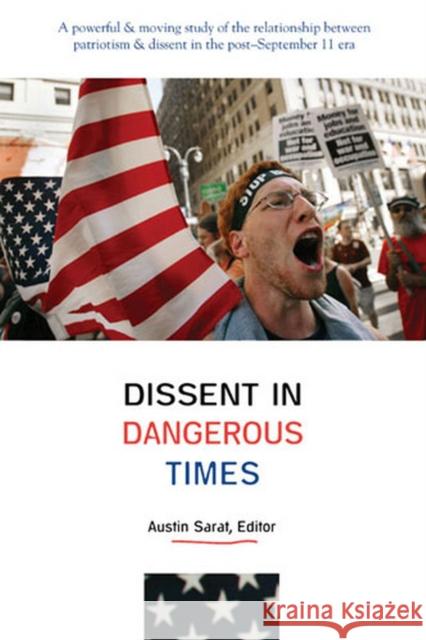
Dissent in Dangerous Times presents essays by six distinguished scholars, who provide their own unique views on the interplay of loyalty, patriotism, and dissent. While dissent has played a central role in our national history and in the American cultural imagination, it is usually dangerous to those who practice it, and always unpalatable to its targets. War does not encourage the tolerance of opposition at home any more than it does on the front: if the War on Terror is to be a permanent war, then the consequences for American political freedoms cannot be overestimated....
Dissent in Dangerous Times presents essays by six distinguished scholars, who provide their own unique views on the interplay of loyalty, patri...
"Sarat and Kearns . . . have edited a truly marvelous work on the impact of the law on daily life and vice versa. . . . the essays are all exemplary, thought- provoking works worthy of a long, contemplative read by scholars, lawyers, and judges alike." --Choice "The subject of law in everyday life is timely in theory and in practice. The essays collected here are stimulating for the very different ways in which they reconfigure the meanings of 'the law' as cultural practice, and 'the everyday' as a cultural domain in which the state expresses a range of interests and engagements....
"Sarat and Kearns . . . have edited a truly marvelous work on the impact of the law on daily life and vice versa. . . . the essays are all exemplary, ...
Law is a profession of words. Simultaneously celebratory of great prose and dogmatically insistent on precise usage, law is a stage for verbal virtuosity, linguistic mastery, and persuasive argument. Yet the linguistic display is not without substance: the words of law take on a seriousness virtually unparalleled in any other domain of human experience. The Rhetoric of Law examines the words used in legal institutions and proceedings and explores both the literary aspect of legal life and the role of rhetoric in shaping the life of the law. The essays in The Rhetoric of Law...
Law is a profession of words. Simultaneously celebratory of great prose and dogmatically insistent on precise usage, law is a stage for verbal virtuos...
The idea of legal rights today enjoys virtually universal appeal, yet all too often the meaning and significance of rights are poorly understood. The purpose of this volume is to clarify the subject of legal rights by drawing on both historical and philosophical legal scholarship to bridge the gap between these two genres--a gap that has divorced abstract and normative treatments of rights from an understanding of their particular social and cultural contexts. Legal Rights: Historical and Philosophical Perspectives shows that the meaning and extent of rights has been dramatically...
The idea of legal rights today enjoys virtually universal appeal, yet all too often the meaning and significance of rights are poorly understood. The ...
The subject of rights occupies a central place in liberal political thought. This tradition posits that rights are entitlements of individuals by virtue of their personhood and that rights stand apart from politics, that rights in fact hold at bay intrusions of state policy. The essays in Identities, Politics, and Rights question these assumptions and examine how rights constitute us as subjects and are, at the same time, implicated in political struggles. In contrast to the liberal notion of rights' universality, these essays emphasize the context-specific nature of rights as well as...
The subject of rights occupies a central place in liberal political thought. This tradition posits that rights are entitlements of individuals by virt...
The concept of culture is troublingly vague and, at the same time, hotly contested, and law's relations to culture are as complex, varied and disputed as the concept of culture itself. The concept of the traditional, unified, reified, civilizing idea of culture has come under attack. The growth of cultural studies has played an important role in redefining culture by including popular culture and questions of social stratification, power and social conflict. Law and legal studies are relative latecomers to cultural studies. As scholars have come to see law as not something apart from...
The concept of culture is troublingly vague and, at the same time, hotly contested, and law's relations to culture are as complex, varied and disputed...
We are witnessing in the last decade of the twentieth century more frequent demands by racial and ethnic groups for recognition of their distinctive histories and traditions as well as opportunities to develop and maintain the institutional infrastructure necessary to preserve them. Where it once seemed that the ideal of American citizenship was found in the promise of integration and in the hope that none of us would be singled out for, let alone judged by, our race or ethnicity, today integration, often taken to mean a denial of identity and history for subordinated racial, gender, sexual...
We are witnessing in the last decade of the twentieth century more frequent demands by racial and ethnic groups for recognition of their distinctive h...
The essays in this book examine law as an active participant in the process through which history is written and memory is constructed. Instead of seeing law as a "victim" of history, the writers treat law as an author of history, not just in the instrumental sense in which law can be said to make a difference in society, but in the ways that law constructs and uses history. Law looks to the past as it speaks to present needs. In the production of judicial opinions--supposedly definitive statements of what the law is--judges reconstruct law's past, tracing out lines of legal precedent that...
The essays in this book examine law as an active participant in the process through which history is written and memory is constructed. Instead of see...
Today the language of human rights, if not human rights themselves, is nearly universal. Human Rights brings together essays that attend to both the allure and criticism of human rights. They examine contestation and contingency in today's human rights politics and help us rethink some of the basic concepts of human rights. Questions addressed in Human Rights include: Can national self-determination be reconciled with human rights? Can human rights be advanced without thwarting efforts to develop indigenous legal traditions? How are the forces of modernization associated with...
Today the language of human rights, if not human rights themselves, is nearly universal. Human Rights brings together essays that attend to bot...