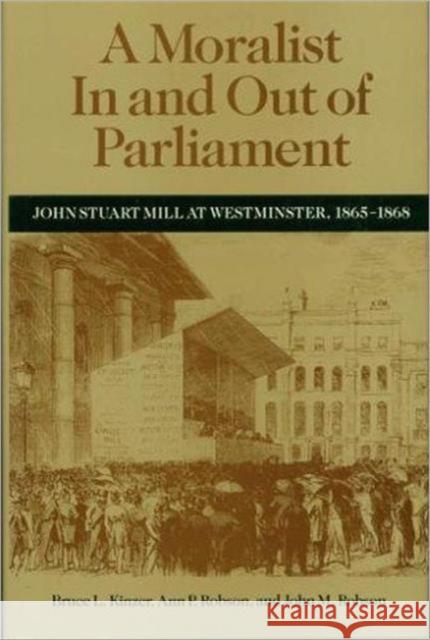
When John Stuart Mill was elected in the "blue-ribbon" liberal constituency of Westminster, there was great interest in seeing how a man of intellect would stand the practical political test. The watershed parliament of 1865-8 in which he served saw the growing polarization of politics between the new Liberal Party and the Conservatives. Mill gained greater eminence - and notoriety - by promoting women's suffrage, proportional and working-class representation, Irish land reform, and racial justice, and generall attempting to radicalize the Liberal party. But in 1868 he was defeated in...
When John Stuart Mill was elected in the "blue-ribbon" liberal constituency of Westminster, there was great interest in seeing how a man of intelle...
Benjamin Disraeli, Queen Victoria's favourite prime minister, was, in the words of Robert Blake, 'the best letter-writer among English statesmen.'
This, the latest volume in the critically acclaimed Letters of Benjamin Disraeli series, contains or describes 951 letters (784 previously unpublished) written by Disraeli between 1852 and 1856. These years cover his first cabinet post, as chancellor of the exchequer, his attempts as House leader to unify the Conservative party, and his opposition to the Crimean War, both in the House and in his newspaper, The Press....
Benjamin Disraeli, Queen Victoria's favourite prime minister, was, in the words of Robert Blake, 'the best letter-writer among English statesmen.'<...
For just over fifty years John Stuart Mill contributed articles and letters to the newspapers, setting before the public a radical position on contemporary events. From 1822 to 1873, in newspapers as widely read as The Times and the Morning Chronicle, and as narrowly circulated as the True Sun and the New Times, he praised his friends and damned his opponents, while commenting on a while range of issues at home and abroad, from banking to Ireland, from wife-beating to land nationalization.
His main series of newspaper writings concerned France...
For just over fifty years John Stuart Mill contributed articles and letters to the newspapers, setting before the public a radical position on cont...
Benjamin Disraeli (1804-81) was one of the most important figures in nineteenth-century Europe, spending three decades in British government and twice serving as prime minister. This volume collects 556 of Disraeli's letters from a tumultuous period in European history - years that witnessed the Italian revolution, the Polish revolt against Russia, anxiety about Napoleon III's intentions in Europe, and the American Civil War.
The letters, of which more than four hundred have never before been published, provide revealing insights into Disraeli's thoughts on political and social...
Benjamin Disraeli (1804-81) was one of the most important figures in nineteenth-century Europe, spending three decades in British government and tw...
For just over fifty years John Stuart Mill contributed articles and letters to the newspapers, setting before the public a radical position on contemporary events. From 1822 to 1873, in newspapers as widely read as The Times and the Morning Chronicle, and as narrowly circulated as the True Sun and the New Times, he praised his friends and damned his opponents, while commenting on a while range of issues at home and abroad, from banking to Ireland, from wife-beating to land nationalization.
His main series of newspaper writings concerned France...
For just over fifty years John Stuart Mill contributed articles and letters to the newspapers, setting before the public a radical position on cont...