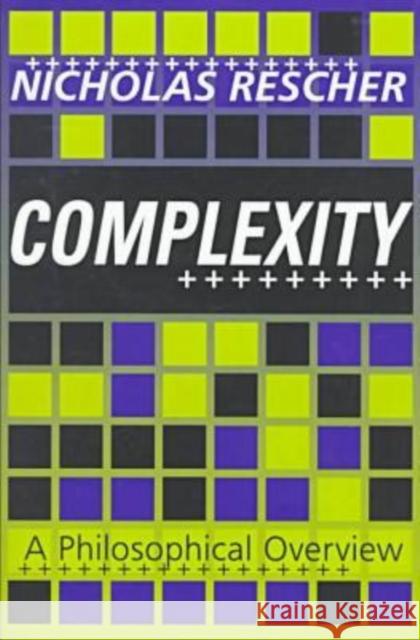
Our world is enormously sophisticated and nature's complexity is literally inexhaustible. As a result, projects to describe and explain natural science can never be completed. This volume explores the nature of complexity and considers its bearing on our world and how we manage our affairs within it.
Rescher's overall lesson is that the management of our affairs within a socially, technologically, and cognitively complex environment is plagued with vast management problems and risks of mishap. In primitive societies, failure to understand how things work can endanger a family or, at...
Our world is enormously sophisticated and nature's complexity is literally inexhaustible. As a result, projects to describe and explain natural sci...
The aim of the book is to introduce the reader to some new areas oflogic which have yet to find their way into the bulk of modern logic books written from the more orthodox direction of the mainstream of develop- ments. Such a work seems to me much needed, both because of the in- trinsic value and increasing prominence of the nonstandard sector of logic, and because this particular sector is of the greatest interest from the standpoint of philosophical implications and applications. This book unites a series of studies in philosophical logic, drawing for the most part on material which I have...
The aim of the book is to introduce the reader to some new areas oflogic which have yet to find their way into the bulk of modern logic books written ...
The eminent philosopher of science Carl G. Hempel, Stuart Professor of Philosophy at Princeton University and a Past President of the American Philosophical Association, has had a long and distinguished academic career in the course of which he has been professorial mentor to some of America's most distinguished philosophers. This volume gathers together twelve original papers by Hempel's students and associates into a volume intended to do homage to Hempel on the occasion of his 65th year in 1970. The papers are grouped around the unifying topic of Hempel's own interests in logic and...
The eminent philosopher of science Carl G. Hempel, Stuart Professor of Philosophy at Princeton University and a Past President of the American Philoso...
The essays included in this volume are a mixture of old and new. Three of them make their first appearance in print on this occa- sion (Nos III, IV, and V). The remaining four are based upon materials previously published in learned journals or anthologies. (However, these previously published papers have been revised and, generally, expanded for inclusion here.) Detailed acknowl- edgement of prior publications is made in the notes to the relevant articles. I am grateful to the editors of these several publications for their kind permission to use this material. I am grateful to an anonymous...
The essays included in this volume are a mixture of old and new. Three of them make their first appearance in print on this occa- sion (Nos III, IV, a...
No short book on the explanation of existence can afford the hubris of claiming to accomplish this task. And certainly no such claim can be or is being made here. What is at issue is not--and cannot be--an actual explanation. Rather, what is attempted here is at the very most a rough sketch of the conceptual architecture that an adequate explanation can be expected to exhibit. No more is achieved than a rough and general indication of the direction in which a satisfactory explanation can unfold. A vast amount of detail will have to be filled in to provide a tenable explanation. Only the...
No short book on the explanation of existence can afford the hubris of claiming to accomplish this task. And certainly no such claim can be or is b...
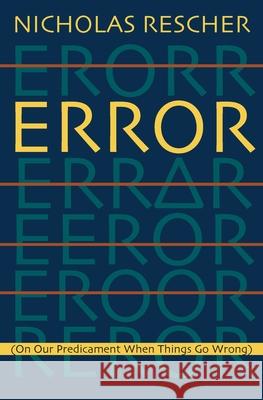
In Error, Nicholas Rescher presents a fresh analysis of the occurrence, causality, and consequences of error in human thought, action, and evaluation. Rescher maintains that error-avoidance and truth-achievement are distinct but equally important factors for rational inquiry, and that error is inherent in the human cognitive process (to err is human). He defines three main categories of error: cognitive (failure to realize truths); practical (failure related to the objective of an action); and axiological (failure in evaluation), and articulates the factors that contribute to each....
In Error, Nicholas Rescher presents a fresh analysis of the occurrence, causality, and consequences of error in human thought, action, and ...
This volume is a reassessment of free will and, as such, seeks to answer the question: Do humans ever act under the guidance of the will? To determine if humans have free will, Rescher first examines what exactly free will is and how it should function. While the literature on the subject of free will is vast, a good deal still remains to be done to avert obscurity and confusion. Rescher leads the reader through a conceptual web of distinctions that, taken together, provide a satisfying contribution to philosophical thought on free will in general.
Rescher sharpens his highly...
This volume is a reassessment of free will and, as such, seeks to answer the question: Do humans ever act under the guidance of the will? To determ...
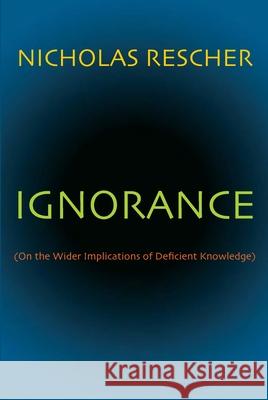
Historically, there has been great deliberation about the limits of human knowledge. Isaac Newton, recognizing his own shortcomings, once described himself as "a boy standing on the seashore . . . whilst the great ocean of truth lay all underscored before me."
In Ignorance, Nicholas Rescher presents a broad-ranging study that examines the manifestations, consequences, and occasional benefits of ignorance in areas of philosophy, scientific endeavor, and ordinary life. Citing philosophers, theologians, and scientists from Socrates to Steven Hawking, Rescher seeks to uncover the...
Historically, there has been great deliberation about the limits of human knowledge. Isaac Newton, recognizing his own shortcomings, once described...
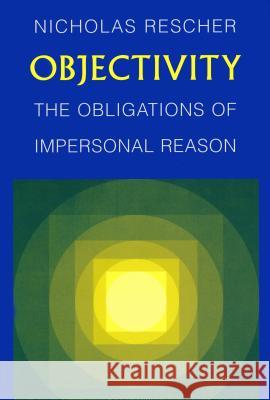
This work argues the case for restoring objectivity to a place of prominence in philosphic and social discourse. By tracing the source of objectivity back to the core of rationality itself, it locates objectivity's reason for being deep in our nature as rational animals.
This work argues the case for restoring objectivity to a place of prominence in philosphic and social discourse. By tracing the source of objectivity ...
The word apory stems from the Greek aporia, meaning impasse or perplexing difficulty. In Aporetics, Nicholas Rescher defines an apory as a group of individually plausible but collectively incompatible theses. Rescher examines historic, formulaic, and systematic apories and couples these with aporetic theory from other authors to form this original and comprehensive survey. Citing thinkers from the pre-Socratics through Spinoza, Hegel, and Nicolai Hartmann, he builds a framework for coping with the complexities of divergent theses, and shows in detail how aporetic analysis can be...
The word apory stems from the Greek aporia, meaning impasse or perplexing difficulty. In Aporetics, Nicholas Rescher defines an apory as a gro...