The Akimel O'odham, or Pima Indians, of the northern Sonoran Desert continue to make their home along Arizona's Gila River despite the alarming degradation of their habitat that has occurred over the past century. The oldest living Pimas can recall a lush riparian ecosystem and still recite more than two hundred names for plants in their environment, but they are the last generation who grew up subsisting on cultivated native crops or wild-foraged plants. Ethnobiologist Amadeo M. Rea has written the first complete ethnobotany of the Gila River Pima and has done so from the perspective...
The Akimel O'odham, or Pima Indians, of the northern Sonoran Desert continue to make their home along Arizona's Gila River despite the alarmin...
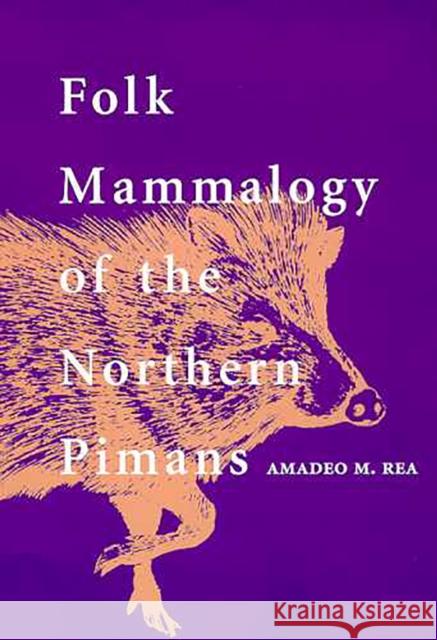
Knowledge held about animals by Pima-speaking Native Americans of Arizona and northwest Mexico is intimately entwined with their way of life--a way that is fading from memory as beavers and wolves vanish also from the Southwest. Ethnobiologist Amadeo Rea has conducted extensive fieldwork among the Northern Pimans and here shares what these people know about mammals and how mammals affect their lives. Rea describes the relationship of the River Pima, Tohono O'odham (Papago), Pima Bajo, and Mountain Pima to the furred creatures of their environment: how they are named and...
Knowledge held about animals by Pima-speaking Native Americans of Arizona and northwest Mexico is intimately entwined with their way of life--a...
There is a common but often unspoken arrogance on the part of outside observers that folk science and traditional knowledge the type developed by Native communities and tribal groups is inferior to the formal science practiced by Westerners. In this lucidly written and humanistic account of the O odham tribes of Arizona and Northwest Mexico, ethnobiologist Amadeo M. Rea exposes the limitations of this assumption by exploring the rich ornithology that these tribes have generated about the birds that are native to their region. He shows how these peoples observational knowledge provides...
There is a common but often unspoken arrogance on the part of outside observers that folk science and traditional knowledge the type developed by Nati...
The Akimel O'odham, or Pima Indians, of the northern Sonoran Desert continue to make their home along Arizona's Gila River despite the alarming degradation of their habitat that has occurred over the past century. The oldest living Pimas can recall a lush riparian ecosystem and still recite more than two hundred names for plants in their environment, but they are the last generation who grew up subsisting on cultivated native crops or wild-foraged plants. Ethnobiologist Amadeo M. Rea has written the first complete ethnobotany of the Gila River Pima and has done so from the perspective...
The Akimel O'odham, or Pima Indians, of the northern Sonoran Desert continue to make their home along Arizona's Gila River despite the alarmin...
Like many rivers of the arid Southwest, the Gila is for much of its length a dry bed except after seasonal rains. Yet a mere century ago it hosted a thriving biological community, and two centuries ago American Indians fished from its banks. It is no mystery how the desert swallowed up the Gila. Beaver trapping, overgrazing, and woodcutting first ruined natural watersheds, then damming confined the last drops of its surface flow. Historical sources and archaeological data inform us of the Gila's past, but its bird life further testifies to the changes. Amadeo Rea traces the decline...
Like many rivers of the arid Southwest, the Gila is for much of its length a dry bed except after seasonal rains. Yet a mere century ago it hosted a t...