A New York Times Notable Book "In an era of jet tourism, Jonathan Raban] remains a traveler-adventurer in the tradition of . . . Robert Louis Stevenson." --The New York Times Book Review In 1782 an immigrant with the high-toned name J. Hector St. John de Crevecoeur--"Heartbreak" in English--wrote a pioneering account of one European's transformation into an American. Some two hundred years later Jonathan Raban, winner of the National Book Critics Circle Award, arrived in Crevecoeur's wake to see how America has paid off for succeeding generations of newcomers. The result is...
A New York Times Notable Book "In an era of jet tourism, Jonathan Raban] remains a traveler-adventurer in the tradition of . . . Robert Louis...
From Jonathan Raban, the award--winning author of Bad Land and Passage to Juneau, comes this quirky and insightful story of what can happen when one can and does go home again. For the past thirty years, George Grey has been a ship bunker in the fictional west African nation of Montedor, but now he's returning home to England-to a daughter who's a famous author he barely knows, to a peculiar new friend who back in the sixties was one of England's more famous singers, and to the long and empty days of retirement during which he's easy prey to the melancholy of memories, all the more acute...
From Jonathan Raban, the award--winning author of Bad Land and Passage to Juneau, comes this quirky and insightful story of what can happen when one c...
A New York Times Editors' Choice for Book of the Year Winner of the Pacific Northwest Booksellers Award Winner of the PEN West Creative Nonfiction Award
"No one has evoked with greater power the marriage of land and sky that gives this country both its beauty and its terror. " --Washington Post Book World In 1909 maps still identified eastern Montana as the Great American Desert. But in that year Congress, lobbied heavily by railroad companies, offered 320-acre tracts of land to anyone bold or foolish enough to stake a claim to them. Drawn by shamelessly inventive brochures,...
A New York Times Editors' Choice for Book of the Year Winner of the Pacific Northwest Booksellers Award Winner of the PEN West Creative Nonficti...
With the same rigorous observation (natural and social), invigorating stylishness, and encyclopedic learning that he brought to his National Book Award-winning Bad Land, Jonathan Raban conducts readers along the Inside Passage from Seattle to Juneau. The physical distance is 1,000 miles of difficult-and often treacherous-water, which Raban navigates solo in a 35-foot sailboat. But Passage to Juneau also traverses a gulf of centuries and cultures: the immeasurable divide between the Northwest's Indians and its first European explorers-- between its embattled fishermen and...
With the same rigorous observation (natural and social), invigorating stylishness, and encyclopedic learning that he brought to his National Book Awar...
Moving, exquisitely written and hugely entertaining, Waxwings captures the landscape and life of contemporary America, confirming Jonathan Raban as one of our very finest writers
Moving, exquisitely written and hugely entertaining, Waxwings captures the landscape and life of contemporary America, confirming Jonathan Raban as on...
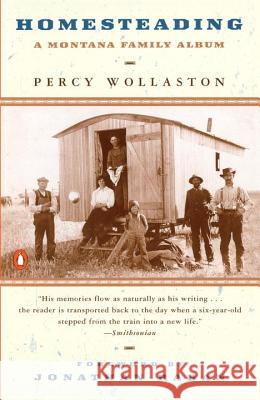
"His memories flow as naturally as his writing. . . . The reader is transported back to the day when a six-year-old stepped from the train into a new life."--Smithsonian As a grown man, Percy Wollaston almost never spoke of the homestead where he grew up--until, in 1972, nearing the age of 70, he wrote this book about his childhood years. Lured by the government's promise of land and the promotional literature of the railroads, six-year-old Percy Wollaston's family left behind their home in North Dakota in 1909, heading West to "take up a claim." They settled near Ismay,...
"His memories flow as naturally as his writing. . . . The reader is transported back to the day when a six-year-old stepped from the train into a new ...