This volume of essays celebrates poetry that aims to change the world, whether through engagement with political issues, reimagining the meanings of love, recasting our relationship with nature; or through new relationships with our spiritual traditions. Alicia Ostriker's opening essay, defining the difference between poetry and propaganda, surveys the artistic accomplishments of the women's poetry movement. Succeeding essays explore the meaning of politics, love, and the spiritual life in the work of Walt Whitman, Elizabeth Bishop, Sharon Olds, Maxine Kumin, Lucille Clifton, and Allen...
This volume of essays celebrates poetry that aims to change the world, whether through engagement with political issues, reimagining the meanings of l...
What happens when women writers re-imagine culture? How do feminists need that ur-text of patriarchy, the Bible? Unwritten volume: Re-thinking teh Bible attempts to re-think certain customary assumptions about feminism and about the Bible, in the light of poetic "readings" of biblical texts by 19th and 20th century women writers. The author proposes that women writers relate to the Bible in complex ways, which both critique biblical misogyny and stem directly from elements of transgressive writing within scripture iteself. Ultimately Ostriker suggests that feminist reinterpretations of...
What happens when women writers re-imagine culture? How do feminists need that ur-text of patriarchy, the Bible? Unwritten volume: Re-thinking teh Bib...
A meditation on the key narratives of the Hebrew Bible, this book includes characters of the Old Testament, and is viewed by the author from a feminist perspective.
A meditation on the key narratives of the Hebrew Bible, this book includes characters of the Old Testament, and is viewed by the author from a feminis...
In this selection of poems from thirty years of a distinguished writing career, we see the growth of a poet's mind, heart, and spirit as Ostriker struggles to love "this wounded / World that we cannot heal, that is our bride." Whether she probes the meaning of childhood, family, marriage, and motherhood, or art, history, politics, and God; whether she is celebrating sexuality or confronting mortality, the poet includes "whatever I can grasp of human experience within my art--the good and beautiful, the evil and chaotic. I tell my students that they must write what they are afraid to write;...
In this selection of poems from thirty years of a distinguished writing career, we see the growth of a poet's mind, heart, and spirit as Ostriker stru...
Alicia Suskin Ostriker's voice has long been acknowledged as a major force in American poetry. In No Heaven, her eleventh collection, she takes a hint from John Lennon's "Imagine" to wrestle with the world as it is: "no hell below us, / above us only sky."
It is a world of cities, including New York, London, Jerusalem, and Berlin, where the poet can celebrate pickup basketball, peace marches, and the energy of graffiti. It is also a world of families, generations coming and going, of love, love affairs, and friendship. Then it is a world full of art and music, of Rembrandt and...
Alicia Suskin Ostriker's voice has long been acknowledged as a major force in American poetry. In No Heaven, her eleventh collection, she ta...
For the first time, the work of Iranian poet Forugh Farrokhzad is being brought to English-speaking readers through the perspective of a translator who is a poet in her own right, fluent in both Persian and English and intimately familiar with each culture. "Sin" includes the entirety of Farrokhzad's last book, numerous selections from her fourth and most enduring book, "Reborn", and selections from her earlier work and creates a collection that is true to the meaning, the intention, and the music of the original poems. Farrokhzad was the most significant female Iranian poet of the twentieth...
For the first time, the work of Iranian poet Forugh Farrokhzad is being brought to English-speaking readers through the perspective of a translator wh...
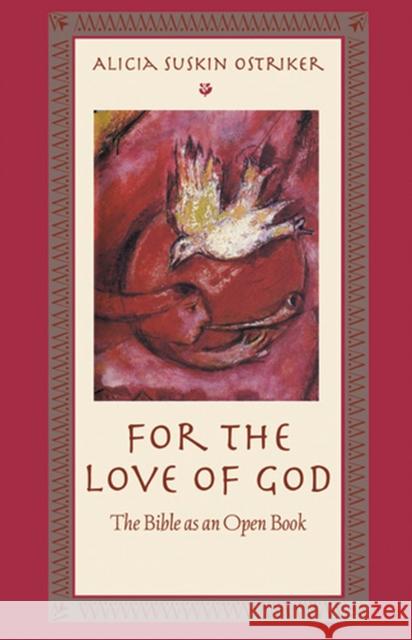
Quoting King Solomon's famous prayer to God at the Temple in Jerusalem, "Behold, the heaven of heavens cannot contain thee; how much less this house that I have builded," Alicia Suskin Ostriker posits a God who cannot be contained by dogma and doctrine. Troubled by the way the Bible has become identified in our culture with a monolithic authoritarianism, Ostriker focuses instead on the extraordinary variability of Biblical writing. For the Love of God is a provocative and inspiring re-interpretation of six essential Biblical texts: The Song of Songs, the Book of Ruth, Psalms,...
Quoting King Solomon's famous prayer to God at the Temple in Jerusalem, "Behold, the heaven of heavens cannot contain thee; how much less this house t...