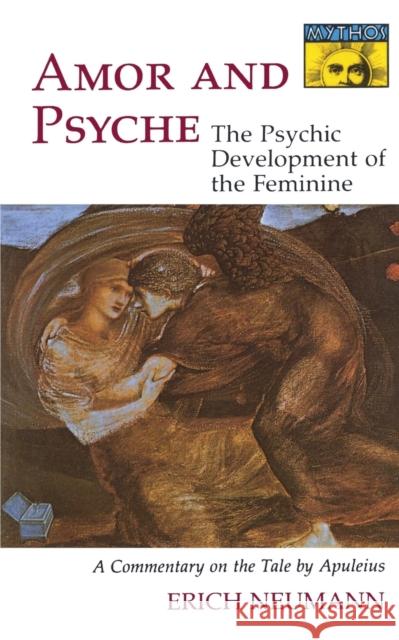
The renowned tale of Amor and Psyche, from Apuleius's second-century Latin novel The Golden Ass, is one of the most charming fragments of classical literature. Neumann chose it as the exemplar of an unusual study of feminine psychology. Unfolding the spiritual and mythical background of the pagan narrative, he shows how the contest between the mortal maid Psyche and the great goddess Aphrodite over the god Amor--Aphrodite's son, Psyche's husband--yields surprising and valuable insights into the psychic life of women.
The renowned tale of Amor and Psyche, from Apuleius's second-century Latin novel The Golden Ass, is one of the most charming fragments of cl...
Four essays on the psychological aspects of art. A study of Leonardo treats the work of art, and art itself, not as ends in themselves, but rather as instruments of the artist's inner situation. Two other essays discuss the relation of art to its epoch and specifically the relation of modern art to our own time. An essay on Chagall views this artist in the context of the problems explored in the other studies.
Four essays on the psychological aspects of art. A study of Leonardo treats the work of art, and art itself, not as ends in themselves, but rather ...
The modern world has witnessed a dramatic breakthrough of the dark, negative forces of human nature. The "old ethic," which pursued an illusory perfection by repressing the dark side, has lost its power to deal with contemporary problems. Erich Neumann was convinced that the deadliest peril now confronting humanity lay in the "scapegoat" psychology associated with the old ethic. We are in the grip of this psychology when we project our own dark shadow onto an individual or group identified as our "enemy," failing to see it in ourselves. The only effective alternative to this dangerous shadow...
The modern world has witnessed a dramatic breakthrough of the dark, negative forces of human nature. The "old ethic," which pursued an illusory perfec...
The Child is an examination of the structure and dynamics of the earliest developments of ego and individuality. In it we progress from the primal relationship of a child and mother through to the emergence of the ego-Self constellation, via the child's relationship to its own body, its Self, the Thou and being-in-the-world. We move from the matriarchate to the patriarchate; from participation mystique to the standpoint of the Self around which the ego revolves as around the sun.
The Child is an examination of the structure and dynamics of the earliest developments of ego and individuality. In it we progress from the primal rel...
In 1934, Erich Neumann, considered by many to have been Carl Gustav Jung's foremost disciple, sent Jung a handwritten note: "I will pursue your suggestion of elaborating on the 'Symbolic Contributions' to the Jacob-Esau problem . . . The great difficulty is the rather depressing impossibility of a publication." Now, eighty years later, in Jacob and Esau: On the Collective Symbolism of the Brother Motif, his important work is finally published. In this newly discovered manuscript, Neumann sowed the seeds of his later works. It provides a window into his...
In 1934, Erich Neumann, considered by many to have been Carl Gustav Jung's foremost disciple, sent Jung a handwritten note: "I will pursue your s...
In 1934, Erich Neumann, considered by many to have been Carl Gustav Jung's foremost disciple, sent Jung a handwritten note: "I will pursue your suggestion of elaborating on the 'Symbolic Contributions' to the Jacob-Esau problem . . . The great difficulty is the rather depressing impossibility of a publication." Now, eighty years later, in Jacob and Esau: On the Collective Symbolism of the Brother Motif, his important work is finally published. In this newly discovered manuscript, Neumann sowed the seeds of his later works. It provides a window into his...
In 1934, Erich Neumann, considered by many to have been Carl Gustav Jung's foremost disciple, sent Jung a handwritten note: "I will pursue your s...