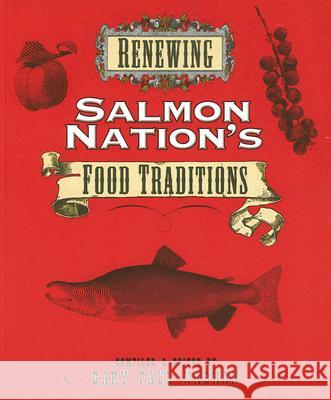
Among all the "food nations" of North America--ranging from Clambake Nation to Chile Pepper Nation--Salmon Nation is the richest in mushrooms, berries, wild roots, fish, and shellfish. Native American traditions are at its core, but other culinary accents--from Spanish to Japanese--have added to the mix. A project of the Renewing Americas Food Traditions (RAFT) consortium, this book describes over 180 species of local plants and animals--many now at risk, others recovering, and all deserving of recognition--that have formed the basis of food traditions in the Pacific Northwest. To identify...
Among all the "food nations" of North America--ranging from Clambake Nation to Chile Pepper Nation--Salmon Nation is the richest in mushrooms, berries...
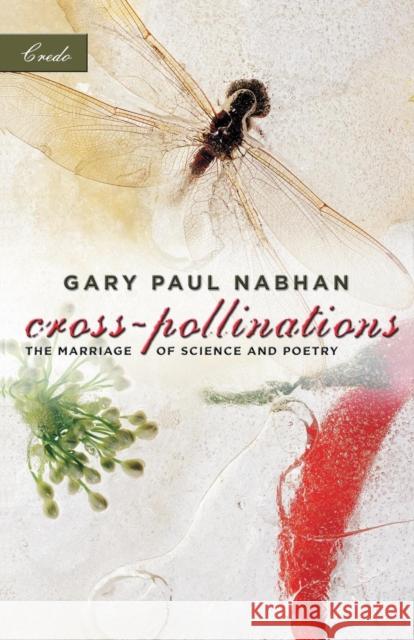
In this book, Nabhan describes the circumstances of several of important--even breakthrough--discoveries that came about through the cross-pollination of science and the arts. His stories mix the personal and scientific in an engaging way. When he found out in high school that he is color blind, an amazing teacher chided him to use his so-called problem to explore varieties of perception. Years later, Nabhan organized teams of color-blind and color-normal scientists to survey a plant thought to be endangered. The color-blind scientists' results changed the views of that ecosystem. Nabhan...
In this book, Nabhan describes the circumstances of several of important--even breakthrough--discoveries that came about through the cross-pollination...
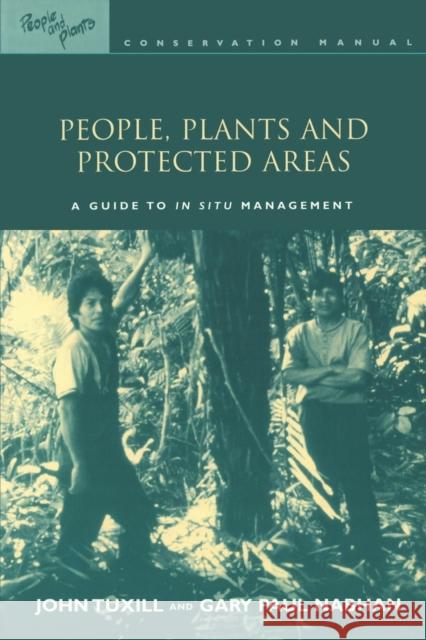
Conservation of plant resources is often focused on seed banks and botanical gardens. However, the two authors of this volume present a comprehensive conservation strategy that complements this ex-situ approach with practical guidance on in-situ management and conservation of plant resources. The book aims to facilitate better management of protected areas and to illustrate new approaches to conservation of plants within their landscapes. It draws on concepts from forestry, the agricultural sciences, anthropology, ethnology and ethnobotany and should be useful to practitioners, academics and...
Conservation of plant resources is often focused on seed banks and botanical gardens. However, the two authors of this volume present a comprehensive ...
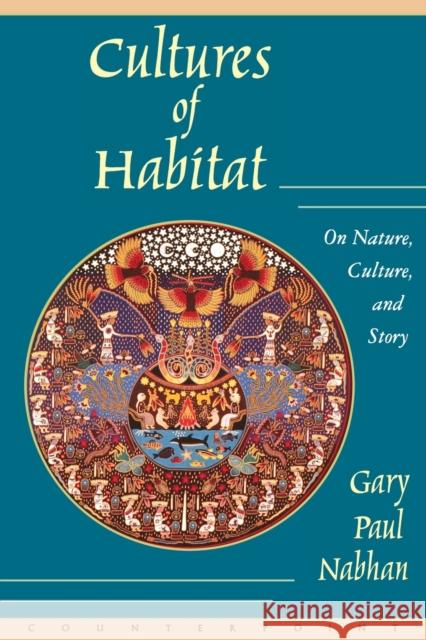
Ethnobotanist Gary Paul Nabhan provides 26 essays that go beyond mere observations of wildlife but offer theories of links between cultural and biological diversity. He champions a shift away from the preservation efforts of the mainstream environmental movement, rejecting the separateness of ecological preserves that exclude humans. Nabhan argues that biodviersity thrives best in the presence of an involved, participatory culture, and his argument is bolstered by research and years of field experiecne.
Ethnobotanist Gary Paul Nabhan provides 26 essays that go beyond mere observations of wildlife but offer theories of links between cultural and biolog...
The landscapes, cultures, and cuisines of deserts in the Middle East and North America have commonalities that have seldom been explored by scientists--and have hardly been celebrated by society at large. Sonoran Desert ecologist Gary Nabhan grew up around Arab grandparents, aunts, uncles, and cousins in a family that has been emigrating to the United States and Mexico from Lebanon for more than a century, and he himself frequently travels to the deserts of the Middle East. In an era when some Arabs and Americans have markedly distanced themselves from one another, Nabhan has been prompted to...
The landscapes, cultures, and cuisines of deserts in the Middle East and North America have commonalities that have seldom been explored by scientists...
Why does food taste better when you know where it comes from? Because history--ecological, cultural, even personal--flavors every bite we eat. Whether it's the volatile chemical compounds that a plant absorbs from the soil or the stories and memories of places that are evoked by taste, layers of flavor await those willing to delve into the roots of real food. In this landmark book, Gary Paul Nabhan takes us on a personal trip into the southwestern borderlands to discover the terroir--the "taste of the place"--that makes this desert so delicious.
To savor the terroir of the...
Why does food taste better when you know where it comes from? Because history--ecological, cultural, even personal--flavors every bite we eat. Whet...
How to harvest water and nutrients, select drought-tolerant plants, and create natural diversity
Because climatic uncertainty has now become -the new normal, - many farmers, gardeners and orchard-keepers in North America are desperately seeking ways to adapt their food production to become more resilient in the face of such -global weirding.- This book draws upon the wisdom and technical knowledge from desert farming traditions all around the world to offer time-tried strategies for:
Building greater moisture-holding capacity and nutrients in...
How to harvest water and nutrients, select drought-tolerant plants, and create natural diversity
Ethnobiology holds a special place in the hearts and minds of many because of its dedication to celebrating the knowledge and values of some of the most distinctive cultural practices in some of the most distinctive places on Earth. Yet we live in a world of diminishing natural and linguistic diversity. Whether due to climate change or capitalism, homogeneity is trumping the once-resplendent heterogeneity all around us. In this important new collection, Gary Paul Nabhan puts forth a call for the future not only of ethnobiology but for the entire planet. He articulates and broadens the...
Ethnobiology holds a special place in the hearts and minds of many because of its dedication to celebrating the knowledge and values of some of the mo...