One of the most troublesome questions about Utopia is Thomas More's reason for writing it. Some of the ideas in it, such as the ease of divorce, euthanasia and both married priests and female priests, seem to be polar opposites of his beliefs and those expected of the devout Catholic that he was. The concept of religious toleration seems to jar particularly with the information we have about him as Lord Chancellor: that he was a keen persecutor of Protestants. Similarly, the criticism of lawyers comes from a writer who, as Lord Chancellor, was arguably the most influential lawyer in England....
One of the most troublesome questions about Utopia is Thomas More's reason for writing it. Some of the ideas in it, such as the ease of divorce, eutha...
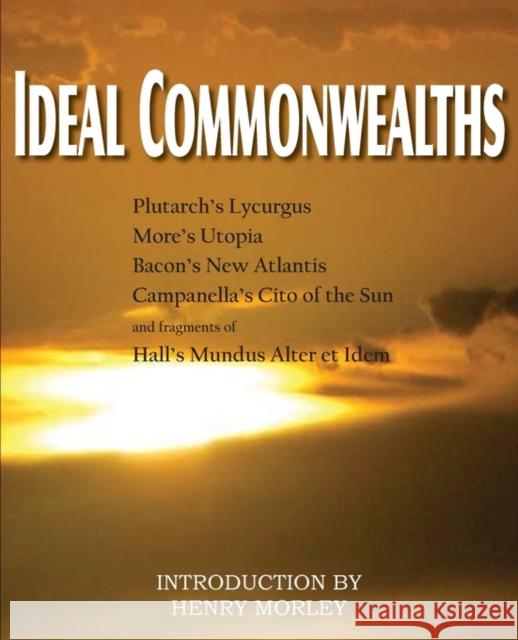
Ideal Commonwealths is comprised of five writings on the ideal civilization including politics and social programs. Inspired by the philosophy of Plato and Socrates and often viewed as satirical, each essay each essay portrays an ideal form of human existence. Life of Lycurgus by Plutarch is a biography of Lycurgus, the legendary lawgiver of Sparta, who established the military-oriented reformation of Spartan society. All his reforms were directed towards the three Spartan virtues: equality, military fitness, and austerity. Utopia by the Tudor statesman and Catholic martyr, Sir Thomas More...
Ideal Commonwealths is comprised of five writings on the ideal civilization including politics and social programs. Inspired by the philosophy of Plat...
Thomas More's Utopia has spurred debate, reflection, and critical thinking since its original publication in the 16th Century. More's fictional island of Utopia provides an exploration of issues that shook him and his contemporaries and continue to be problematic in the modern day; the details of More's utopian society, such as the permissibility of euthanasia and comments on chastity in the priesthood, combine with proposals of coexisting varied religions to put forth a work that incorporates the totality of More's religious, sociological, and philosophical talents.
Thomas More's Utopia has spurred debate, reflection, and critical thinking since its original publication in the 16th Century. More's fictional island...
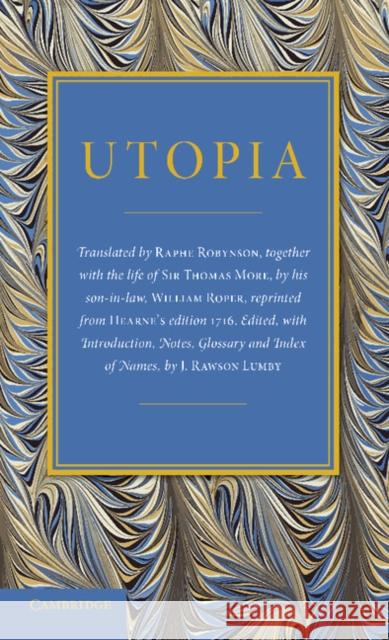
Originally published in 1879, and reprinted numerous times, this book presents the complete English text of Thomas More's Utopia, together with a glossary and detailed textual notes. An introduction and biography of More are also included. This book will be of value to anyone with an interest in More's writings and political philosophy in general.
Originally published in 1879, and reprinted numerous times, this book presents the complete English text of Thomas More's Utopia, together with a glos...
Satire de la societe de son epoque, L'Utopie est la celebre uvre de Thomas More ecrite en 1516. Humaniste chretien et ami d'Erasme, il denonce les egarements de l'Eglise et de l'Etat et imagine une societe ideale, utopique afin de sauver l'humanite et recreer le monde. Creee par Thomas More, l'utopie signifie a la fois lieu qui n'existe pas et lieu du bonheur, et pourrait donc signifier lieu du bonheur qui n'existe pas. Un livre indispensable a tous ceux qui revent du bonheur ou qui veulent imposer leur idee du bonheur."
Satire de la societe de son epoque, L'Utopie est la celebre uvre de Thomas More ecrite en 1516. Humaniste chretien et ami d'Erasme, il denonce les...
More's best known and most controversial work, Utopia is a novel written in Latin. More completed and Erasmus published the book in Leuven in 1516, but it was only translated into English and published in his native land in 1551 (long after More's execution), and the 1684 translation became the most commonly cited. More (also a character in the book) and the narrator/traveller, Raphael Hythlodeaus (whose name alludes both to the healer archangel Raphael, and 'speaker of nonsense', the surname's Greek meaning), discuss modern ills in Antwerp, as well as describe the political arrangements of...
More's best known and most controversial work, Utopia is a novel written in Latin. More completed and Erasmus published the book in Leuven in 1516, bu...
Utopia is a work of fiction and political philosophy by Thomas More (1478-1535) published in 1516, composed in the Latin language. English translations of the title include A Truly Golden Little Book, No Less Beneficial Than Entertaining, of the Best State of a Republic, and of the New Island Utopia (literal) and A Fruitful and Pleasant Work of the Best State of a Public weal, and of the New Isle Called Utopia (traditional). The book is a frame narrative primarily depicting a fictional island society and its religious, social and political customs.
Utopia is a work of fiction and political philosophy by Thomas More (1478-1535) published in 1516, composed in the Latin language. English translation...