This treatise on the question of knowledge challenges readers to re-examine the protective barriers built to isolate science from other forms of enquiry, and each particular science from its neighbours. The author argues that philosophy itself must stop being treated as an obscure speciality, and take up its role as the key to understanding. The text will be of interest to those concerned with the plight of education and institutionalized knowledge, and the fate of learning in the future.
This treatise on the question of knowledge challenges readers to re-examine the protective barriers built to isolate science from other forms of enqui...
In The Ethical Primate, Mary Midgley, 'one of the sharpest critical pens in the West' according to the Times Literary Supplement, addresses the fundamental question of human freedom. Scientists and philosophers have found it difficult to understand how each human-being can be a living part of the natural world and still be free. Midgley explores their responses to this seeming paradox and argues that our evolutionary origin explains both why and how human freedom and morality have come about.
In The Ethical Primate, Mary Midgley, 'one of the sharpest critical pens in the West' according to the Times Literary Supplement, ad...
In The Ethical Primate, Mary Midgley, 'one of the sharpest critical pens in the West' according to the Times Literary Supplement, addresses the fundamental question of human freedom. Scientists and philosophers have found it difficult to understand how each human-being can be a living part of the natural world and still be free. Midgley explores their responses to this seeming paradox and argues that our evolutionary origin explains both why and how human freedom and morality have come about.
In The Ethical Primate, Mary Midgley, 'one of the sharpest critical pens in the West' according to the Times Literary Supplement, ad...
Why do the big philosophical questions so often strike us as far-fetched and little to with everyday life? Mary Midgley shows that it need not be that way; she shows that there is a need for philosophy in the real world. Her popularity as one of our foremost philosophers is based on a no-nonsense, down-to-earth approach to fundamental human problems, philosphical or otherwise. In Utopias, Dolphins and Computers she makes her case for philosophy as a difficult but necessary tool for solving some of the most pressing issues facing contemporary society. How should we treat animals?...
Why do the big philosophical questions so often strike us as far-fetched and little to with everyday life? Mary Midgley shows that it need not be that...
This work is an investigation of why and how science has so powerfully shaped the way we understand ourselves, our behaviour towards others and our place in the world. Moral philosopher Mary Midgely shows how the roots of the problem lie in the fragmented, atom-like picture of ourselves we inherited from the 17th century. Breaking the world up into small parts and observing them in isolation may work in science, but she clearly spells out how this kind of approach can be disastrous when turned towards understanding ourselves, our interaction with the environment and our interaction with other...
This work is an investigation of why and how science has so powerfully shaped the way we understand ourselves, our behaviour towards others and our pl...
Midgley exposes the illogical logic of poor doctrines that shelter themselves behind the prestige of science. Always at home when taking on the high priests of evolutionary theory - Dawkins, Wilson and their acolytes - she has described evolution as the creation-myth of our age. In Evolution As A Religion she examines how science comes to be used as a substitute for religion and points out how badly that role distorts it. Her argument is insightful - a lively indictment of these misuses of science.
Midgley exposes the illogical logic of poor doctrines that shelter themselves behind the prestige of science. Always at home when taking on the high p...
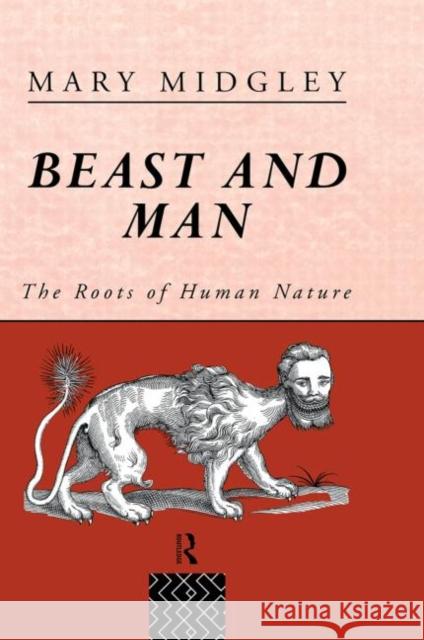
Philosophers have traditionally concentrated on the qualities that make human beings different from other species. In Beast and Man Mary Midgley stresses continuities. What makes people tick? Largely, she asserts, the same things as animals. She tells us humans are rather more like other animals than we previously allowed ourselves to believe, and reminds us just how primitive we are in comparison to the sophistication of many animals.
Philosophers have traditionally concentrated on the qualities that make human beings different from other species. In Beast and Man Mary Midgley stres...
One of the UK's foremost moral philosophers, Mary Midgley recounts her remarkable story in this elegiac and moving account of friendships found and lost, bitter philosophical battles and of a profound love of teaching.
In spite of her many books and public profile, little is known about Mary's life. Part of a famous generation of women philosophers that includes Elizabeth Anscombe, Philippa Foot, Mary Warnock and Iris Murdoch, Midgley tells us in vivid and humorous fashion how they cut a swathe through the arid landscape of 1950s British Philosophy, writing and arguing about the...
One of the UK's foremost moral philosophers, Mary Midgley recounts her remarkable story in this elegiac and moving account of friendships found and lo...
"Animals and Why They Matter" examines the barriers that our philosophical traditions have erected between human beings and animals and reveals that the too-often ridiculed subject of animal rights is an issue crucially related to such problems within the human community as racism, sexism, and age discrimination. Mary Midgley's profound and clearly written narrative is a thought-provoking study of the way in which the opposition between reason and emotion has shaped our moral and political ideas and the problems it has raised. Whether considering vegetarianism, women's rights, or the...
"Animals and Why They Matter" examines the barriers that our philosophical traditions have erected between human beings and animals and reveals that t...
GAIA, named after the ancient Greek mother-goddess, is the notion that the Earth and the life on it form an active, self-maintaining whole. By its use of personification it attacks the view that the physical world is inert and lifeless. It has a scientific side, as shown by the new university departments of earth science which bring biology and geology together to study the continuity of the cycle. It also has a visionary or spiritual aspect. What the contributors to this book believe is needed is to bring these two angles together. With global warming now an accepted fact, the lessons of...
GAIA, named after the ancient Greek mother-goddess, is the notion that the Earth and the life on it form an active, self-maintaining whole. By its ...