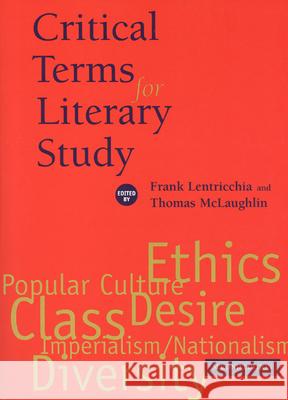
Since its publication in 1990, Critical Terms for Literary Study has become a landmark introduction to the work of literary theory--giving tens of thousands of students an unparalleled encounter with what it means to do theory and criticism. Significantly expanded, this new edition features six new chapters that confront, in different ways, the growing understanding of literary works as cultural practices. These six new chapters are "Popular Culture," "Diversity," "Imperialism/Nationalism," "Desire," "Ethics," and "Class," by John Fiske, Louis Menand, Seamus Deane, Judith Butler,...
Since its publication in 1990, Critical Terms for Literary Study has become a landmark introduction to the work of literary theory--giving tens...
Everybody s got a theory . . . or do they? Thomas McLaughlin argues that critical theory raising serious, sustained questions about cultural practice and ideology is practiced not only by an academic elite but also by savvy viewers of sitcoms andTV news, by Elvis fans and Trekkies, by labor organizers and school teachers, by the average person in the street. Like academic theorists, who are trained in a tradition of philosophical and political skepticism that challenges all orthodoxies, the vernacular theorists McLaughlin identifies display a lively and healthy alertness to...
Everybody s got a theory . . . or do they? Thomas McLaughlin argues that critical theory raising serious, sustained questions about cultural pr...
This work argues that critical theory is practiced by ordinary people as well as an academic elite. Their questioning of established institutions, it suggests, is healthy, and the author calls on academic institutions to recognize the theoretical strategies that students bring into the classroom.
This work argues that critical theory is practiced by ordinary people as well as an academic elite. Their questioning of established institutions, it ...