What is the source of personal writing? When do we begin to consider our own lives worthy of a story? These powerful and passionate selections of spiritual autobiography do not merely represent a vital literary tradition; they bring together fifty-eight writers whose search for truth and understanding has spanned over two millennia and several continents. From Saint Augustine and Rabi'a to T. S. Eliot and Kathleen Norris, each of these autobiographers tells the story of the inner life as a spiritual quest. Although separated culturally, historically, and linguistically, they are united...
What is the source of personal writing? When do we begin to consider our own lives worthy of a story? These powerful and passionate selections of spir...
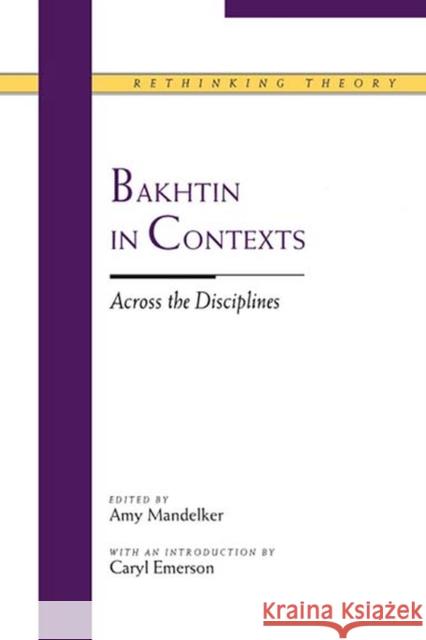
The Russian critic M. M. Bakhtin has recently become a major figure in contemporary theory beyond his traditional influence in Slavic literary studies. Bakhtin in Contexts explores the revolutionary impact Bakhtin's ideas have carried in contemporary discussion of language, art, culture, and social science in recent years. The contributors represent a broad range of disciplines in the humanities and social sciences, epitomizing the views of Russian and American specialists in those fields Bakhtin often referred to as "the human sciences." The diversity of perspective and flexibility of...
The Russian critic M. M. Bakhtin has recently become a major figure in contemporary theory beyond his traditional influence in Slavic literary studies...
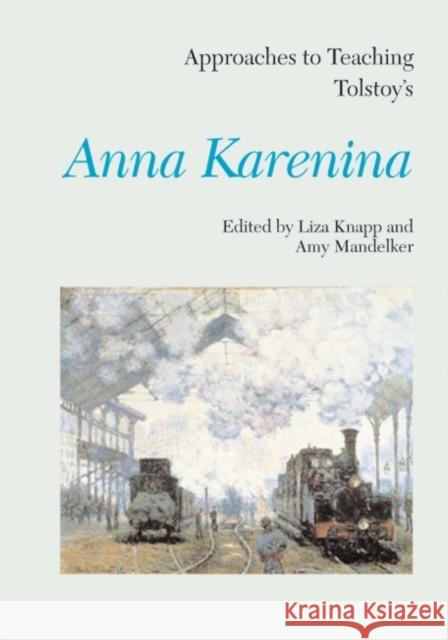
Anna Karenina is probably the most often taught nineteenth-century Russian novel in the American academy. Teachers have found that including this virtuoso work of art on a syllabus reaps many rewards and stirs up heated classroom discussion -- on sex and sexuality, dysfunction in the family, gender roles, society's hypocrisy and cruelty. But translation and transliteration problems, the peculiarity of Russian names and terms, and the unfamiliarity of Russian geography and history present a range of pedagogical challenges.
Anna Karenina is probably the most often taught nineteenth-century Russian novel in the American academy. Teachers have found that including this virt...
Anna Karenina is probably the most often taught nineteenth-century Russian novel in the American academy. Teachers have found that including this virtuoso work of art on a syllabus reaps many rewards and stirs up heated classroom discussion -- on sex and sexuality, dysfunction in the family, gender roles, society's hypocrisy and cruelty. But translation and transliteration problems, the peculiarity of Russian names and terms, and the unfamiliarity of Russian geography and history present a range of pedagogical challenges.
Anna Karenina is probably the most often taught nineteenth-century Russian novel in the American academy. Teachers have found that including this virt...