Deianeira sends her husband Herakles a poisoned robe. Eriphyle trades the life of her husband Amphiaraos for a golden necklace. Atreus's wife Aerope gives away the token of his sovereignty, a lamb with a golden fleece, to his brother Thyestes, who has seduced her. Gifts and exchanges always involve a certain risk in any culture, but in the ancient Greek imagination, women and gifts appear to be a particularly deadly combination.
This book explores the role of gender in exchange as represented in ancient Greek culture, including Homeric epic and tragedy, non-literary texts, and...
Deianeira sends her husband Herakles a poisoned robe. Eriphyle trades the life of her husband Amphiaraos for a golden necklace. Atreus's wife Aerop...
In recent years, the topic of ancient Greek hero cult has been the focus of considerable discussion among classicists. Little attention, however, has been paid to female heroized figures. Here Deborah Lyons argues for the heroine as a distinct category in ancient Greek religious ideology and daily practice. The heroine, she believes, must be located within a network of relations between male and female, mortal and immortal. Using evidence ranging from Homeric epic to Attic vase painting to ancient travel writing, she attempts to re-integrate the feminine into our picture of Greek notions...
In recent years, the topic of ancient Greek hero cult has been the focus of considerable discussion among classicists. Little attention, however, h...
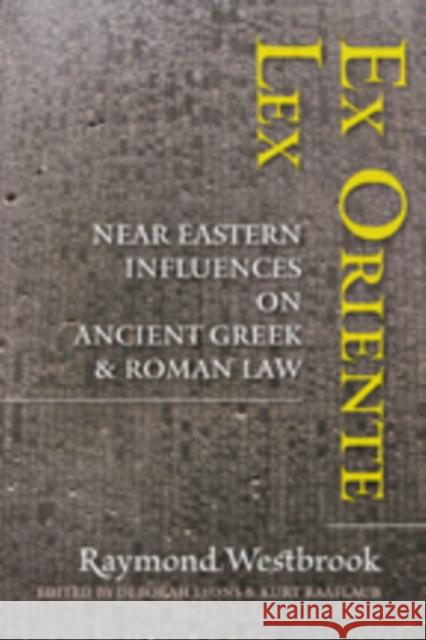
Throughout the twelve essays that appear in Ex Oriente Lex, Raymond Westbrook convincingly argues that the influence of Mesopotamian legal traditions and thought did not stop at the shores of the Mediterranean, but rather had a profound impact on the early laws and legal developments of Greece and Rome as well. He presents readers with tantalizing fragments of early Greek or archaic Roman law which, when placed in the context of the broader Near Eastern tradition, suddenly acquire unexpected new meanings.
Before his untimely death in July 2009, Westbrook was regarded as one of...
Throughout the twelve essays that appear in Ex Oriente Lex, Raymond Westbrook convincingly argues that the influence of Mesopotamian legal t...
In recent years, the topic of ancient Greek hero cult has been the focus of considerable discussion among classicists. Little attention, however, has been paid to female heroized figures. Here Deborah Lyons argues for the heroine as a distinct category in ancient Greek religious ideology and daily practice. The heroine, she believes, must be located within a network of relations between male and female, mortal and immortal. Using evidence ranging from Homeric epic to Attic vase painting to ancient travel writing, she attempts to re-integrate the feminine into our picture of Greek notions...
In recent years, the topic of ancient Greek hero cult has been the focus of considerable discussion among classicists. Little attention, however, h...