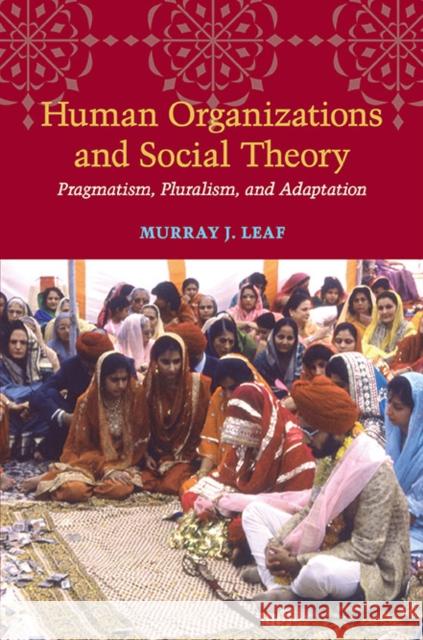
In the 1930s, George Herbert Mead and other leading social scientists established the modern empirical analysis of social interaction and communication, enabling theories of cognitive development, language acquisition, interaction, government, law and legal processes, and the social construction of the self. However, they could not provide a comparably empirical analysis of human organization.
The theory in this book fills in the missing analysis of organizations and specifies more precisely the pragmatic analysis of communication with an adaptation of information theory to ordinary...
In the 1930s, George Herbert Mead and other leading social scientists established the modern empirical analysis of social interaction and communica...
While European reconstruction after World War II followed the pluralistic Marshall Plan that grounded social order in individual interests and interdependence, the roots of dirigiste planning in South Asia, as in the rest of the Third World, lie mainly in the line of deterministic theories represented by Positivism and Marxism. Despite a national commitment to dirigiste planning, however, India retains substantial interstitial pluralism--pluralism within an overall centralized system--that varies from state to state. This variation is directly reflected in interstate variations in...
While European reconstruction after World War II followed the pluralistic Marshall Plan that grounded social order in individual interests and inte...
The world s great religions depend on traditions of serious scholarship, dedicated to preserving their key texts but also to understanding them and, therefore, to debating what understanding itself is and how best to do it. They also have important public missions of many kinds, and their ideas and organizations influence many other important institutions, including government, law, education, and kinship. Anthropology of Eastern Religions: Ideas, Organizations, and Constituencies is a comparative survey of the world s major religious traditions as professional enterprises and, often, as...
The world s great religions depend on traditions of serious scholarship, dedicated to preserving their key texts but also to understanding them and, t...
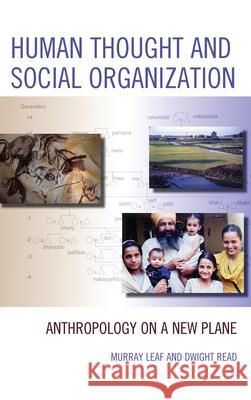
Human beings have two outstanding characteristics compared to all other species: the apparently enormous elaboration of our thought through language and symbolism and the elaboration of our forms of social organization. The view taken in Human Thought and Social Organization: Anthropology on a New Plane is that these are intimately interconnected. To understand this connection, the book compares the structure of the systems of thought that organizations are built upon with the organizational basis of human thinking as such. An experimental method is used, leading to a new science of the...
Human beings have two outstanding characteristics compared to all other species: the apparently enormous elaboration of our thought through language a...
The world's "great" religions depend on traditions of serious scholarship, dedicated to preserving their key texts but also to understanding them and, therefore, to debating what understanding itself is and how best to do it. They also have important public missions of many kinds, and their ideas and organizations influence many other important institutions, including government, law, education, and kinship. The Anthropology of Western Religions: Ideas, Organizations, and Constituencies is a comparative survey of the world's major religious traditions as professional enterprises and, often,...
The world's "great" religions depend on traditions of serious scholarship, dedicated to preserving their key texts but also to understanding them and,...