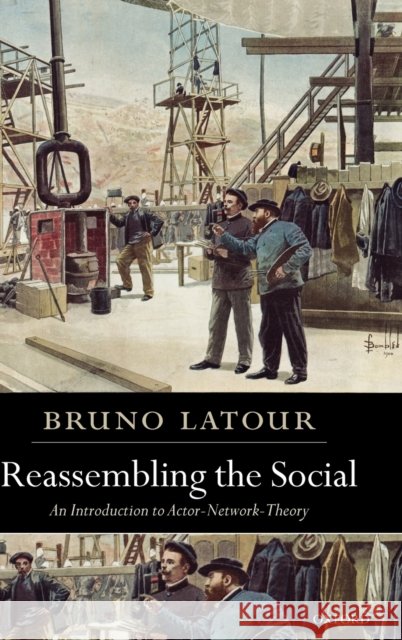
Reassembling the Social is a fundamental challenge from one of the world's leading social theorists to how we understand society and the 'social'. Bruno Latour's contention is that the word 'social' as used by Social Scientists has become laden with assumptions to the point where it has become a misnomer. When the adjective is applied to a phenomenon, it is used to indicate a stabilized state of affairs, a bundle of ties that in due course may be used to account for another phenomenon. Latour also finds the word used as if it described a type of material, in a comparable way to an adjective...
Reassembling the Social is a fundamental challenge from one of the world's leading social theorists to how we understand society and the 'social'. Bru...
How can economics become genuinely quantitative? This is the question that French sociologist Gabriel Tarde tackled at the end of his career, and in this pamphlet, Bruno Latour and Vincent Antonin Lepinay offer a lively introduction to the work of the forgotten genius of nineteenth-century social thought. Tarde s solution was in total contradiction to the dominant views of his time: to quantify the connections between people and goods, you need to grasp passionate interests. In Tarde s view, capitalism is not a system of cold calculations rather it is a constant amplification in the...
How can economics become genuinely quantitative? This is the question that French sociologist Gabriel Tarde tackled at the end of his career, and i...
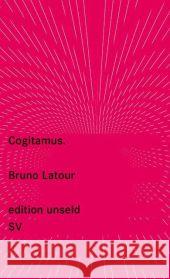
Nach Bruno Latour kann es auf die Frage "Was tun?" nur eine Antwort geben: "Politische Ökologie!" Diese Antwort läßt allerdings in unserem alltäglichen Verständnis von Ökologie und in dem traditionellen Begriffsgefüge von polis, logos und physis keinen Stein auf dem anderen. Latour geht es nicht mehr einfach darum, die Idee der Natur in die Politik einzubringen. Vielmehr muß Ökologie als politische Philosophie der Natur begriffen werden und sich dem Risiko der Metaphysik stellen. Nur wenn sie erkennt, daß Natur keinen besonderen Bereich der Realität darstellt, sondern daß sie von...
Nach Bruno Latour kann es auf die Frage "Was tun?" nur eine Antwort geben: "Politische Ökologie!" Diese Antwort läßt allerdings in unserem alltägl...
»Man muß die Gesellschaft verändern!« Diese Parole aus alter Zeit ist nach wie vor aktuell, denn die heutige Gesellschaft ist voller Härte und Zumutungen. Um diese Veränderung zu ermöglichen, sollte man aber vielleicht erst einmal versuchen, den Begriff »Gesellschaft« zu verändern und den Riß zwischen der Praxis der Soziologie, der Theorie der Politik und des Glaubens an die Idee der Gesellschaft zu schließen. Um einen Ausweg aus dieser Krise zu finden, sollte so die provokative These dieses Buchs diese Spannung bis zum äußersten ausgereizt werden.§Bruno Latour, der die...
»Man muß die Gesellschaft verändern!« Diese Parole aus alter Zeit ist nach wie vor aktuell, denn die heutige Gesellschaft ist voller Härte und ...
Am Beginn der modernen Naturwissenschaft steht die strikte Trennung von Natur und Gesellschaft, von "natürlichen" und "gesellschaftlichen" Instanzen. Bruno Latour optiert in seinem Klassiker der modernen Soziologie dafür, sich diese Trennung etwas genauer anzusehen. Seine These lautet: Je strikter und gründlicher diese Trennung in der Moderne vollzogen wurde, um so besser konnten sich zwischen den getrennten Bereichen "Quasiobjekte" ausbreiten, die sowohl natürlich als auch gesellschaftlich determiniert sind. Diese hybriden "Quasiobjekte", welche die Moderne ausgeblendet hat, gilt es...
Am Beginn der modernen Naturwissenschaft steht die strikte Trennung von Natur und Gesellschaft, von "natürlichen" und "gesellschaftlichen" Instanzen....
Bruno Latour's long term project is to compare the felicity and infelicity conditions of the different values dearest to the heart of those who have 'never been modern'. According to him, this is the only way to develop an anthropology of the Moderns. After his work on science, on technology and, more recently, on law, this book explores the truth conditions of religious speech acts.
Even though there is no question that religion is one of the values that has been intensely cherished in the course of history, it's also clear that it has become immensely difficult to tune in to...
Bruno Latour's long term project is to compare the felicity and infelicity conditions of the different values dearest to the heart of those who have '...
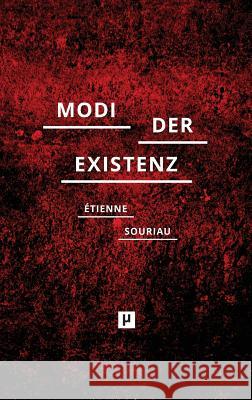
"Ware die Philosophie auch nur eine Stunde der Mu he wert, wenn sie uns nicht fu r das Leben ru stete?" Gezielten Schrittes entwirft der franzosische Philosoph Etienne Souriau in diesem dicht gedrangten Buch eine Grammatik der Existenz. Im Fokus steht nicht nur ihre Theorie, sondern auch die tatsachliche Ausu bung der "Kunst des Existierens." Wie Gilles Deleuze und William James vertritt Souriau dabei die These eines existenziellen Pluralismus: Es gibt Phanomene, Dinge, das Virtuelle, fiktionale Wesen - die Existenz ist polyphon. Souriaus radikale Herangehensweise hat auch Bruno Latour und...
"Ware die Philosophie auch nur eine Stunde der Mu he wert, wenn sie uns nicht fu r das Leben ru stete?" Gezielten Schrittes entwirft der franzosische ...