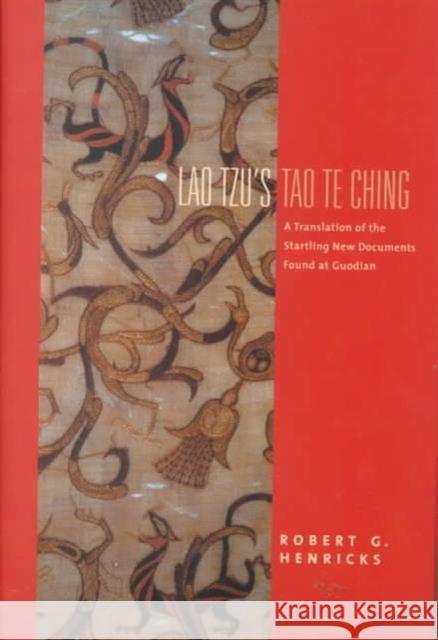
In 1993, an astonishing discovery was made at a tomb in Guodian in Hubei province (east central China). Written on strips of bamboo that have miraculously survived intact since 300 B.C., the "Guodian Laozi," is by far the earliest version of the Tao Te Ching ever unearthed. Students of ancient Chinese civilization proclaimed the text a decisive breakthrough in the understanding of this famous text: it provides the most conclusive evidence to date that the text was the work of multiple authors and editors over hundreds of years, rather than the achievement of a single individual writing...
In 1993, an astonishing discovery was made at a tomb in Guodian in Hubei province (east central China). Written on strips of bamboo that have miraculo...
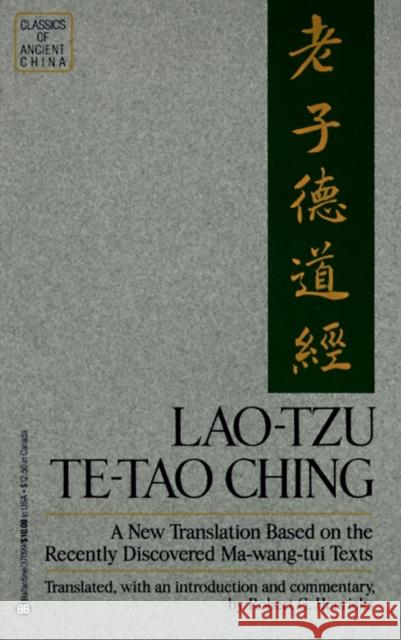
Lao-tzu's -Te-Tao Ching- has been treasured for thousands of years for its poetic statement of life's most profound and elusive truths. This new translation, based on the 1973 discovery of two copies of the manuscript more than five centuries older than any others known, corrects many defects of the later versions. In his extensive commentary, Professor Henricks reevaluates traditional interpretations.
Lao-tzu's -Te-Tao Ching- has been treasured for thousands of years for its poetic statement of life's most profound and elusive truths. This new trans...
Written during the golden age of Chinese philosophy, and composed partly in prose and partly in verse, the Tao Te Ching is surely the most terse and economical of the world's great religious texts. In a series of short, profound chapters it elucidates the idea of the Tao, or the Way-an idea that in its ethical, practical, and spiritual dimensions has become essential to the life of China's enormously powerful civilization. In the process of this elucidation, Lao-tzu both clarifies and deepens those central religious mysteries around which our life on earth revolves.
Translation...
Written during the golden age of Chinese philosophy, and composed partly in prose and partly in verse, the Tao Te Ching is surely the most t...
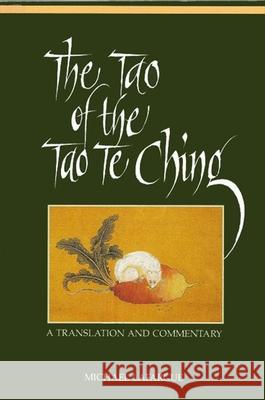
In this new translation and commentary, LaFargue interprets the concept of "Tao" in the Tao Te Ching as a spiritual state of mind cultivated in a particular school in ancient China' a state of mind which also expressed itself in a simple but satisfying life-style, and in a low-key but effective style of political leadership. The interpretation offered here is not only historically accurate, but also conveys the spiritual depth of the Tao Te Ching and its contemporary relevance. The translation is made transparent by a design that presents all of the commentary on the page facing the relevant...
In this new translation and commentary, LaFargue interprets the concept of "Tao" in the Tao Te Ching as a spiritual state of mind cultivated in a part...