Peter Kivy is the author of many books on the history of art and, in particular, the aesthetics of music. This collection of essays spans a period of some thirty years and focuses on a richly diverse set of issues: the biological origins of music, the role of music in the liberal education, the nature of the musical work and its performance, the aesthetics of opera, the emotions of music, and the very nature of music itself. Some of these subjects are viewed as part of the history of ideas, others as current problems in the philosophy of art. A particular feature of the volume is that Kivy...
Peter Kivy is the author of many books on the history of art and, in particular, the aesthetics of music. This collection of essays spans a period of ...
Music, Language, and Cognition is the third collection of Peter Kivy's seminal papers in the philosophy of music. In essays which span his earliest work in the field and his more recent contributions to journals, anthologies, and conference proceedings, Kivy considers the origin of music, the medium of expression in opera, the role of music in film, the nature of an "ideal" performance, and the question of whether absolute music has a meaning, among other issues. Rich with critical analysis and informed by the history of both philosophy and music, this volume will be of interest to anyone who...
Music, Language, and Cognition is the third collection of Peter Kivy's seminal papers in the philosophy of music. In essays which span his earliest wo...
Peter Kivy presents a selection of his new and recent writings on the philosophy of music--an area to which he has been one of the most eminent contributors. In his distinctively elegant and informal style, Kivy explores such topics as musicology and its history, the nature of musical works, and the role of emotion in music, and does so in a way that will attract the interest of philosophical and musical readers alike. Most works are published here for the first time, each one unique and accessible, making this collection a delight both to followers of Kivy's work and to first-time readers.
Peter Kivy presents a selection of his new and recent writings on the philosophy of music--an area to which he has been one of the most eminent contri...
The Blackwell Guide to Aesthetics is the most authoritative survey of the central issues in contemporary aesthetics available. The volume features eighteen newly commissioned papers on the evaluation of art, the interpretation of art, and many other forms of art such as literature, movies, and music.
Provides a guide to the central traditional and cutting edge issues in aesthetics today.
Written by a distinguished cast of contributors, including Peter Kivy, George Dickie, Noel Carroll, Paul Guyer, Ted Cohen, Marcia Eaton, Joseph Margolis,...
The Blackwell Guide to Aesthetics is the most authoritative survey of the central issues in contemporary aesthetics available. The volume featu...
Antithetical Arts constitutes a defence of musical formalism against those who would put literary interpretations on the absolute music canon. In Part I, the historical origins of both the literary interpretation of absolute music and musical formalism are laid out. In Part II, specific attempts to put literary interpretations on various works of the absolute music canon are examined and criticized. Finally, in Part III, the question is raised as to what the human significance of absolute music is, if it does not lie in its representational or narrative content. The answer is that, as yet,...
Antithetical Arts constitutes a defence of musical formalism against those who would put literary interpretations on the absolute music canon. In Part...
As the title of this book was meant to suggest, its subject is the way we talk about (and write about) works of art: or, rather, one of the ways, namely, the way we describe works of art for critical purposes. Be cause I wished to restrict my subject matter in this way, I have made a sharp, and no doubt largely artificial distinction between describing and evaluating. And I must, at the outset, guard against a misreading of this distinction to which I have left myself open. In distinguishing between evaluative and descriptive aesthetic judgments, I am not saying that when I assert "X is p,"...
As the title of this book was meant to suggest, its subject is the way we talk about (and write about) works of art: or, rather, one of the ways, name...
The concept of genius intrigues us. Artistic geniuses have something other people don't have. In some cases that something seems to be a remarkable kind of inspiration that permits the artist to exceed his own abilities. It is as if the artist is suddenly possessed, as if some outside force flows through him at the moment of creation. In other cases genius seems best explained as a natural gift. The artist is the possessor of an extra talent that enables the production of masterpiece after masterpiece. This book explores the concept of artistic genius and how it came to be symbolized by three...
The concept of genius intrigues us. Artistic geniuses have something other people don't have. In some cases that something seems to be a remarkable ki...
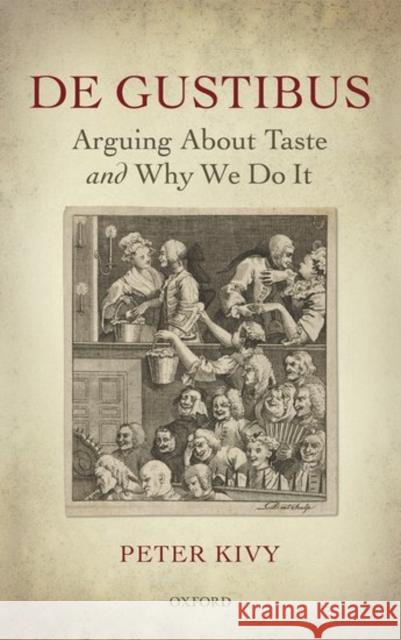
In De Gustibus Peter Kivy deals with a question that has never been fully addressed by philosophers of art: why do we argue about art? We argue about the 'facts' of the world either to influence people's behaviour or simply to get them to see what we take to be the truth about the world. We argue over ethical matters, if we are ethical 'realists, ' because we think we are arguing about 'facts' in the world. And we argue about ethics, if we are 'emotivists, ' or are now what are called 'expressionists, ' which is to say, people who think matters of ethics are simply matters of 'attitude, ' to...
In De Gustibus Peter Kivy deals with a question that has never been fully addressed by philosophers of art: why do we argue about art? We argue about ...
Peter Kivy, world-renowned philosopher of art, completed work on this book shortly before his untimely death in 2017. In it he addresses the novel, making an invaluable contribution to the field of philosophy of literature and raising questions of a philosophical nature about the novel that will be of interest both to the professional philosopher and to the general reader.
Peter Kivy, world-renowned philosopher of art, completed work on this book shortly before his untimely death in 2017. In it he addresses the novel, ma...