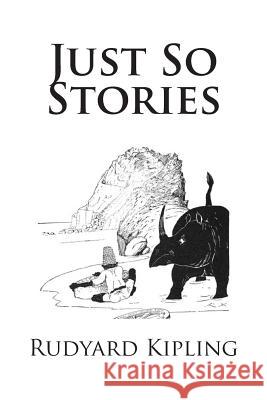
IN the sea, once upon a time, O my Best Beloved, there was a Whale, and he ate fishes. He ate the starfish and the garfish, and the crab and the dab, and the plaice and the dace, and the skate and his mate, and the mackereel and the pickereel, and the really truly twirly-whirly eel. All the fishes he could find in all the sea he ate with his mouth-so Till at last there was only one small fish left in all the sea, and he was a small 'Stute Fish, and he swam a little behind the Whale's right ear, so as to be out of harm's way. Then the Whale stood up on his tail and said, 'I'm hungry.' And the...
IN the sea, once upon a time, O my Best Beloved, there was a Whale, and he ate fishes. He ate the starfish and the garfish, and the crab and the dab, ...
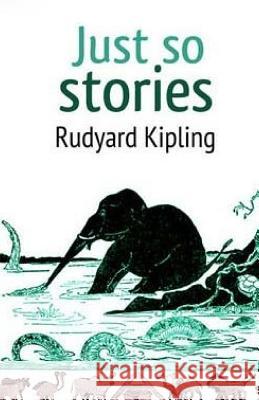
The Just So Stories typically have the theme of a particular animal being modified from an original form to its current form by the acts of man, or some magical being. For example, the Whale has a tiny throat because he swallowed a mariner, who tied a raft inside to block the whale from swallowing other men. The Camel has a hump given to him by a djinn as punishment for the camel's refusing to work (the hump allows the camel to work longer between times of eating). The Leopard's spots were painted by an Ethiopian (after the Ethiopian painted himself black). The Kangaroo gets its powerful hind...
The Just So Stories typically have the theme of a particular animal being modified from an original form to its current form by the acts of man, or so...
One of the few advantages that India has over England is a great Knowability. After five years' service a man is directly or indirectly acquainted with the two or three hundred Civilians in his Province, all the Messes of ten or twelve Regiments and Batteries, and some fifteen hundred other people of the non-official caste. In ten years his knowledge should be doubled, and at the end of twenty he knows, or knows something about, every Englishman in the Empire, and may travel anywhere and everywhere without paying hotel-bills.
One of the few advantages that India has over England is a great Knowability. After five years' service a man is directly or indirectly acquainted wit...
She was the daughter of Sonoo, a Hill-man, and Jadeh his wife. One year their maize failed, and two bears spent the night in their only poppy-field just above the Sutlej Valley on the Kotgarth side; so, next season, they turned Christian, and brought their baby to the Mission to be baptized. The Kotgarth Chaplain christened her Elizabeth, and "Lispeth" is the Hill or pahari pronunciation.
She was the daughter of Sonoo, a Hill-man, and Jadeh his wife. One year their maize failed, and two bears spent the night in their only poppy-field ju...
The weather door of the smoking-room had been left open to the North Atlantic fog, as the big liner rolled and lifted, whistling to warn the fishing-fleet. "That Cheyne boy's the biggest nuisance aboard," said a man in a frieze overcoat, shutting the door with a bang. "He isn't wanted here. He's too fresh." A white-haired German reached for a sandwich, and grunted between bites: "I know der breed. Ameriga is full of dot kind. I dell you you should imbort ropes' ends free under your dariff."
The weather door of the smoking-room had been left open to the North Atlantic fog, as the big liner rolled and lifted, whistling to warn the fishing-f...
The Just So Stories for Little Children were written by British author Rudyard Kipling. They are highly fantasised origin stories and are among Kipling's best known works. The stories, first published in 1902, are pourquoi stories, fantastic accounts of how various phenomena came about. A forerunner of these stories is "How Fear Came" in The Second Jungle Book (1895), in which Mowgli hears the story of how the tiger got his stripes.
The Just So Stories for Little Children were written by British author Rudyard Kipling. They are highly fantasised origin stories and are among Kiplin...
El libro de la selva (en ingles: The Jungle Book), tambien llamado El libro de las tierras virgenes, publicado en 1894, es una coleccion de historias escritas por el ingles nacido en India Rudyard Kipling (Bombay, 1865 - Londres, 1936), el primer escritor britanico en ser galardonado con el Premio Nobel de Literatura en 1907. La historia, que fue inicialmente publicada en revistas entre 1893-1894 y que contaba en algunos casos con ilustraciones del padre de Rudyard, John Lockwood Kipling, se basa en cuentos de animales de la selva india que, de forma antropomorfica, plantean lecciones...
El libro de la selva (en ingles: The Jungle Book), tambien llamado El libro de las tierras virgenes, publicado en 1894, es una coleccion de historias ...