In The Pride of the Confederate Artillery, Nathaniel Cheairs Hughes, Jr., illustrates the significance of the unit and, for the first time, positions this pivotal group in its rightful place in history. The Fifth Company, Washington Artillery of New Orleans, fought with the Army of Tennessee from Shiloh to Chickamauga, from Perryville to Mobile, and from Atlanta to Jackson, Mississippi. Slocomb's Battery, as it was also known, won repeated praise from every commander of that army. Although it sustained high losses, the company was recognized for its bold, tenacious fighting and was...
In The Pride of the Confederate Artillery, Nathaniel Cheairs Hughes, Jr., illustrates the significance of the unit and, for the first time, positio...
Written in 1865, when he was 20-years-old, Stephenson's diary relates his observations and reminiscences in detail. A private who became a veteran infantryman and artilleryman, Stephenson witnessed the death of Leonidas Polk and shared a blanket with General Breckinridge.
Written in 1865, when he was 20-years-old, Stephenson's diary relates his observations and reminiscences in detail. A private who became a veteran inf...
As adjutant of the Battalion Washing-ton Artillery of New Orleans, William Miller Owen was in an ideal position to observe his unit's inner workings. During his service, which spanned the entire war, he drafted and received orders; fought at Antietam, Fredericksburg, Chancellorsville, Gettysburg, and Chickamauga; and endured the siege at Petersburg. Well acquainted with the officer corps of the Army of Northern Virginia, Owen chatted with General James Longstreet, took rides with General Robert E. Lee, and dined with President Jefferson Davis
.Based on Owen's diary from these years, this...
As adjutant of the Battalion Washing-ton Artillery of New Orleans, William Miller Owen was in an ideal position to observe his unit's inner working...
D. H. Hill Nathaniel Cheairs Hughes Timothy D. Johnson
A welcome addition to the eyewitness sources available to researchers and scholars of the U.S.-Mexican War
Born in July 1821, Daniel Harvey Hill grew up in "genteel poverty" on a large plantation in York District, South Carolina. He entered West Point and graduated in the middle of the renowned Class of 1842. Following garrison duty as a junior lieutenant with the First and Third Artilleries, Hill joined the Fourth Artillery at Fortress Monroe in January 1846. Six months later he was en route to Mexico.
Published here for the first time, Hill's diary vividly...
A welcome addition to the eyewitness sources available to researchers and scholars of the U.S.-Mexican War
One of the most quoted poets in American history is also one of the least known. Key lines from Theodore O'Hara's The Bivouac of the Dead can be found in cemeteries and on monuments throughout the country, especially the South, and as far away as Europe. During the 1880s, the elegy became the official verse chosen by the U.S. government to commemorate the Civil War dead. Yet O'Hara's name has never appeared with those inscriptions and until now little has been known about his life. With this book, Nathaniel Hughes and Thomas Ware offer the first complete biography of O'Hara and also analyze...
One of the most quoted poets in American history is also one of the least known. Key lines from Theodore O'Hara's The Bivouac of the Dead can be found...
For two years, Tyree H. Bell (1814-1902) served as one of Nathan Bedford Forrest's most trusted lieutenants in the Civil War. Forrest's legendary exploits and charisma often eclipsed the contributions of his subordinates, as his story was told and retold by admiring soldiers and historians. Bell, however, stood out from others who served with Forrest. He was neither a professional soldier nor an attorney-politician; he was, instead, a farmer with no previous military experience, a model of the citizen-soldier. Using Bell's unpublished autobiography and other primary materials, including...
For two years, Tyree H. Bell (1814-1902) served as one of Nathan Bedford Forrest's most trusted lieutenants in the Civil War. Forrest's legendary expl...
Major N. F. Cheairs, a privileged and enterprising Middle Tennessee farmer, went to war with misgivings in 1861. An active Whig, he viewed Lincoln's election as revolution. Secession was equally revolutionary, however, and he voted against it in the special Tennessee referendum of February 1861. Nevertheless, when war came Cheairs sided with his neighbors and his state. He raised and equipped an infantry company and led it north to Kentucky and disaster at Fort Donelson. Two long years of imprisonment followed, broken by exchange and a chance to fight alongside his friend Nathan Bedford...
Major N. F. Cheairs, a privileged and enterprising Middle Tennessee farmer, went to war with misgivings in 1861. An active Whig, he viewed Lincoln's e...
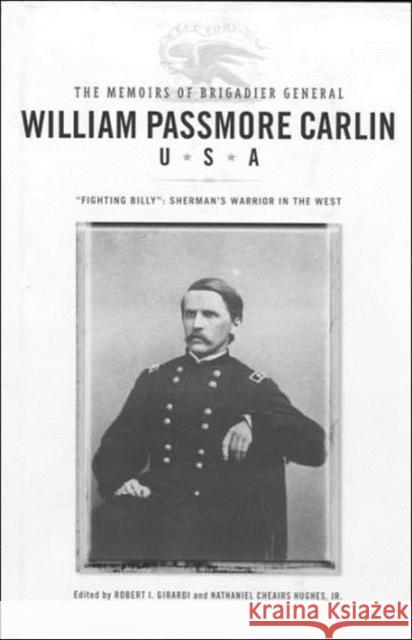
William Passmore Carlin (1829-1903) was a native of Illinois who graduated from West Point in 1850 and served on frontier duty and in Utah before the Civil War. Carlin began his Civil War career as colonel of the 38th Illinois Infantry and served in the early battles in Missouri and Mississippi. He commanded troops in the important battles of Perryville, Stones River, Liberty Gap, Chickamauga, Missionary Ridge, Buzzard Roost, Resaca, Kennesaw Mountain, the siege of Atlanta, Jonesboro, and Bentonville. A successful brigade and division commander from Perryville to Sherman's March to the Sea...
William Passmore Carlin (1829-1903) was a native of Illinois who graduated from West Point in 1850 and served on frontier duty and in Utah before the ...
Though deeply embedded in abolitionist New England, Yale University had a surprisingly large number of its students and alumni join the cause of the Confederacy. These men were a diverse lot, coming not just from the South but from other corners of the country. And even more surprisingly, years after the secessionist conflict, Yale honored the wartime service of these Confederate prodigals in famed Memorial Hall alongside their many classmates who fought on the other side. Yale's Confederates brings together short biographies of over five hundred Yale students and graduates who served in...
Though deeply embedded in abolitionist New England, Yale University had a surprisingly large number of its students and alumni join the cause of the C...