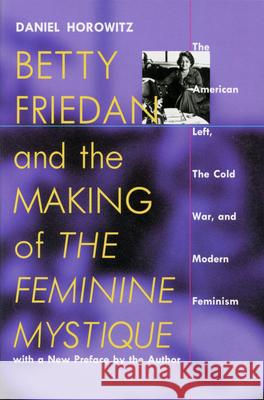
Ever since the 1963 publication of her landmark book, The Feminine Mystique, Betty Friedan has insisted that her commitment to women's rights grew out of her experiences as an alienated suburban housewife. Yet as Daniel Horowitz persuasively demonstrates in this illuminating and provocative biography, the roots of Friedan's feminism run much deeper than she has led us to believe. Drawing on an impressive body of new research -- including Friedan's own papers -- Horowitz traces the development of Friedan's feminist outlook from her childhood in Peoria, Illinois, through her wartime years at...
Ever since the 1963 publication of her landmark book, The Feminine Mystique, Betty Friedan has insisted that her commitment to women's rights grew ...
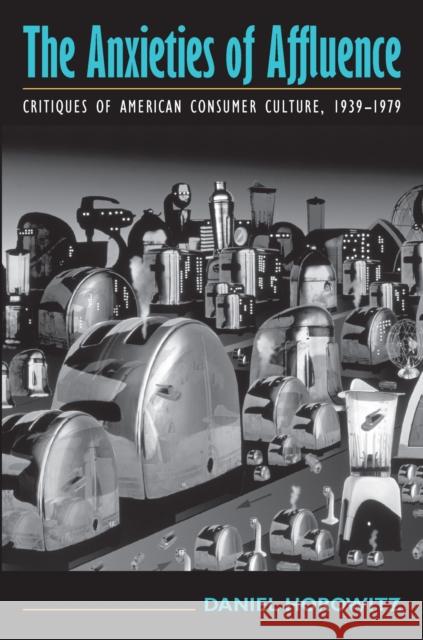
This book charts the reactions of prominent American writers to the unprecedented prosperity of the decades following World War II. It begins with an examination of Lewis Mumford's wartime call for "democratic" consumption and concludes with an analysis of the origins of President Jimmy Carter's "malaise" speech of 1979. Between these bookends, Daniel Horowitz documents a broad range of competing views, each in its own way reflective of a deep-seated ambivalence toward consumer culture.
This book charts the reactions of prominent American writers to the unprecedented prosperity of the decades following World War II. It begins with ...
Vance Packard's bestselling books--Hidden Persuaders (1957), Status Seekers (1959), and Waste Makers (1960)--taught the generation that came of age in the late 1950s and early 1960s about the dangers posed by advertising, social climbing, and planned obsolescence. Like Betty Friedan and William H. Whyte, Jr., Packard (1914- ) was a journalist who played an important role in the nation's transition from the largely complacent 1950s to the tumultuous 1960s. He was also one of the first social critics to benefit from and foster the newly energized social and political...
Vance Packard's bestselling books--Hidden Persuaders (1957), Status Seekers (1959), and Waste Makers (1960)--taught the generatio...
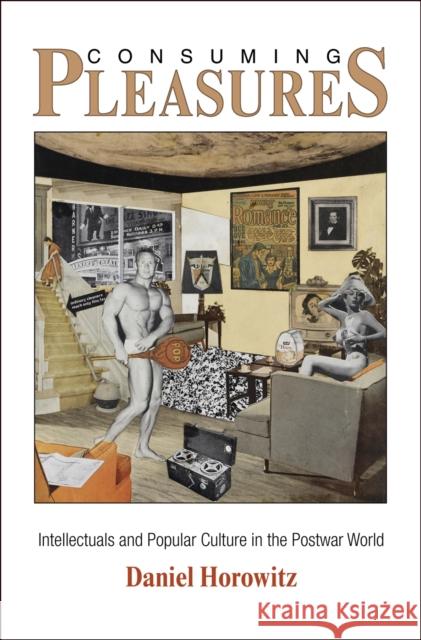
How is it that American intellectuals, who had for 150 years worried about the deleterious effects of affluence, more recently began to emphasize pleasure, playfulness, and symbolic exchange as the essence of a vibrant consumer culture? The New York intellectuals of the 1930s rejected any serious or analytical discussion, let alone appreciation, of popular culture, which they viewed as morally questionable. Beginning in the 1950s, however, new perspectives emerged outside and within the United States that challenged this dominant thinking. "Consuming Pleasures" reveals how a group of...
How is it that American intellectuals, who had for 150 years worried about the deleterious effects of affluence, more recently began to emphasize p...
How did the 1950s become oThe Sixtieso? This is the question at the heart of Daniel HorowitzAEs On the Cusp . Part personal memoir, part collective biography, and part cultural history, the book illuminates the dynamics of social and political change through the experiences of a small, and admittedly privileged, generational cohort.
How did the 1950s become oThe Sixtieso? This is the question at the heart of Daniel HorowitzAEs On the Cusp . Part personal memoir, part collective bi...