Akhenaten, also known as Amenhotep IV, was king of Egypt during the Eighteenth Dynasty and reigned from 1375 to 1358 B.C. E. Called the "religious revolutionary," he is the earliest known creator of a new religion. The cult he founded broke with Egypt's traditional polytheism and focused its worship on a single deity, the sun god Aten. Erik Hornung, one of the world's preeminent Egyptologists, here offers a concise and accessible account of Akhenaten and his religion of light.Hornung begins with a discussion of the nineteenth-century scholars who laid the foundation for our knowledge of...
Akhenaten, also known as Amenhotep IV, was king of Egypt during the Eighteenth Dynasty and reigned from 1375 to 1358 B.C. E. Called the "religious rev...
This volume, the only up-to-date study of its kind in any language, reviews the foundations of Ancient Egyptian chronology before presenting a relative and an absolute chronology for the time span from prehistoric times down until the Hellenistic Period.
This volume, the only up-to-date study of its kind in any language, reviews the foundations of Ancient Egyptian chronology before presenting a relativ...
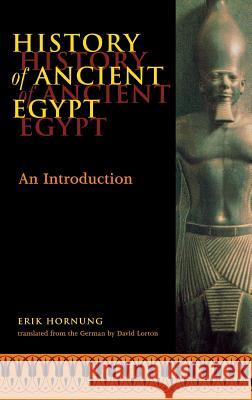
Each interpreter of ancient Egypt seems to bring new insights and the famous German Egyptologist, Erik Hornung, is no exception. One of the great strengths of his newly translated history is his expertise in burial customs and ritual. Revised throughout for this English version, his account of the history of ancient Egypt includes an updated bibliography, a glossary and a chronological table.
Each interpreter of ancient Egypt seems to bring new insights and the famous German Egyptologist, Erik Hornung, is no exception. One of the great stre...
Nachdem statt des einen, unvollstandigen Exemplars aus dem Grab Sethos' I., das Gustave Jequier Ende des 19. Jahrhunderts fur seine Edition des Amduat verwendet hatte, um die Mitte des 20. Jahrhunderts sieben Exemplare der Kurzfassung aus dem Neuen Reich vorlagen, nahm sich Erik Hornung diese erste Neuherausgabe der Kurzfassung als Erganzung zu seiner kritischen Ausgabe des ausfuhrlichen Amduat vor. Der Fokus liegt hierbei auf den Versionen des Neuen Reiches (18. bis 20. Dynastie); Papyri der Spatzeit (21. Dynastie ff.) werden nur im Kommentar herangezogen. Wie bei der Langfassung des Amduat...
Nachdem statt des einen, unvollstandigen Exemplars aus dem Grab Sethos' I., das Gustave Jequier Ende des 19. Jahrhunderts fur seine Edition des Amduat...
Der agyptische Text des 16. Jahrhunderts v. Chr., der hier erstmals unter Berucksichtigung aller Versionen des Neuen Reiches herausgegeben wird, bereichert die Weltliteratur um eine der altesten und gedankenreichsten Jenseitsschilderungen. In den Felsgrabern im "Tal der Konige" fur die Pharaonen des Neuen Reiches aufgezeichnet, begleiten Texte und Bilder des Amduat den nachtlichen Hinabstieg des Sonnengottes in die Unterwelt, seine Sorge um die Toten, seine morgendliche Neugeburt und das Schicksal der Seligen und Verdammten, wobei erstmals in der Religionsgeschichte Hollenvorstellungen...
Der agyptische Text des 16. Jahrhunderts v. Chr., der hier erstmals unter Berucksichtigung aller Versionen des Neuen Reiches herausgegeben wird, berei...