This landmark work chronicles the origin and evolution of solid state physics, which grew to maturity between 1920 and 1960. The book examines the early roots of the field in industrial, scientific and artistic efforts and traces them through the 1950s, when many physicists around the world recognized themselves as members of a distinct subfield of physics research centered on solids. The book opens with an account of scientific and social developments that preceded the discovery of quantum mechanics, including the invention of new experimental means for studying solids and the establishment...
This landmark work chronicles the origin and evolution of solid state physics, which grew to maturity between 1920 and 1960. The book examines the ear...
On December 16, 1947, John Bardeen and Walter Brattain, physicists at Bell Laboratories, jabbed two electrodes into a sliver of germanium. The power flowing from the germanium far exceeded what went in; in that moment the transistor was invented and the Information Age was born. No other devices have been as crucial to modern life as the transistor and the microchip it spawned, but the story of the science and personalities that made these inventions possible has not been fully told until now. Crystal Fire fills this gap and carries the story forward. William Shockley, Bell Labs' team leader...
On December 16, 1947, John Bardeen and Walter Brattain, physicists at Bell Laboratories, jabbed two electrodes into a sliver of germanium. The power f...
This volume is a lucid and accurate history of the technical research that led to the first atomic bombs. The authors explore how the "critical assembly" of scientists, engineers, and military personnel at Los Alamos, responding to wartime deadlines, collaborated to create a new approach to large-scale research. The book opens with an introduction laying out major themes. After a synopsis of the prehistory of the bomb project, from the discovery of nuclear fission to the start of the Manhattan Engineer District, and an overview of the early materials program, the book examines the...
This volume is a lucid and accurate history of the technical research that led to the first atomic bombs. The authors explore how the "critical assemb...
This volume is a lucid and accurate history of the technical research that led to the first atomic bombs. The authors explore how the "critical assembly" of scientists, engineers, and military personnel at Los Alamos, responding to wartime deadlines, collaborated to create a new approach to large-scale research. The book opens with an introduction laying out major themes. After a synopsis of the prehistory of the bomb project, from the discovery of nuclear fission to the start of the Manhattan Engineer District, and an overview of the early materials program, the book examines the...
This volume is a lucid and accurate history of the technical research that led to the first atomic bombs. The authors explore how the "critical assemb...
Editors Laurie Brown, Max Dresden and Lillian Hoddeson have assembled a prestigious group of physicists and historians of science to present a broadly balanced picture of this exciting scientific era that witnessed the coming of age of particle physics and its development into 'big science'. The historical studies and analyses provided in the volume are unique in their scope and level of detail. Major topics and developments addressed include the important experiments and their theoretical explanations, the design and construction of scientific instruments and the establishment of major...
Editors Laurie Brown, Max Dresden and Lillian Hoddeson have assembled a prestigious group of physicists and historians of science to present a broadly...
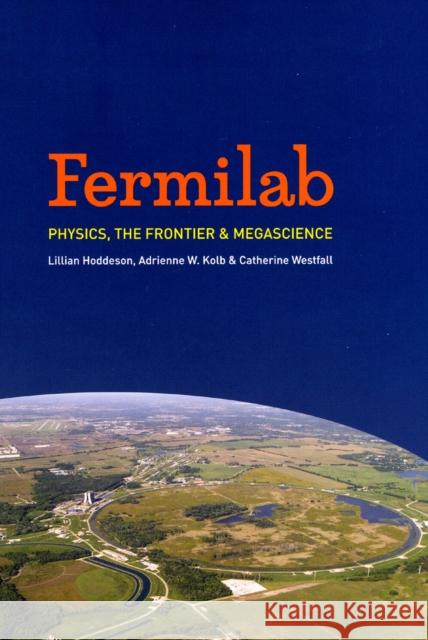
Lillian Hoddeson Adrienne W. Kolb Catherine Westfall
Fermi National Accelerator Laboratory, located in the western suburbs of Chicago, has stood at the frontier of high-energy physics for forty years. "Fermilab "is the first history of this laboratory and of its powerful accelerators told from the point of view of the people who built and used them for scientific discovery.
Focusing on the first two decades of research at Fermilab, during the tenure of the laboratory s charismatic first two directors, Robert R. Wilson and Leon M. Lederman, the book traces the rise of what they call megascience, the collaborative struggle to conduct...
Fermi National Accelerator Laboratory, located in the western suburbs of Chicago, has stood at the frontier of high-energy physics for forty years....