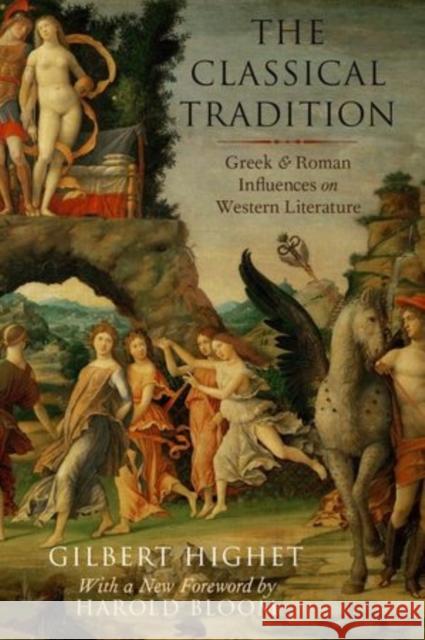
Originally published in 1949, Gilbert Highet's seminal The Classical Tradition is a herculean feat of comparative literature and a landmark publication in the history of classical reception. As Highet states in the opening lines of his Preface, this book outlines "the chief ways in which Greek and Latin influence has moulded the literatures of western Europe and America." With that simple statement, Highet takes his reader on a sweeping exploration of the history of western literature. To summarize what he covers is a near-impossible task. Discussions of Ovid and French literature of...
Originally published in 1949, Gilbert Highet's seminal The Classical Tradition is a herculean feat of comparative literature and a landmark p...
Literary satire assumes three main forms: monologue, parody, and narrative (some fictional, some dramatic). This book by Gilbert Highet is a study of these forms, their meaning, their variation, their powers. Its scope is the range of satirical literature--from ancient Greece to modern America, from Aristophanes to Ionesco, from the parodists of Homer to the parodists of Eisenhower. It shows how satire originated in Greece and Rome, what its initial purposes and methods were, and how it revived in the Renaissance, to continue into our own era.
Contents: Preface. I. Introduction. II....
Literary satire assumes three main forms: monologue, parody, and narrative (some fictional, some dramatic). This book by Gilbert Highet is a study ...
In the Aeneid men, women, gods, and goddesses are characterized by the speeches assigned to them far more than by descriptions of their appearance or behavior. Most of the speeches are highly emotional and individualized, reminding us of the most powerful utterances of Greek tragedy.
Gilbert Highet has analyzed all the speeches in the Aeneid, using statistical techniques as well as more traditional methods of scholarship. He has classified the speeches; identified their models in earlier Greek and Latin literature; analyzed their structure; and discussed their...
In the Aeneid men, women, gods, and goddesses are characterized by the speeches assigned to them far more than by descriptions of their appe...
In the Aeneid men, women, gods, and goddesses are characterized by the speeches assigned to them far more than by descriptions of their appearance or behavior. Most of the speeches are highly emotional and individualized, reminding us of the most powerful utterances of Greek tragedy.
Gilbert Highet has analyzed all the speeches in the Aeneid, using statistical techniques as well as more traditional methods of scholarship. He has classified the speeches; identified their models in earlier Greek and Latin literature; analyzed their structure; and discussed their...
In the Aeneid men, women, gods, and goddesses are characterized by the speeches assigned to them far more than by descriptions of their appe...
Literary satire assumes three main forms: monologue, parody, and narrative (some fictional, some dramatic). This book by Gilbert Highet is a study of these forms, their meaning, their variation, their powers. Its scope is the range of satirical literature--from ancient Greece to modern America, from Aristophanes to Ionesco, from the parodists of Homer to the parodists of Eisenhower. It shows how satire originated in Greece and Rome, what its initial purposes and methods were, and how it revived in the Renaissance, to continue into our own era.
Contents: Preface. I. Introduction. II....
Literary satire assumes three main forms: monologue, parody, and narrative (some fictional, some dramatic). This book by Gilbert Highet is a study ...